
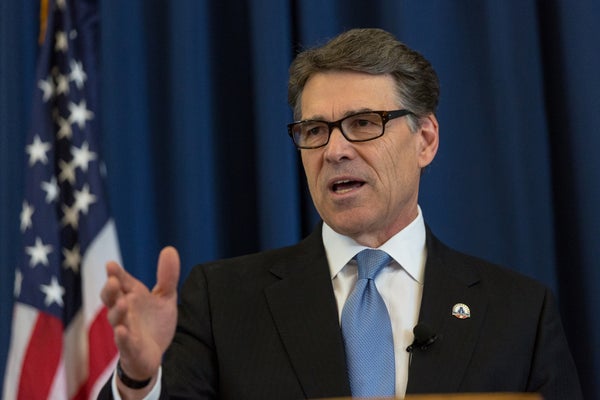
Rick Perry, President-elect Donald Trump’s apparent choice to become U.S. Department of Energy secretary, was known for backing oil and gas development during his 14 years as Texas governor. But Perry also championed efforts to have his state store nuclear waste—an issue that will likely occupy a big part of his agenda if he is nominated and confirmed.
The department—which Perry as a 2012 presidential candidate promised to abolish, although he famously forgot its name during a debate—is charged with the politically volatile process of developing an underground repository for highly radioactive spent fuel from commercial power plants at Nevada’s Yucca Mountain, 90 miles northwest of Las Vegas. The agency has also opened a smaller underground dump in southeastern New Mexico for radioactive materials leftover from atomic bomb– making. That site has suspended storage since two 2014 accidents, irritating states such as Idaho that want their toxic trash shipped to the facility. And under Pres . Barack Obama the department has been moving ahead with developing a “consent-based” waste storage policy that does not force states to accept any waste against their residents’ wishes, and if they do accept it, their residents will have a say over how it is done.The year “2017 will be a very big year when it comes to nuclear waste policy,” predicted Samuel Brinton, a senior policy analyst at the Bipartisan Policy Center think tank in Washington, D.C.
During Perry’s governorship a Dallas company, Waste Control Specialists (WCS), won state backing to run one of a handful of U.S. facilities to dispose of low-level radioactive materials from hospitals and shut-down reactors. The site opened in 2012 in west Texas. In addition to raising concerns about groundwater contamination and whether the state’s approval process was above board, watchdog groups questioned whether sizeable campaign donations to Perry from the company’s late founder, billionaire Harold Simmons, influenced the decision. Those debates arose during Perry’s 2012 presidential bid; Perry denied any special rewarding of contributors.
On supporting science journalism
If you're enjoying this article, consider supporting our award-winning journalism by subscribing. By purchasing a subscription you are helping to ensure the future of impactful stories about the discoveries and ideas shaping our world today.
In 2014 Perry asked the Texas Commission on Environmental Quality to examine letting the state store higher-level commercial waste that—as in the other states hosting privately run reactors—now sits at the plants where it is generated. Citing the continual delays with the Yucca Mountain project, which the Obama administration mothballed in the face of Nevadans’ opposition, Perry said in a letter to state lawmakers, “The citizens of Texas—and every other state currently storing radioactive waste—have been betrayed by their federal government … because a federal solution still does not exist.” He cited potential competition from neighboring New Mexico and added: “I believe it is time for Texas to act.”
Perry did not mention WCS . But the company in April sent the U.S. Nuclear Regulatory Commission an application to store high-level reactor waste for 40 years, pending final disposal. The NRC announced last month it would start seeking public comments to be covered in an environmental review of the company’s request. Environmental groups have argued that the application should be dismissed because Congress never intended a private facility to be in the waste storage business when it passed the 1982 law governing how to deal with commercial high-level waste.
Meanwhile the incoming Trump administration is reportedly examining whether to revive Yucca Mountain as the permanent storage solution. At a 2011 presidential debate, Perry opposed opening the project over Nevadans’ vehement objections, saying that states—not the feds—should decide whether accepting any radioactive refuse is worth the money and jobs that come with it. “Some state out there will see the economic issue, and they will have [waste] in their state,” he predicted. But energy experts say he would likely face pressure from Republicans and the utility industry to take a hard look at Nevada—and his potential new boss, who during the campaign declined to take a public position on the project, could still overrule him.