
Razi Nalim has lived in the United States for 30 years. An engineer at Indiana University–Purdue University Indianapolis, he often travels around the world to recruit science and engineering students to his university. But last week, on the cusp of a recruitment trip to India, he hesitated when asked whether he would still encourage foreign, Muslim students to work or study in the United States.
“I would still say the opportunity for doing cutting-edge science here is unmatched,” said Nalim, who is Muslim. “Where I think I would caution people to think more carefully is longer term: where would they want to live and raise a family? That’s a harder question to answer.”
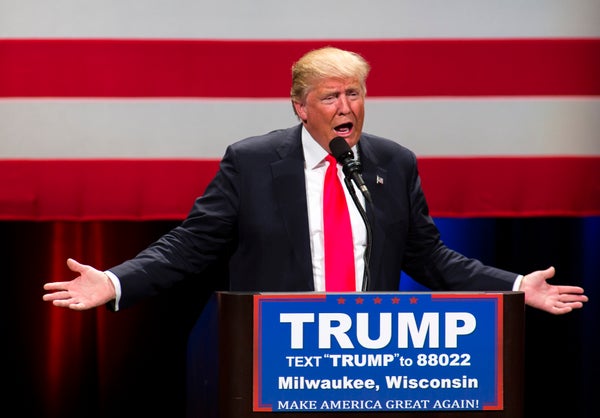
For Nalim and others, the roots of such concerns are apparent. In December, US presidential candidate Donald Trump, who has campaigned against immigration, boasted that he would ban Muslims from entering the country if elected. (On March 30, Trump—now the Republican front runner—said that he would make exceptions for some Muslims, notably his wealthy Muslim friends.)
On supporting science journalism
If you're enjoying this article, consider supporting our award-winning journalism by subscribing. By purchasing a subscription you are helping to ensure the future of impactful stories about the discoveries and ideas shaping our world today.
Science advocates worry that Trump’s broader anti-immigration stance could pose a threat to US research dominance. Roughly 5% of all students in the United States hail from other countries—including more than 380,000 people studying science, engineering, technology or mathematics. “We’ve always been a nation which has welcomed scientific brainpower from other countries,” says Mary Woolley, president of Research!America, a science-advocacy group in Alexandria, Virginia. “We don’t want that to turn around now.”
Scientific issues have scarcely been mentioned on the campaign trail so far. Hillary Clinton, the Democratic front runner, has pledged to boost support for research into Alzheimer’s disease, and has pushed back against Trump’s anti-immigration and anti-Muslim stance. When she was a senator, Clinton backed health and research-related bills, and as first lady to former president Bill Clinton, she advocated for research on women’s health.
Trump is a wealthy real-estate mogul with no political legacy to mine for clues as to his scientific opinions. In the course of the campaign, he has linked autism to childhood vaccines, and dismissed climate change. (“It’s called weather,” he said.) In October, conservative radio host Michael Savage suggested on air that if elected, Trump should appoint him as head of the US National Institutes of Health (NIH). “Well, you know you’d get common sense if that were the case, that I can tell you,” Trump replied, during the light-hearted conversation. “Because I hear so much about the NIH, and it’s terrible.”
With little more than this to go on, advocates of science funding are worried. “It feels like there’s a lot of cynicism toward science and scientists, and that’s concerning,” says Benjamin Corb, public-affairs director at the American Society for Biochemistry and Molecular Biology in Rockville, Maryland.
Trump’s position on immigration is clearer. He frequently boasts that if elected, he would build a wall along the border with Mexico—and force Mexico to pay for it—which has earned him both supporters and derision. A President Trump could bode ill for long-running efforts to boost the number of foreign professionals working in the United States on visas for highly skilled workers, known as H-1Bs. But Trump’s statements regarding H-1B visas have been difficult to parse. At times, he has advocated bringing skilled workers into the country; at others, he has said that the H-1B programme is too often abused and should be restricted.
Such statements worry Brad Hayes, a computer scientist at the Massachusetts Institute of Technology in Cambridge. Hayes is an US citizen, but says that some of his most outstanding colleagues are not. “A lot of them want to end up here after they get their PhDs, but now that’s in doubt,” he says. “We absolutely want these people to stay. If they get lumped in with this ‘close our borders, keep everybody out’, we’re doing ourselves a disservice.”
Hayes inadvertently cast a spotlight on the simplicity of Trump’s rhetoric when he decided to use a neural network to model Trump’s noticeably repetitive and simplistic speech patterns. He has been posting the results—computer-generated parody quotes based on Trump’s campaign speeches—on Twitter using the handle @DeepDrumpf. (Trump’s ancestral name, Drumpf, was changed by the family several generations ago.)
“We’re going to build the wall,” says one tweet, in reference to Trump’s Mexico plan. Hayes says that the project was only meant to be fun, but it ended up making a point. “A lot of the rhetoric that’s being used is fairly content-light.”
But that rhetoric is having an effect, says Ehab Abouheif, a developmental biologist at McGill University in Montreal, Canada, who is Muslim. On a recent trip to be interviewed for a position in the United States, recruiters’ “constant question was, ‘Are you really sure you would want to come?’” he says. “My scientist colleagues are really scared.”
To Abouheif, who fondly remembers completing his PhD and his postdoc in the United States, the current climate is surreal. “If you are trying to stop Muslims from coming in, it means that the ones who are there already are not going to feel comfortable either,” he says. “It would be a shame to alienate this big swathe of society.”
This article is reproduced with permission and was first published on April 5, 2016.