
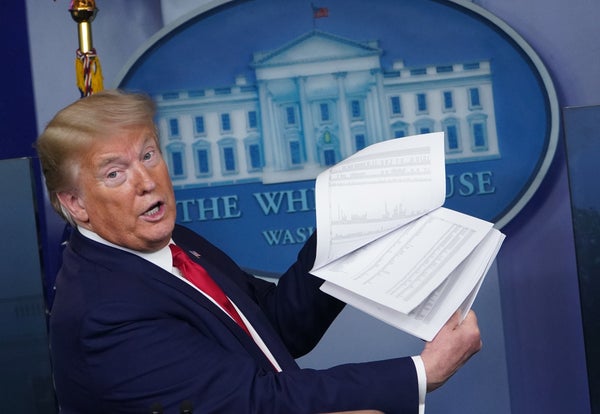
In the final year of Donald Trump’s presidency, more than 450,000 Americans died from COVID-19, and life expectancy fell by 1.13 years, the biggest decrease since World War II. Many of the deaths were avoidable; COVID-19 mortality in the U.S. was 40 percent higher than the average of the other wealthy nations in the Group of Seven (G7).
In a Lancet report by the Commission on Public Policy and Health in the Trump Era, released on February 20, we chronicled Trump's effects on population health. His incompetent and malevolent response to the COVID-19 pandemic capped a presidency suffused with health-harming policies and actions.
However, we also found that Americans' health began lagging before Trump took office. In 1980, U.S. life expectancy was similar to that of other G7 nations; by 2018 it was 3.4 years shorter. 461,000 deaths would have been averted in 2018 if U.S. life expectancy had kept pace with the rest of the G7. That’s equivalent to the number of Americans who died from COVID-19 last year.
On supporting science journalism
If you're enjoying this article, consider supporting our award-winning journalism by subscribing. By purchasing a subscription you are helping to ensure the future of impactful stories about the discoveries and ideas shaping our world today.
Faced with the pandemic, Trump suppressed scientific data, delayed testing, mocked and blocked mask-wearing, and convened mass gatherings where social distancing was impossible. Despite the mounting threats of COVID-19 and global warming, he pulled the U.S. out of the World Health Organization and the Paris climate accord. He installed industry insiders in regulatory posts tasked with protecting Americans from environmental and occupational hazards; their regulatory rollbacks resulted in 22,000 excess deaths from such hazards in 2019 alone. He pushed through a $1.9 trillion tax cut for the wealthy, creating a budget hole that he then used to justify cutting food and housing assistance for the needy. He tried, but failed, to repeal the ACA, then bent every effort to undermine it, pushing up the number of uninsured Americans by 2.3 million. He denied entry to refugees fleeing violence, abused immigrant detainees, and penalized immigrants for accessing basic social services.
Although Trump bears special blame for America’s health woes, many of his policies did not represent a radical break with the past. Both Republican and Democratic administrations have pursed economic, health and social policies deleterious to population health.
Nixon’s racially targeted war on drugs initiated mass incarceration, compromising the health of prisoners, their families and others in their communities. Starting in the Reagan era, financial deregulation, trade deals favoring corporations and attacks on union labor caused de-industrialization and increased income precarity in many parts of the country, contributing to an epidemic of “deaths of despair.” Bill Clinton’s welfare cuts and tough-on-crime measures compromised the life chances of many Americans, particularly Black and brown Americans. Market-based health care reforms dating to Reagan, and endorsed by Democrats and Republicans alike, have commercialized and bureaucratized medical care, raising costs and shifting care toward the wealthy. And corporate lobbyists have blocked regulation of dangerous products like firearms, obesogenic foods and addictive medications.
These longstanding policies have contributed to persistent race-based health gaps bequeathed by the legacies of slavery, Jim Crow segregation and Native American genocide, and widening gaps by income, education and geography. And the pattern of government neglect set the stage for the racist and nativist appeals Trump used to fuel his political rise. In 2016, Trump gained his largest electoral margins in counties with the worst mortality trends.
Fortunately, many of the policies needed to ameliorate COVID-19’s damage would also begin to address the longer-standing mortality crisis. We need more than vaccinations. We need universal paid sick leave, Medicare for All, environmental and workplace protections, income supports and affordable housing to limit crowding and ensure food security, alternatives to incarceration, public health infrastructure, investments in education and compensation to Native and Black Americans for the wealth and labor confiscated from them.
It is tempting, after the chaos of the Trump years, to seek a return to normal. But normal in the U.S. was deadly for hundreds of thousands of Americans every year. Our nation’s public health and social policy infrastructure has suffered 40 years of neglect. Failing to repair it will ensure that the U.S. remains vulnerable to the next health crisis, that health inequities will persist and that our politics will remain mired in division.
As the Biden Administration looks to the future, we need massive reinvestment in the conditions needed for a healthy population.
This is an opinion and analysis article.
