
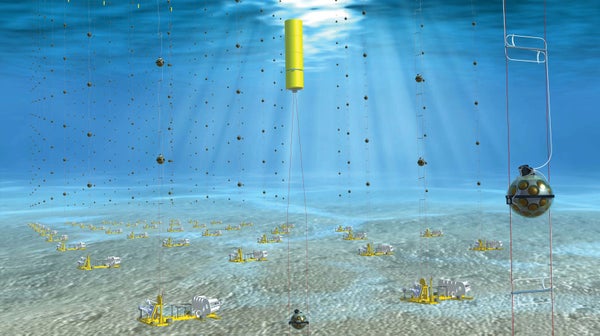
Suspended near the bottom of the Mediterranean Sea off France and Italy, 126 football-sized glass spheres are already using the ocean itself as an instrument to search for signals from dark matter, supernovae and neutron star collisions. These are the first of many such globes deployed for a project called the Cubic Kilometer Neutrino Telescope, or KM3NeT.
Its target, neutrinos, are fundamental particles that have no electrical charge and almost no mass. “Unlike cosmic rays, neutrinos are not deflected by magnetic fields in intergalactic space, making them unique messengers,” says Walter Winter, a neutrino astrophysicist at the German Electron Synchrotron (DESY) research center, who is not involved with KM3NeT. “They are complementary to other sources of information like electromagnetic radiation and gravitational waves.”
Neutrinos can pass through most other matter with only a tiny fraction interacting; this ghostly behavior makes them ideal candidates for astronomy. KM3NeT is set to be installed throughout one cubic kilometer of water—enough for 400,000 Olympic swimming pools—split over two locations, turning the surrounding water into a giant lens. More than 6,000 spheres, each containing 31 highly sensitive detectors called photomultiplier tubes, will cling to strings anchored to the seafloor and kept taut by floats.
On supporting science journalism
If you're enjoying this article, consider supporting our award-winning journalism by subscribing. By purchasing a subscription you are helping to ensure the future of impactful stories about the discoveries and ideas shaping our world today.
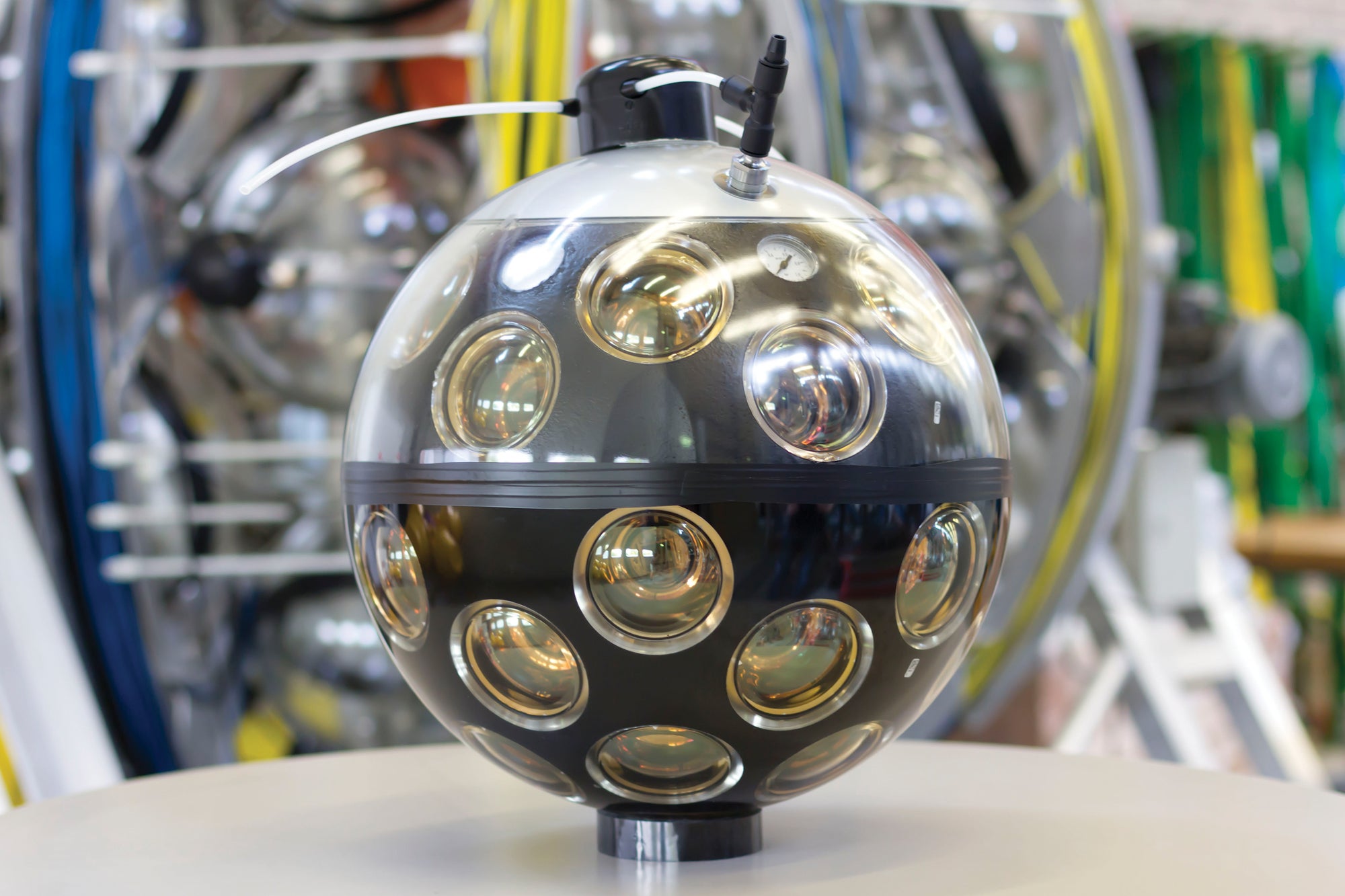
Credit: KM3NET
“Perhaps one or two neutrinos in a million will interact with quarks inside the nucleus of either hydrogen or oxygen” in the water, says the project's physics and software manager, Paschal Coyle of the Marseille Particle Physics Center. “Because the cosmic neutrinos possess very high energy, the result of such interactions is the release of a charged particle that travels very fast.”
In fact, it travels through the water faster than light can, producing an effect Coyle likens to an optical equivalent of the Concorde jet's sonic boom. Researchers can determine the original neutrinos' energy and direction using the faint light released—so-called Cherenkov radiation—picked up by the undersea sensors.
Among the handful of astronomy-focused neutrino telescopes in existence, “KM3NeT is unique, especially in observing the Southern [Hemisphere] sky with unprecedented directional and energy resolutions, paired with its enormous size,” Winter says.
The French site, scheduled for completion in 2024, will detect low-energy neutrinos generated when cosmic rays interact with Earth's atmosphere. As they pass through the planet, these particles provide an x-ray-like view of what is inside. The Italian site, set for 2026, will focus on cosmic neutrinos produced in the cataclysmic deaths of distant stars—or in dense regions of colliding dark matter.
Intriguingly, the telescopes' clearest view is looking downward; Earth works as a filter to block background particles from the cosmic rays that continuously bombard our world. Neutrinos are the only known particles from those rays that make it through the planet.