
The U.S.’s most ambitious particle physics project ever is one step closer to reality.
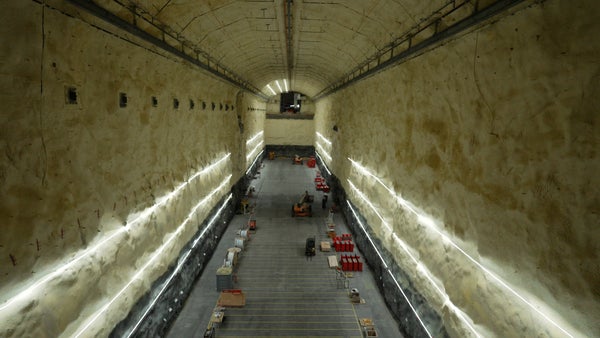
The Deep Underground Neutrino Experiment (DUNE) will be a giant in both budgetary and basic science terms: A cavernous, multibillion-dollar Department of Energy facility one mile below the town of Lead, S.D., that will serve as a catcher’s mitt for ghostly particles, called neutrinos, beamed from a lab in Illinois.
Particle physicists hope DUNE will finally settle the biggest open questions in their most coherent picture of the universe, the Standard Model. It might even speak to humanity’s oldest question of all: why we (or any matter at all) even exist.
On supporting science journalism
If you're enjoying this article, consider supporting our award-winning journalism by subscribing. By purchasing a subscription you are helping to ensure the future of impactful stories about the discoveries and ideas shaping our world today.
Now that existential catcher’s mitt is finally getting built. At an event yesterday at the Sanford Underground Research Facility in Lead—formerly the Homestake gold mine—project leaders and government supporters gathered to sign the first steel beam to be sent underground, beginning the construction of the facility’s detectors.
“As a South Dakotan, knowing that on this ground, our little piece of the planet, the fact that we are going to transform our understanding of matter is pretty incredible,” said Representative Dusty Johnson of South Dakota. DUNE is funded primarily through the Department of Energy. But it is an international collaboration involving 38 countries—the 10 million pounds of steel for the first vessel were contributed by CERN, the European laboratory for particle physics.
“DUNE has been the dream of many in the physics community for more than two decades,” says Sowjanya Gollapinni, co-spokesperson of the DUNE collaboration. “It’s the moment when this becomes real.”
The neutrino is a nearly weightless particle that sails through matter like a phantasm. No other known particle is so shy in its interactions—a neutrino can traverse a light-year-long block of lead without touching a single atom. It’s also a shape-shifter; produce one of the three neutrino “flavors” in a beam heading west from New York City, and by the time your friend in Los Angeles measures it, that neutrino will likely be a different flavor.
These mind-bending properties are why the neutrino remains the least-understood of all the Standard Model’s characters. Physicists can’t even say how the three neutrino masses are ordered, let alone nail down their exact values. They hope the particle’s oddities might conceal an answer to an almost philosophical question that the Standard Model raises: Why is there something rather than nothing?
The neutrino’s connection to such weighty matters rests on the fact that basically every fundamental matter-generating process also makes antimatter in equal numbers. Yet the outcome of the big bang was somehow a tiny sliver more matter than antimatter—all the galaxies, dust and living things in the universe belong to this minuscule excess. Many physicists suspect the weird shape-shifting behavior of neutrinos might have played a key role in this cosmic conundrum.

The Deep Underground Neutrino Experiment (DUNE) project and government representatives commemorated the start of the facility’s construction by signing the first steel beam to be sent underground.
605 Media & Entertainment/Landin Burke
Scientists have been studying neutrino “oscillation” for decades by beaming neutrinos from sources (such as particle colliders or nuclear reactors) to faraway detectors. Then they measure how many of the neutrinos have changed flavor in transit.
DUNE aims to push this approach to its limit. Physicists will use a particle accelerator at Fermilab in Batavia, Ill., to produce the most intense beam of neutrinos ever—a companion to DUNE officially dubbed the Long-Baseline Neutrino Facility (LBNF). The LBNF will be pointed downward and westward from Fermilab, aimed directly at the heart of DUNE’s cavern below Lead, 800 miles away, which will be filled with tens of millions of pounds of liquid argon.
“Everything about DUNE is unprecedented: the most intense neutrino beam, the biggest liquid argon detectors, the longest distance neutrinos will travel,” Gollapinni says. “It’s truly amazing.”
To remain liquid without freezing or boiling, all that argon must be kept in a narrow range of extreme cold, just a few degrees away from about -300 degrees Fahrenheit. The argon’s jostling atoms will release electrons when, all too rarely, they’re pummeled by passing neutrinos, creating a signal that physicists can detect. But before any of that can happen, DUNE’s personnel must build two massive steel containers for the argon. This is the phase of the project that’s now commencing.
The first step involves getting 10 million pounds of steel beams underground through a 20-foot-wide shaft—and that only covers the first container. Project leaders liken the task to building a ship inside a glass bottle—except the neck of the bottle is a mile long, and the ship is a one-tenth-scale aircraft carrier. They hope to have the first container completed in about nine months.
But even once they have both containers assembled, they’ll still need to prep those containers for becoming the most elaborate and sensitive neutrino detectors ever constructed. Before any argon is piped in, the containers must be laced with hundreds of massive wire grids, each composed of thousands of thin hand-strung wires that are now under construction.
The project’s vast ambitions have already accrued about five years of delay, and, all told, its price to taxpayers has ballooned to nearly $5 billion. The current goal is to have the first detector online by early 2030. That could mean that, even in a best-case scenario, DUNE won’t determine the mass ordering of neutrinos until 2034—and any answer to the question of matter-antimatter imbalance wouldn’t arrive until the end of that decade.
That’s a long time to wait, given that the U.S. isn’t the only competitor in what’s truly a global race to elucidate the final particle in physicists’ best model of reality. Japan’s Hyper-Kamiokande (Hyper-K) neutrino experiment is on track to start taking data in 2028. Hyper-K may measure the matter-antimatter asymmetry before DUNE, but doing so will depend on how on-schedule Japan’s project can stay, and whether the still unknown answer is within reach of this competing project’s more modest approach.
Meanwhile China’s Jiangmen Underground Neutrino Observatory (JUNO) experiment released its first results late last year. JUNO is essentially a downscaled and entirely independent version of DUNE, a subterranean facility about 90 miles west of Hong Kong that places a smaller and different liquid detector in the path of neutrino beams from two nuclear reactors. China’s project has already provided world-leading precision for the gap between the two smallest neutrino masses—a key part of determining the ordering. JUNO hopes to beat DUNE to that answer—but isn’t built to settle matter’s excess alone.
“I don’t think people are spending every day thinking, ‘We’ve got to be first,’” says Edward Blucher, a DUNE physicist at the University of Chicago. “In 20 years, we’re going to know much more about this kind of science, and it’s going to be a result of things that were measured with Hyper-K and JUNO and DUNE.”
“All of us are acutely aware that a huge investment has been made in this project and that we have to execute it successfully,” Blucher concludes. “It’s very important for this experiment itself, but I think it’s very important for the future of particle physics in the U.S., too.”