New Issue: Science’s Impossible Questions. Read Now

China’s Giant Underground Neutrino Observatory Just Released Its First Results—And They’re Promising

Hidden beneath the hills of southern China, the JUNO observatory shows promise in solving neutrino mysteries

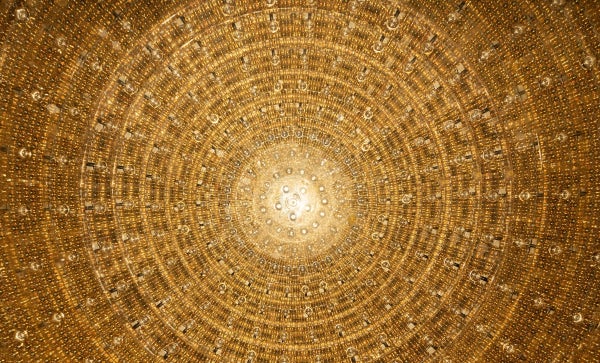
A circle of gold photomultiplier tubes that are part of the JUNO neutrino observatory.

JUNO’s central detector is filled with scintillating fluid and surrounded by photomultiplier tubes.

Yuexiang Liu/JUNO Collaboration

Join Our Community of Science Lovers!

Trillions of neutrinos whiz through our bodies every day, pulsing from the sun, outer space and deep beneath Earth. Yet these elusive subatomic particles have proven difficult to study. That could soon change, however. Buried 700 meters beneath the rolling hills of southern China, an enormous neutrino observatory called JUNO has released its first results after a mere 59 days of operation. And so far, they are very promising, physicists say.

“The physics result is already world-leading in the areas that it touches,” says particle physicist Juan Pedro Ochoa-Ricoux of the University of California, Irvine, who co-leads a team on JUNO.

“In particular, we measured two neutrino oscillation parameters, and that measurement is already for both parameters the best in the world,” he says. The results were published in two separate preprints on arXiv.org.


On supporting science journalism

If you're enjoying this article, consider supporting our award-winning journalism by subscribing. By purchasing a subscription you are helping to ensure the future of impactful stories about the discoveries and ideas shaping our world today.


JUNO—short for Jiangmen Underground Neutrino Observatory—has been tasked with a tall order: determine the ordering of masses of the three types of neutrino. In other words, do they follow a “normal mass ordering,” where the first flavor of neutrino is the lightest and the third the heaviest, or an inverted one, in which the third neutrino mass state is the lightest?

The answer to this question holds myriad implications, from informing other experiments to uncovering new physics to explaining certain cosmological mysteries. That’s because despite being such lightweights, neutrinos are so incredibly numerous that they may play an outsized role in the distribution of matter in the universe.

JUNO’s spherical detector, which is akin to a 13-story-tall fishbowl, primarily measures so-called electron antineutrinos spewing from the nearby Yangjian and Taishan nuclear plants. When the particles strike a proton inside the detector, a reaction triggers two light flashes that ping photomultiplier tubes and get converted into electrical signals.

The new measurements from these neutrino-proton collisions are now considered the most precise for two oscillation parameters, which act as proxies for differences in their mass, according to Ochoa-Ricoux.

“It is the first time we’ve turned on a scientific instrument like JUNO that we’ve been working on for over a decade. It’s just tremendously exciting,” Ochoa-Ricoux says. “And then to see that we’re able to already do world-leading measurements with it, even with such a small amount of data, that’s also really exciting.”

Still, the physicists will need years’ worth of neutrino detections to answer the mass-ordering conundrum.

Jeanna Bryner is editor in chief of Scientific American. Previously she was editor in chief of Live Science and, prior to that, an editor at Scholastic's Science World magazine. Bryner has an English degree from Salisbury University, a master’s degree in biogeochemistry and environmental sciences from the University of Maryland and a graduate science journalism degree from New York University. She has worked as a biologist in Florida, where she monitored wetlands and did field surveys for endangered species, including the gorgeous Florida Scrub Jay. She also received an ocean sciences journalism fellowship from the Woods Hole Oceanographic Institution. She is a firm believer that science is for everyone and that just about everything can be viewed through the lens of science.

More by Jeanna Bryner

Subscribe to Support Independent Journalism

Great science journalism requires human expertise, time, effort and creativity. And it costs money. That’s why I and the journalists here at Scientific American hope you’ll join our community.

When you subscribe, you are supporting staff and freelance journalists who are passionate about telling science stories that are true, important and compelling. Our editors and reporters are often experts in their fields, which means they understand the nuances of big discoveries and can untangle the breakthroughs from the hype. With a subscription, you are also supporting rigorous fact-checking to ensure the words we publish are precise and accurate. And you’re supporting original illustrations, graphics and photos that bring you closer to an advanced laboratory, an ice sheet in Antarctica or a space mission in orbit. You’re helping us craft other types of high-quality journalism as well: Our newsletters are carefully written, edited and curated by staffers you have or will come to know and love. Our Science Quickly podcast is based on original reporting, collaboration with editors and scientists and exacting production.

Subscriptions keep this engine running so we can continue to deliver thoughtful, rigorous and independent science journalism to you. In an era of viral misinformation, this work is crucial. If you value what we do, I hope you’ll consider joining us as a subscriber

Thank you,

Jeanna Bryner, Editor in Chief, Scientific American

Subscribe