
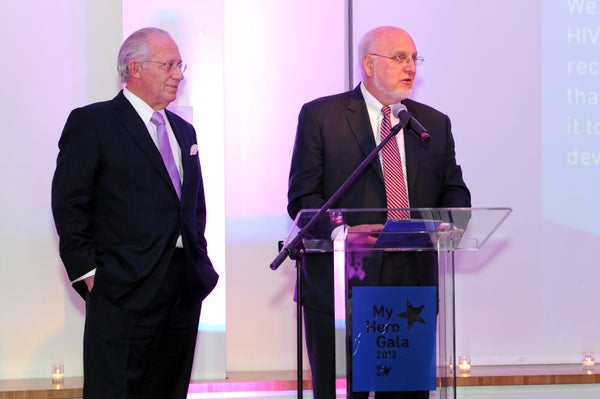
The Secretary of Health and Human Services on Wednesday named Robert Redfield as his choice for director of the U.S. Centers for Disease Control and Prevention. Redfield, a virologist and professor at the University of Maryland School of Medicine, will soon replace Brenda Fitzgerald—who resigned in January amid reports about her investments in tobacco and health care companies. The CDC director job does not require Senate confirmation.
Redfield is well known for his extensive AIDS research, and oversees clinical programs offering HIV care to thousands of patients around Baltimore and Washington, D.C. He also supervises international care and treatment programs under The U.S. President’s Emergency Plan for AIDS Relief (PEPFAR), according to the University of Maryland’s Web site.
Redfield has a long history of publishing reports about his work: In 1988 he co-wrote a Scientific Americanfeature article about early HIV research (available via subscription only), which emphasized the importance of studying the progression of HIV into AIDS, and of diagnosing the viral disease as early as possible.
On supporting science journalism
If you're enjoying this article, consider supporting our award-winning journalism by subscribing. By purchasing a subscription you are helping to ensure the future of impactful stories about the discoveries and ideas shaping our world today.
Beyond his laboratory, Redfield advocated for mandatory HIV testing in the 1980s—a practice that was widely opposed then, as it is now. He also helped implement an HIV-screening program at the Department of Defense, requiring every recruit to be tested for the infectious disease and banning anyone who tested positive from entering military service.
Redfield does not have much experience in policy or public health, two areas typically considered essential for overseeing the CDC and promoting its priorities on Capitol Hill. Sen. Patty Murray (D-Wash.), the ranking member of the Senate Committee on Health, Education, Labor and Pensions, wrote to the White House this week expressing concerns about Redfield’s lack of public health experience. She asked Trump to reconsider the selection, and wrote that some ethics and scientific practices in parts of Redfield’s research in the early 1990s were worrisome—although Redfield was never found guilty of scientific misconduct.
Some other reactions from the public health community were generally more favorable. “I think he’s a world-class researcher, and from my perspective he thoroughly understands the lab and lab system issues, so that’s a positive,” says Scott Becker, executive director of the Association of Public Health Laboratories. “I do think that there will be a steep learning curve, coming from an academic research organization into a very large public health practice organization.”
Immediate challenges ahead for Redfield will include navigating this season’s spike in influenza cases, and any related work on flu vaccine research—for which he may be relatively well suited because of his credentials as a virologist and immunologist. Financing public health work will be another of the agency’s most pressing issues—even as the Trump administration has proposed significantly slashing the CDC’s budget, including a 43 percent cut to its Public Health Emergency Preparedness program. Other key tasks will include implementing the White House’s new plan to combat the opioid crisis as well as staying ahead of emerging infectious diseases. HHS Secretary Alex Azar said in a statement that Redfield's background as a clinician running a treatment network for HIV and Hepatitis C patients in Baltimore will now allow him to "hit the ground running" with the opioid epidemic.