Watch Live Today: The James Webb Space Telescope Will Spark a New Era in Astronomy [Video]

Astronomer Amber Straughn will present a free live Webcast tonight at 7 P.M. Eastern time about NASA’s revolutionary space observatory

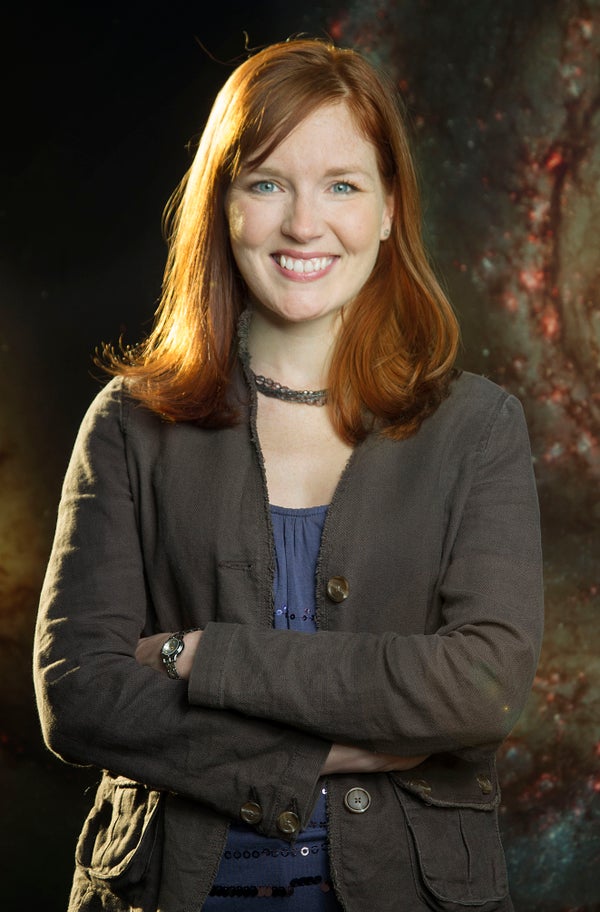
NASA astrophysicist Amber Straughn is deeply involved with the agency's next major observatory, the James Webb Space Telescope, which is slated to launch in 2018.

Join Our Community of Science Lovers!

Where did we come from? How did we get here? Are we alone?

At its core, astronomy is the science tasked with addressing these existential questions that lie at the heart of what it means to be human. And for more than a quarter century one observatory more than any other has brought us closer to answers: The Hubble Space Telescope.

Stationed in low Earth orbit above the starlight-scattering atmosphere, Hubble’s 2.4-meter mirror and state-of-the-art instruments have allowed scientists to glimpse far-distant galaxies formed in the universe’s infancy, the births of stars right here in our own Milky Way and even a handful of worlds orbiting other suns. With each groundbreaking observation, Hubble helped fill in details of what might be the greatest story ever to be told: How galaxies, stars, planets and ultimately life itself emerged from the big bang’s primordial chaos. But Hubble is reaching its limits, leaving us just on the cusp of peering farther into the unknown. A successor 100 times more powerful—the James Webb Space Telescope—will launch in 2018 to continue the revolution in astronomy that Hubble began, says NASA astrophysicist and Webb deputy project scientist Amber Straughn.


On supporting science journalism

If you're enjoying this article, consider supporting our award-winning journalism by subscribing. By purchasing a subscription you are helping to ensure the future of impactful stories about the discoveries and ideas shaping our world today.


Join Straughn this evening at the Perimeter Institute for Theoretical Physics in Ontario for a behind-the-scenes look at Webb’s immense scientific promise—and the immense technical challenges NASA overcame to build it. In a special presentation that will be broadcast live at 7 P.M. Eastern time on this page, Straughn will explain how Webb will unveil the universe’s very first stars and galaxies, and how it might even find the first signs of extraterrestrial life on planets beyond our solar system. The talk, “A New Era in Astronomy,” is part of Perimeter’s public lecture series presented by BMO Financial. Online viewers can pose questions by tweeting to @Perimeter using the #piLIVE hashtag.

Lee Billings is a science journalist specializing in astronomy, physics, planetary science, and spaceflight and is senior desk editor for physical science at Scientific American. He is author of a critically acclaimed book, Five Billion Years of Solitude: The Search for Life Among the Stars, which in 2014 won a Science Communication Award from the American Institute of Physics. In addition to his work for Scientific American, Billings’s writing has appeared in the New York Times, the Wall Street Journal, the Boston Globe, Wired, New Scientist, Popular Science and many other publications. Billings joined Scientific American in 2014 and previously worked as a staff editor at SEED magazine. He holds a B.A. in journalism from the University of Minnesota.

More by Lee Billings

It’s Time to Stand Up for Science

If you enjoyed this article, I’d like to ask for your support. Scientific American has served as an advocate for science and industry for 180 years, and right now may be the most critical moment in that two-century history.

I’ve been a Scientific American subscriber since I was 12 years old, and it helped shape the way I look at the world. SciAm always educates and delights me, and inspires a sense of awe for our vast, beautiful universe. I hope it does that for you, too.

If you subscribe to Scientific American, you help ensure that our coverage is centered on meaningful research and discovery; that we have the resources to report on the decisions that threaten labs across the U.S.; and that we support both budding and working scientists at a time when the value of science itself too often goes unrecognized.

In return, you get essential news, captivating podcasts, brilliant infographics, can't-miss newsletters, must-watch videos, challenging games, and the science world's best writing and reporting. You can even gift someone a subscription.

There has never been a more important time for us to stand up and show why science matters. I hope you’ll support us in that mission.

Thank you,

David M. Ewalt, Editor in Chief, Scientific American

Subscribe