
An emergency is a serious situation that requires immediate action. When someone calls 911 because they can’t breathe, that’s an emergency. When someone stumbles on the sidewalk because their chest is pounding and their lips are turning blue, that’s an emergency. Both people require help right away. Multiply those individuals by millions of people who have similar symptoms, and it constitutes the biggest global health emergency in a century: the COVID-19 pandemic.
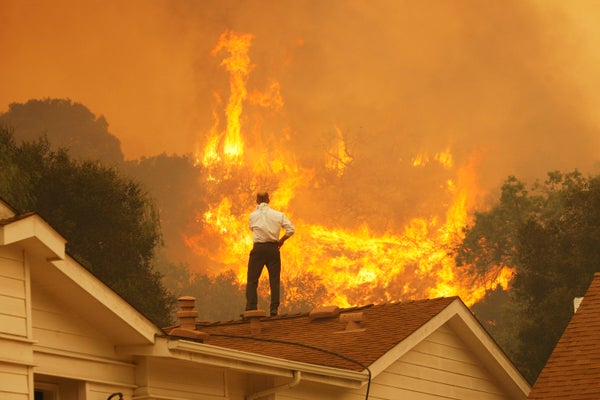
Now consider the following scenarios: A hurricane blasts Florida. A California dam bursts because floods have piled water high up behind it. A sudden, record-setting cold snap cuts power to the entire state of Texas. These are also emergencies that require immediate action. Multiply these situations worldwide, and you have the biggest environmental emergency to beset the earth in millennia: climate change.
Given the circumstances, Scientific American has agreed with major news outlets worldwide to start using the term “climate emergency” in its coverage of climate change. An official statement about this decision, and the impact we hope it can have throughout the media landscape, is below.
On supporting science journalism
If you're enjoying this article, consider supporting our award-winning journalism by subscribing. By purchasing a subscription you are helping to ensure the future of impactful stories about the discoveries and ideas shaping our world today.
This idea is not a journalistic fancy. We are on solid scientific ground. In January Scientific American published an article about a study entitled “World Scientists’ Warning of a Climate Emergency.” At the time, more than 11,000 scientists from 153 countries had signed a report to signify their agreement that the world is facing a climate emergency that requires bold action. As of April 9 another 2,100 had signed on. As our article said, “the adverse effects of climate change are much more severe than expected and now threaten both the biosphere and humanity.... Every effort must be made to reduce emissions and increase removal of atmospheric carbon in order to restore the melting Arctic and end the deadly cycle of damage that the current climate is delivering.” Our article also noted that as of January, “1,859 jurisdictions in 33 countries have issued climate emergency declarations covering more than 820 million people.”
Journalism should reflect what science says: the climate emergency is here. The statement we have issued was coordinated by Covering Climate Now, a global journalism initiative with more than 400 media partners. Here it is:
April 12, 2021
From Covering Climate Now, Scientific American,Columbia Journalism Review, the Nation, the Guardian, Noticias Telemundo, Al Jazeera, Asahi Shimbun and La Repubblica:
The planet is heating up way too fast. It’s time for journalism to recognize that the climate emergency is here.
This is a statement of science, not politics. Thousands of scientists—including James Hansen, the NASA scientist who put the problem on the public agenda in 1988, and David King and Hans Schellnhuber, former science advisers to the British and German governments, respectively—have said humanity faces a “climate emergency.”
Why “emergency”? Because words matter. To preserve a livable planet, humanity must take action immediately. Failure to slash the amount of carbon dioxide in the atmosphere will make the extraordinary heat, storms, wildfires and ice melt of 2020 routine and could “render a significant portion of the Earth uninhabitable,” warned the January Scientific American article.
The media’s response to COVID-19 provides a useful model. Guided by science, journalists have described the pandemic as an emergency, chronicled its devasting impacts, called out disinformation and told audiences how to protect themselves (with masks and social distancing, for example).
We need the same commitment to the climate story. As partners in Covering Climate Now, a global consortium of hundreds of news outlets, we will present coverage in the lead-up to Earth Day, April 22, 2021, around the theme “Living Through the Climate Emergency.” We invite journalists everywhere to join us.
This is an opinion and analysis article.
