
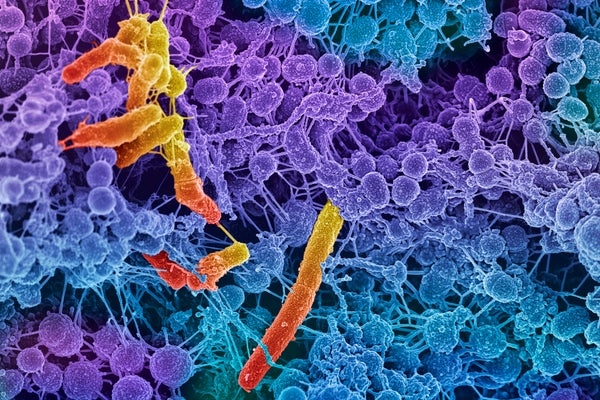
For the first time, scientists have spotted rogue bits of RNA colonizing the bacteria in our gut. These “obelisks,” as the researchers have dubbed them, may represent a whole new class of infectious agent.
“It’s just super thrilling,” says Kathleen Hefferon, a microbiologist at Cornell University who was not involved in the research. The study is available on the preprint server bioRxiv and is not yet published in a peer-reviewed scientific journal.
To detect the obelisks, lead author Ivan Zheludev of Stanford University and his colleagues sifted through data from an RNA database containing thousands of sequences isolated from human excrement. RNA is similar to DNA but is usually a single strand of “letters,” or base pairs, rather than a double strand, and it typically conveys messages from DNA that instruct the body to make proteins. The researchers identified thousands of distinct loops of single-stranded RNA that did not code for proteins. They even found one group of obelisks inside the common mouth bacterium Streptococcus sanguinis. Additionally, they analyzed information on the mouth and gut microbiomes of 472 people from five previous studies and detected obelisks in nearly 10 percent of the participants.
On supporting science journalism
If you're enjoying this article, consider supporting our award-winning journalism by subscribing. By purchasing a subscription you are helping to ensure the future of impactful stories about the discoveries and ideas shaping our world today.
Obelisks bear some resemblance to viroids—tiny, circular fragments of single-stranded RNA. Like viruses, viroids need a host to replicate, and they can infect and cause disease in eukaryotes, organisms with cells that have nuclei. Specifically, they have been documented extensively in flowering plants, as well as in a few fungi and animals. But unlike viruses, they lack an external protein coat. This makes them some of the simplest self-replicating collections of genetic material on the planet.
Where obelisks differ is in their shape and structure. Obelisks are rolled into a rod shape instead of remaining a flat circle, and their RNA sequences don’t match any known viroid sequences. They are also the first viroidlike elements to be detected in bacterial cells, rather than in more complex organisms.
“It will be interesting to see how to classify these things,” says biochemist Zasha Weinberg of Leipzig University in Germany, referring to the obelisks. Because they don’t eat, regenerate or copulate, viroids and their kin blur the line between living and nonliving things.
Given the ubiquity of viroids in the plant world, finding something similar in bacteria makes perfect sense, says Hefferon, who studies disease-causing viroids in commercial crops such as potatoes. Even so, to finally find them is exciting, Hefferon adds.
Future research, Hefferon hopes, will turn up viroidlike elements in even more places. If these simple snippets of RNA are present in organisms as disparate as potatoes and Streptococcus bacteria, there’s no reason that they shouldn’t infiltrate other living things as well. “This could very well be happening in mammalian cells,” she says. But scientists will need to study obelisks further to determine whether they are capable of infecting or causing disease in such organisms.
Studying obelisks in more detail could even help scientists trace the origin of life on Earth. Some researchers believe that viroids and their relatives represent the oldest, most primitive forms of life—or at least some predecessor to it. And if they are capable of infecting organisms across the evolutionary tree, they may have played a role in shaping the myriad species we know today. “There’s so much we don’t know,” Hefferon says. “It feels like we’re finding fossils of a whole other world.”