
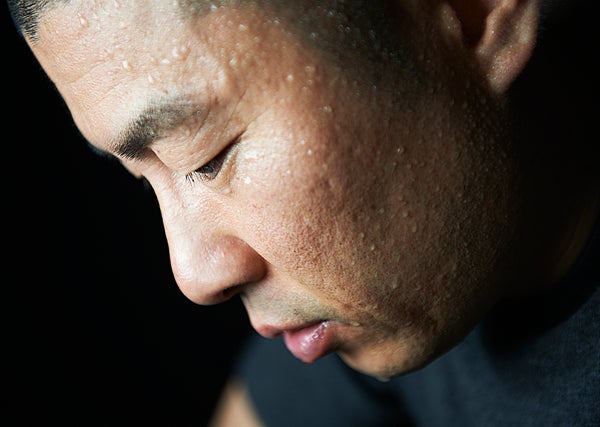

Yesterday morning, I was riding my bike up a pretty significant hill. To get up that hill, I was pedaling as hard as I could. I had nearly reached the top when I felt that familiar trickle of moisture run down my forehead. Even though it was only 6ºC (42ºF), I was sweating.
Our human meat-sack bodies work optimally when their internal temperature hovers around 98.6ºF (37ºC). When the body gets warmer than that, the brain doesn't like it, so the hypothalamus (the part that controls temperature) sends a message to your body saying "Let's cool down!" That's when your sweat glands spring into action, and you start perspiring.
On supporting science journalism
If you're enjoying this article, consider supporting our award-winning journalism by subscribing. By purchasing a subscription you are helping to ensure the future of impactful stories about the discoveries and ideas shaping our world today.
Perspiration is made almost completely of water, with smaller amounts of other chemicals in it as well. (We'll get to that in a moment.) Perspiration leaves our body through tiny holes in our skin called pores, and when the sweat meets the air, it begins evaporating (turning from a liquid to vapor) and cools us down.
Sweat is a great cooling system, but it is also a great way for our body to remove certain elements from our bloodstream. Salt, ammonia, potassium, glucose, lactate, and urea, to name a few. Our sweat also contains biochemical markers such as metabolites, electrolytes, and even heavy metals, which can give doctors and researchers a window into a person's health and even aid in diagnosing some diseases.
In recent years, scientists have developed sweat sensors in the form of patches, bandages, and tattoos that can make these types of measurements on the fly. A team of scientists at the University of California, Berkeley, is developing wearable skin sensors that can detect what's in your sweat. But before we get into that, let's look at how we measured sweat in the past, and how we're looking at it today.
Continue reading “What Can We Learn from Our Sweat?” on QuickAndDirtyTips.com