
For the first time, scientists have observed antimatter particles falling under the effect of gravity—a phenomenon that was long theorized but never before seen.
The results suggest that antimatter interacts with gravity just like regular matter does. This fits with what Albert Einstein posited in his general theory of relativity—the best theory of gravity we have. Gathering enough evidence to say so, however, took some three decades of delicate preparation to build the necessary real-world experiment.
“You really don’t know anything until you observe it,” says Jeffrey Hangst, spokesperson for the experiment, called ALPHA (Antihydrogen Laser Physics Apparatus), at CERN near Geneva. That is especially the case, he adds, for areas that concern the interplay of gravity and antimatter, two of the most notoriously slippery topics in all of theoretical physics. “This is something you simply are morally obligated to measure if you can,” Hangst says.
On supporting science journalism
If you're enjoying this article, consider supporting our award-winning journalism by subscribing. By purchasing a subscription you are helping to ensure the future of impactful stories about the discoveries and ideas shaping our world today.
Einstein’s general relativity breaks down at quantum scales, suggesting it is incomplete. Yet researchers remain flummoxed in their generations-spanning quest to forge a superior theory of quantum gravity. And antimatter lies at the heart of one of the biggest mysteries in existence.
Antimatter is the same as ordinary matter but with an opposite charge. The antimatter counterpart to the negatively charged electron, for example, is the positron, which has the same mass and spin but a positive charge rather than a negative one. When an antimatter particle and its matter counterpart meet, they annihilate each other. According to the Standard Model of physics, the big bang should have created equal amounts of matter and antimatter. If it had done so, however, nothing should exist: all of the antimatter and matter particles should have annihilated one another. Instead the universe today is almost entirely matter, with antimatter occurring only rarely as a product of radioactive decay or in cosmic-ray collisions. Physicists believe that there must have been some primordial imbalance that allowed matter to dominate the universe, yet the hows and whys remain open questions.
“Anything you can do with antimatter must be done to see what’s wrong with it,” Hangst says, “if anything.”
Antimatter’s volatility in the presence of matter poses a problem for studying it. The ALPHA collaboration scientists first make negatively charged antiprotons (the antimatter versions of protons) in an “antimatter factory,” a high-speed particle collider at CERN aptly called the Antiproton Decelerator. They then harvest positively charged positrons from a radioactive source, trapping these antimatter particles together in a vacuum to shield them from normal matter. The antiprotons and positrons attract, forming neutrally charged atoms of antihydrogen, the antimatter version of hydrogen. The neutral charge is important because gravity is a weak force. Trying to measure gravity’s pull on a charged particle is a lost cause because it’s effectively impossible to nullify ambient electric fields that would skew the results.
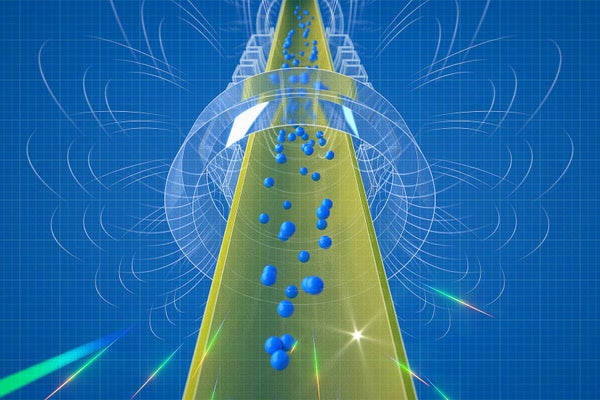
At supercooled temperatures, the antihydrogen atoms are herded via an electromagnetic field in a vertical trap called ALPHA-g, a sort of atomic version of an indoor skydiving tunnel. Here, researchers can systematically release the antihydrogen molecules, measuring how many fall down and escape out of the bottom of the trap before annihilating and how many escape out of the top. The atoms have to be cold—just above absolute zero—because heat rises. Much as an electric field can overwhelm the weak force of gravity, so, too, can the warmth of a lonely atom.
For regular hydrogen, the researchers calculated that 80 percent of atoms should fall, while 20 percent should slip through gravity’s clutches to escape out of the trap’s top. If Einstein was correct that antimatter and matter interact with gravity in the same way, the same proportion should hold true for the antihydrogen.
And it did. Within the experiment’s margin of error, the researchers could detect no gravitational differences between antihydrogen and hydrogen.
“They measured, for the first time, that antihydrogen is falling downwards in the same way as hydrogen would,” says Anna Soter, a physicist at the Swiss Federal Institute of Technology Zurich, who is not involved with the ALPHA collaboration but reviewed the new paper and wrote an article that accompanied it. Both the study and Soter’s article appeared today in the journal Nature.
The ALPHA team then took the experiment one step further by adjusting the magnetic force in the ALPHA-g trap to various strengths that would act against gravity or work alongside it to push the antihydrogen atoms up or force them down faster. Here, again, the researchers saw antimatter particles behaving in the same manner as regular matter.
The experiment doesn’t have enough precision to say with certainty that there are no differences whatsoever between gravity’s pull on antimatter versus matter, Soter says, though there is also no theoretical reason to think such differences exist. It will be important to do further experiments with greater precision, she says.
Those follow-ups are already being planned and could begin as early as next year, Hangst says. One immediate step is to use laser cooling to make the antihydrogen atoms even colder, correspondingly boosting ALPHA’s sensitivity to gravity’s effects. “There’s a lot of work to do,” he says, “but we’re well on our way.”