
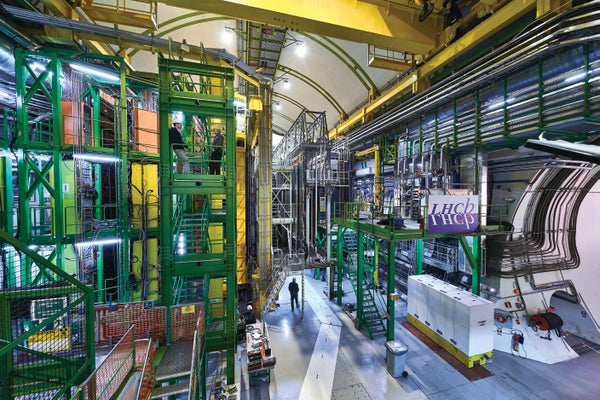
We could have been living in an antimatter universe, but we are not. Antimatter is matter’s upside-down twin—every matter particle has a matching antimatter version with the opposite charge. Physicists think the cosmos started out with just as much antimatter as matter, but most of the former got wiped out. Now they may be one step closer to knowing why.
Researchers at the Large Hadron Collider Beauty (LHCb) experiment at CERN near Geneva have discovered antimatter and matter versions of “charm” quarks—one of six types, or flavors, of a class of elementary matter particles—acting differently from one another. In a new study, which was presented in March at the “Rencontres de Moriond” particle physics conference in La Thuile, Italy, the physicists found that unstable particles called D0 mesons (which contain charm quarks) decayed into more stable particles at a slightly different rate than their antimatter counterparts. Such differences could help explain how an asymmetry arose between matter and antimatter after the big bang, resulting in a universe composed mostly of matter.
Matter and antimatter annihilate each other on contact, and researchers believe such collisions destroyed almost all of the antimatter (and a large chunk of the matter) that initially existed in the cosmos. But they do not understand why a relatively small excess of matter survived to become the stars and planets and the rest of the cosmos. Consequently, physicists have been looking for a kind of matter that behaves so differently from its antimatter version that it would have had time to generate this excess in the early universe.
On supporting science journalism
If you're enjoying this article, consider supporting our award-winning journalism by subscribing. By purchasing a subscription you are helping to ensure the future of impactful stories about the discoveries and ideas shaping our world today.
The newly discovered mismatch in decay rates between charm quarks and antiquarks turns out to be too small to account for the universe’s excess of matter. The result, however, “does bring us closer to finding the answer because it shows one of the possible answers may not be the right one,” says theoretical physicist Yuval Grossman of Cornell University, who was not involved in the new work. “I am also excited because it’s the first time we’ve ever seen this [phenomenon in charm quarks].”
Physicists previously found similar variations in two other quark flavors, but those were also too tiny to account for our matter-dominated universe. Scientists are holding out hope of finding much larger matter-antimatter differences elsewhere, such as in ghostly particles called neutrinos or reactions involving the Higgs boson—the particle that gives others mass—says LHCb team member Sheldon Stone of Syracuse University: “There are lots of different searches going on.”