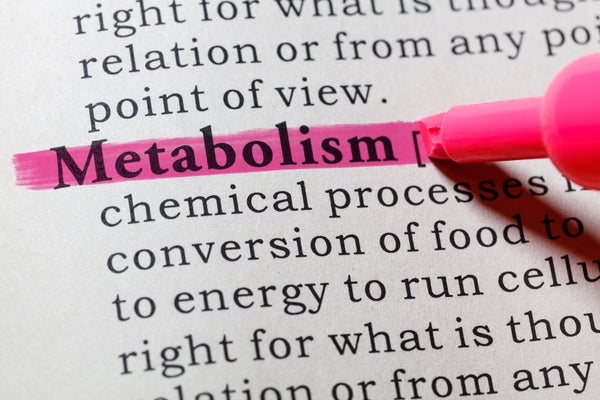
You've probably heard the word "metabolism," especially as it relates to weight loss or gain. But what is your metabolism, what does it do, and do you have any control over it?
Scientifically speaking, "metabolism" is a term that describes all the chemical reactions involved in being a living organism. And while it is true that metabolism is linked to body weight, a slow metabolism is rarely the root cause of excess weight gain.
While there are health conditions that slow the metabolism such as Cushing's Syndrome or an underactive thyroid gland (hypothyroidism), those cases are quite rare. So while it may be tempting to blame your metabolism for weight gain, it is a natural process and your body has many mechanisms that regulate it to meet your individual needs.
On supporting science journalism
If you're enjoying this article, consider supporting our award-winning journalism by subscribing. By purchasing a subscription you are helping to ensure the future of impactful stories about the discoveries and ideas shaping our world today.
Most often, when we talk about metabolism, we are actually talking about what is known as our basal metabolic rate (BMR). And our BMR is better defined as the average amount of calories we expend while simply living our best lives.
If you enjoyed this article, I’d like to ask for your support. Scientific American has served as an advocate for science and industry for 180 years, and right now may be the most critical moment in that two-century history.
SciAm always educates and delights me, and inspires a sense of awe for our vast, beautiful universe. I hope it does that for you, too.
If you subscribe to Scientific American, you help ensure that our coverage is centered on meaningful research and discovery; that we have the resources to report on the decisions that threaten labs across the U.S.; and that we support both budding and working scientists at a time when the value of science itself too often goes unrecognized.