
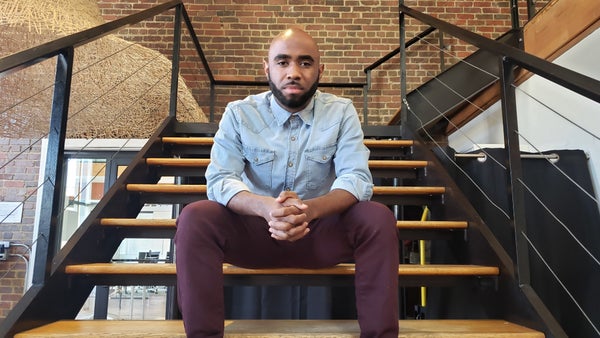
Nehemiah Mabry has long imagined a world where people of color have fuller representation inside the world of science. That vision started with him.
Mabry was raised by a mother and father who encouraged him to speak up and to develop a passion for math, science and engineering. That support led him to NASA, where he apprenticed while still a student in high school.
The experience put Mabry on a path to becoming a structural engineer. And since getting his Ph.D., he has spent nearly a decadehelping others to find their own way to a STEM career.
On supporting science journalism
If you're enjoying this article, consider supporting our award-winning journalism by subscribing. By purchasing a subscription you are helping to ensure the future of impactful stories about the discoveries and ideas shaping our world today.
“I believe in the power of images—people actually seeing something,” he says. “A lot of young people who haven’t seen something need a vision to borrow at first.”
Mabry is CEO and founder of STEMedia, a company that hosts workshops and virtual events and creates video and branded content around STEM topics. “We have a particular interest in the elevation of unrepresented people, meaning Black and brown and the Indigenous communities,” he says.
Mabry started his journey in higher education at an HBCU, or a historically Black college or university. There, he was surrounded by relatable role models and peers. When he transferred to a non-HBCU to complete a dual degree, his relationship with science, at times, turned ugly. Mabry remembers one particular conversation. ”I was flat out asked why am I getting a Ph.D. because ‘you all don’t get Ph.D.s,’” he says. The comment, in all of its plain-to-see racism, energized Mabry rather than discouraging him.
In a recent video interview, he talked about his path, the actual value proposition of increasing diversity inside science and some of the Black researchers who inspired him the most from a young age.
Click here to watch the extended version of the interview.
This discussion is part of a speaker series hosted by the
Black Employee Network at Springer Nature, the publisher of Scientific American. The series aims to highlight Black contributions to STEM (science, technology, engineering and mathematics)—a history that has not been widely recognized. It will cover career paths, role models and mentorship, and diversity in STEM.