
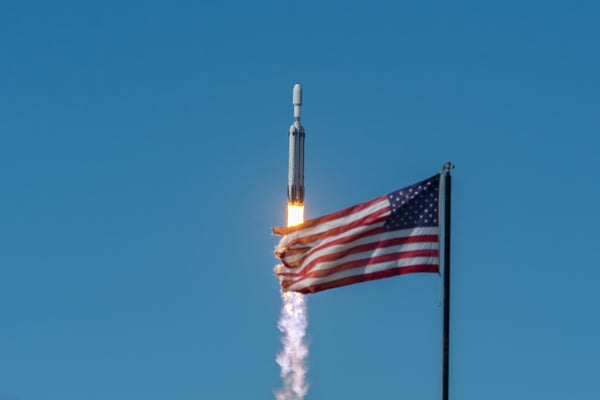
SpaceX, the world’s biggest space company, announced a deal in April with Cursor, an AI-code-writing start-up based in San Francisco, signaling the rocket firm’s intention to acquire it for $60 billion. That’s more than twice NASA’s current annual budget—and also about how much capital SpaceX could raise from its upcoming initial public offering (IPO) in June.
The plan to snap up Cursor is part of a huge shift at SpaceX toward AI. The company bought Elon Musk’s xAI in February and, following the template set by SpaceX’s highly profitable Starlink satellite megaconstellation, is vigorously pursuing the prospect of creating a vast network of data centers in space. Meanwhile Musk’s other trillion-dollar-plus company, Tesla, is expanding its own investments in AI and robotics.
“It’s going to be interesting to see whether the Cursor acquisition goes through or whether this is posturing before the IPO,” says Jordan Bimm, a space historian at the University of Chicago. He also points out that the purpose of all this AI-related investment is not yet clear. “Is space going to be the place where AI is used, or is AI going to be the means for us to do more in space?” he asks.
On supporting science journalism
If you're enjoying this article, consider supporting our award-winning journalism by subscribing. By purchasing a subscription you are helping to ensure the future of impactful stories about the discoveries and ideas shaping our world today.
SpaceX’s move comes as it struggles with the delayed development of its massive Starship rocket—a necessary asset for the company’s orbital-data-center ambitions, as well as for NASA’s Artemis program to return astronauts to the moon. SpaceX is contracted with the space agency to provide a Starship-based Human Landing System (HLS) for the Artemis IV mission targeted for 2028, and precursor tests of the HLS in Earth orbit are set for next year’s Artemis III. SpaceX has been growing as a prime U.S. defense contractor as well; it has been providing a military-grade version of Starlink called Starshield and handling most launches for the Pentagon. At the same time, the company’s lofty talk of space exploration beyond the moon, especially of Mars, has notably lessened.
SpaceX’s supporters, partners and critics alike now seek to understand its AI pivot. “This speaks to the—optimistically, the nimbleness—but also the idiosyncrasies and fickleness of having a space company led by a single person, rather than a space program run by and for the public,” says Casey Dreier, chief of space policy at the nonprofit Planetary Society.
AI can mean a lot of things, and Starlink has already been using traditional AI tools for maneuvering its teeming satellites and avoiding collisions. But now SpaceX’s investments reveal a new focus on generative AI: it sees a vast $22.7 trillion market in AI for businesses, according to its recent S-1 regulatory filing, required for companies planning to go public.
These investments might pay off in the long run, or they might prove to be a distraction. NASA in 2020 had awarded SpaceX a $135 million contract to develop its HLS lunar lander for the Artemis program’s long-awaited moon landing, previously planned for 2024. Then, last fall, NASA reopened the contract to competitors, perhaps in a sign of the space agency’s frustration over delays—or concern that China’s ambitious space program may beat the U.S. at sending astronauts to the lunar surface for the first time since the Apollo era. And in February Musk announced that SpaceX was prioritizing the creation of a “self-growing city” on the moon over the company’s long-held goal of bringing human civilization to Mars.
NASA’s concerns about the company’s focus are legitimate, says Wendy Whitman Cobb, a professor of strategy and security studies at the School of Advanced Air and Space Studies at Air University. “Up until recently, SpaceX didn’t see the moon as a big thing to do,” she says. “It’s only been with Blue Origin coming up and nipping at SpaceX’s heels, in terms of lunar activities, where you now see SpaceX and Elon Musk changing their tune.”
In the meantime, the broader space economy landscape continues to evolve. Blue Origin, founded by rival billionaire Jeff Bezos, has commenced commercial launches of its own gargantuan reusable rocket, New Glenn—although not without major problems. And another launch upstart, Rocket Lab, is trying to nab smaller launch contracts that previously would have gone to SpaceX’s Falcon 9 with its own Electron and soon-to-debut Neutron rockets. Newer companies, such as Firefly Aerospace, Stoke Space and Relativity Space, are also striving to rise to the competition.
There’s no shortage of companies large and small betting on space-based data centers as the next big thing. But only one currently has the capability to launch on a near-daily cadence and for a relatively low cost, and that’s SpaceX. That would allow SpaceX to leverage its ongoing launch dominance and its considerable control over its own supply chain to outmatch many competitors. “This is just the boldest version yet of SpaceX’s general strategy of vertical integration and finding ways of making their existing and past successes magnified into future success,” says Matthew Weinzierl, a Harvard Business School researcher who studies the private space sector.
In January SpaceX applied with the Federal Communications Commission for authorization to launch up to one million solar-array-powered satellites for orbital data centers. Nvidia-backed start-up Starcloud filed plans in February for a network of 88,000 data-center satellites. And Blue Origin filed in March for a constellation of more than 50,000 spacecraft.
The engineering challenges posed by waste heat, space radiation and latency, not to mention the costs involved, are formidable. In addition, these projects would flood already unsustainably congested orbits with thousands of satellites. It’s not clear that they’re feasible, as SpaceX itself acknowledged in a pre-IPO filing in April: “Our initiatives to develop orbital AI compute and in-orbit, lunar, and interplanetary industrialization are in early stages, involve significant technical complexity and unproven technologies, and may not achieve commercial viability.”
Some observers, like Dreier and Whitman Cobb, understandably view the transition to AI investment with some skepticism. Musk is prone to hype, after all, and he previously claimed SpaceX would send astronauts to Mars in the 2020s. (The company is nowhere close to reaching that objective.) Furthermore, SpaceX is already stretched thin: in addition to everything else, it’s trying to ramp up Starlink Mobile, which aims to provide global satellite-to-phone Internet and connectivity, while also seeking to further increase its share of Pentagon contracts as it plays a role in developing prototype space-based interceptors for the Space Force’s Golden Dome missile-defense system. Advancing so many business endeavors at once can be risky.
SpaceX’s sudden burst of AI investments also means the company is vulnerable to any deflating AI bubble. OpenAI recently missed revenue and user growth targets, a possible sign of the unstable financial foundations of the AI industry, with concerning implications for Oracle and other companies banking on it. For its part, xAI had been losing $1 billion per month when it merged with SpaceX.
But, for now, SpaceX itself remains so flush with cash that Musk has used the currently private company to secure favorable loans for himself and to prop up his other ventures. And the IPO that is coming soon could bring SpaceX a whopping valuation of $1.75 trillion. Nevertheless, even if the company’s focus on AI fares poorly, competing companies remain behind it in the near term, and NASA and the Pentagon will continue depending on it as a top contractor, Dreier says. “It’s hard to overstate SpaceX’s dominance.”