
This article is from Proof Positive, our friendly newsletter that explores the joys and peculiarities of math. Sign up today for a weekly math essay and puzzle in your email inbox.
“I know it will be called blasphemy by some, but I believe that π is wrong.” With this bold opening statement in a 2001 Mathematical Intelligencer article, mathematician Robert Palais launched a debate that continues to this day.
On supporting science journalism
If you're enjoying this article, consider supporting our award-winning journalism by subscribing. By purchasing a subscription you are helping to ensure the future of impactful stories about the discoveries and ideas shaping our world today.
For many, an attack on pi is tantamount to an attack on all of mathematics! Hardly any other symbol is so strongly associated with the subject. Songs, poems, books and films have been dedicated to pi. The date of the International Day of Mathematics, March 14, is based on the first digits of pi. It is all the more astonishing, then, that Palais has won over quite a few supporters.
Anyone who thinks this is a circle of people who despise mathematics is completely wrong. On the contrary, their passion for the subject drives them to such disruption.
To make one thing clear from the outset: no one in this debate doubts the correct calculation of pi. But Palais argues that it was wrong to choose the value 3.14159... as the fundamental constant of a circle. He believes it would be much more appropriate to use twice that value, a value now known as tau (τ).
Nine years after Palais’s article was published, physicist Michael Hartl posted “The Tau Manifesto” online. In it, he elaborated on and expanded upon Palais’s arguments. “π is a confusing and unnatural choice for the circle constant,” Hartl wrote.
Why Tau is Superior to Pi
The Tau Manifesto lists several reasons why a constant tau is more suitable than pi:
In mathematics, the radius, not the diameter, is what defines a circle. Therefore, the mathematical constant pi should be defined in terms of its radius, and tau allows you to quickly do that. With it, the circumference of a circle is calculated as: C = τ × r.
In trigonometry, we work with radians instead of degrees. A full rotation, or 360 degrees, corresponds to 2π—something that isn’t very intuitive. It would be much simpler if 360 degrees simply corresponded to the constant tau. Half a rotation, or 180 degrees, would then be τ ⁄ 2.
A factor of 2π appears in numerous mathematical and physical formulas (as when calculating the period of a simple pendulum or that of a mass on a spring). These equations would all be simpler if we could use tau.
“What really worries me is that the first thing we broadcast to the cosmos to demonstrate our ‘intelligence,’ is 3.14...,” Palais wrote in his 2001 article. “I am a bit concerned about what the lifeforms who receive it will do after they stop laughing at creatures who must rarely question orthodoxy.” In the years following the publication of Palais’s article and Hartl’s manifesto, the topic attracted increasing media attention. Internet forums saw heated debates about which constant was superior, and in classrooms, some teachers and students began using tau instead of pi. Programmers, too, increasingly defined the constant tau as 2π in their code. “I hope that one day we will all be tauists,” Hartl said in a 2011 interview with Spektrum der Wissenschaft, which is Scientific American’s German-language sister publication.
Why Pi Is Superior to Tau
The arguments of the “Tau Manifesto” do not convince everyone, however. Quite a few experts remain convinced that pi is a constant. Shortly after Hartl’s proposal, “The Pi Manifesto” appeared (as you might expect). According to this manifesto, written by mathematician Michael Cavers, Hartl’s arguments were “full of selective bias in order to convince readers of the benefits of of τ over π.” In many cases, tau would bring more disadvantages than advantages, Cavers claimed. The Pi Manifesto lists several reasons why replacing pi makes no sense:
Thousands of years ago, the mathematical constant pi was defined as the ratio of circumference to diameter. One reason for this is that the diameter of a circle is much easier to determine than its radius. Therefore, the formula C = 2πr must be retained.
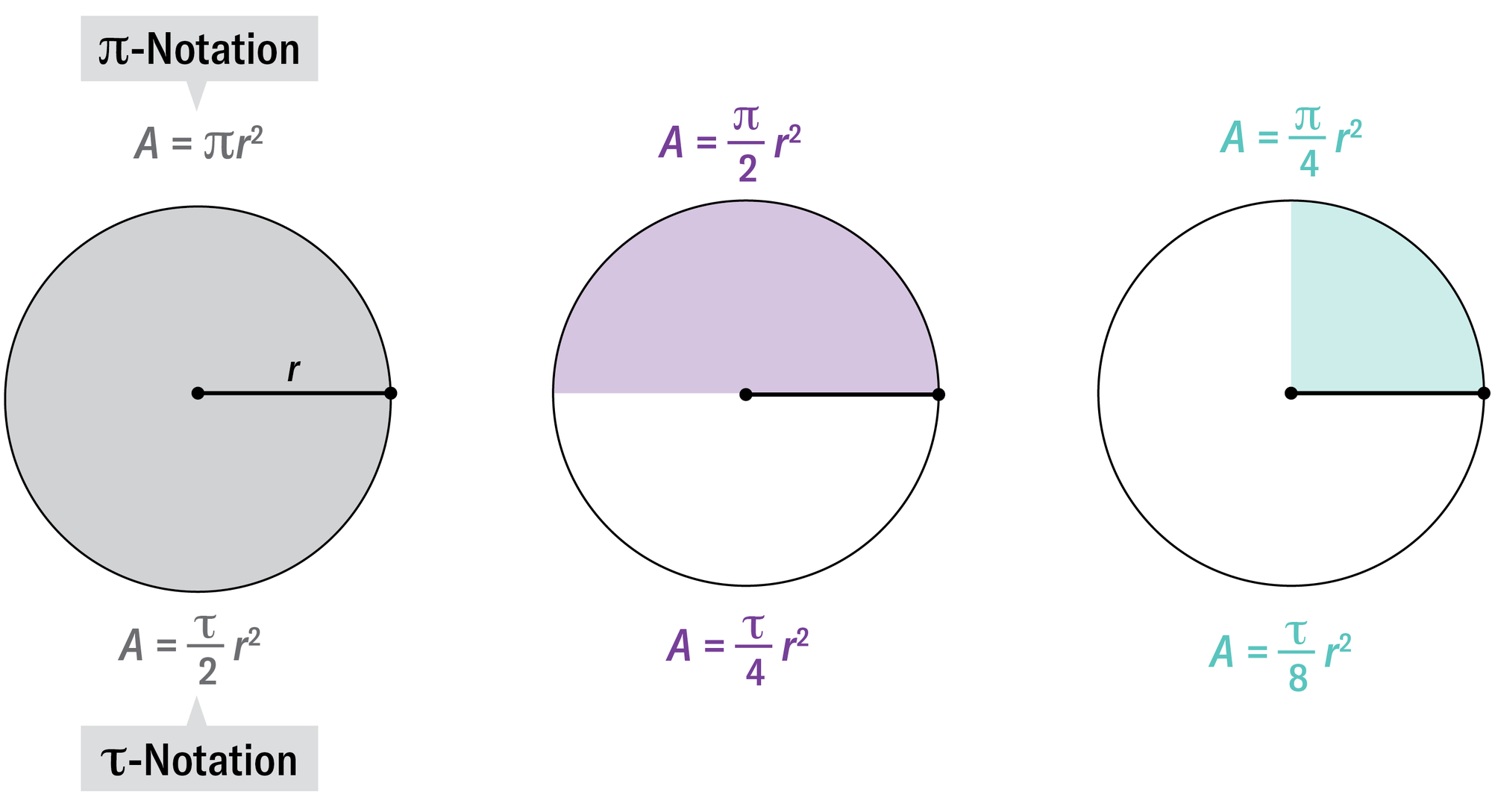
The area of a circle can be described by the simple formula A = πr². When this formula is used, a circle with a radius of 1 has an area of π, and a semicircle has an area of π ⁄ 2.
Particularly in the fields of probability theory and statistics, several formulas depend solely on pi. Replacing it with tau would introduce factors of 1 ⁄ 2 in these cases.
The mathematics itself does not change one way or the other, of course. You might therefore ask why the experts are making such a fuss. After all, it’s just about notation.This may not seem particularly important—but notation doesn’t just determine whether a result can be represented simply or in a complicated way. Notation is also crucial for intuitive understanding.For example, the tau camp has made the case that angles can be expressed more intuitively using tau than pi. Here’s an illustration:

Amanda Montañez
But consider the contrast in notation when we look at the area of a circle or various parts of a circle:
Amanda Montañez
Whether pi or tau is more suitable here is not so easy to say. Both tauists and pi supporters concede that the opposing side has an edge in certain contexts and makes some valid arguments. The fact is that pi has been deeply rooted in not only mathematics but also popular culture for centuries. Letting go of this constant and introducing a new one would be anything but simple. And dealing with two different circle numbers would simply create confusion.
Some parties are, therefore, advocating for a compromise. “The Proper Pi Manifesto” (not to be confused with The Pi Manifesto) proposes keeping pi but introducing a completely new unit, “darians,” instead of radians to measure angles.
Or even better, perhaps, is the idea mentioned in the web comic xkcd: a constant called “pau” that has a value of 1.5π. Then everyone would be equally confused.
This article originally appeared in Spektrum der Wissenschaft and was reproduced with permission. It was translated from the original German version with the assistance of artificial intelligence and reviewed by our editors.