
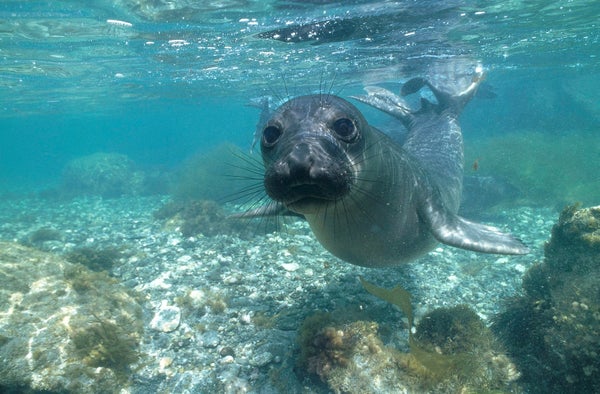
Scientists have long been in the dark about how deep-diving seals forage for their meals in pitch-black seas, and the answer may have been right under the animals’ nose all along: whiskers. With the help of a group of northern elephant seals in California’s Año Nuevo State Park, researchers have now seen this super specialized sensory system at work in the wild for the first time.
By gluing tiny cameras, each about as big as a snack-size candy bar, to the seals’ left cheeks, researchers at the University of California, Santa Cruz, and their colleagues recorded more than nine hours of footage of the animals’ long, flexible whisker hairs in motion while they dove for their dinner. In most similar studies of wild marine mammals, researchers used trackers that only measured how far animals traveled and how deep they went. But this time scientists built cameras systems small enough to record actual footage of seals’ deep dives without getting in their way. The first-of-its-kind video footage used in the team’s new study, published on Monday in Proceedings of the National Academy of Sciences USA, is a big step forward in understanding how seals hunt rather than just where they go.
Seals in captivity have shown they can hunt with whiskers alone when blindfolded, so researchers had long suspected that this sensory system might be the key to the animals’ knack for low-light foraging. “But in natural conditions, animals will use all of the information from many sensory systems and integrate it to shape behavior in the wild.... They may use eyes; they may use whiskers; they may use hearing,” says U.C. Santa Cruz marine ecologist Taiki Adachi, the study’s lead author. “We make sure that seals actively use whiskers in the deep ocean.”
On supporting science journalism
If you're enjoying this article, consider supporting our award-winning journalism by subscribing. By purchasing a subscription you are helping to ensure the future of impactful stories about the discoveries and ideas shaping our world today.
The spot where each whisker meets the seal’s face is surrounded by nerve endings, making this array of specialized hairs incredibly sensitive to minuscule changes in nearby water flow. In the study footage, Adachi and his colleagues saw the foraging seals moving their whiskers back and forth with muscles in their snout—a motion known as “whisking”—in patterns similar to the ones rats and mice use to explore on land. The researchers only observed this behavior once the seals were down at their usual hunting depths, suggesting the animals were using their whiskers to search for tiny surges of water caused by fish flicking their tail and swimming around. When the seals were not feeding, they kept their whiskers pressed back against their head. The whiskers only kicked into action when the animals were ready to feel for their next meal.
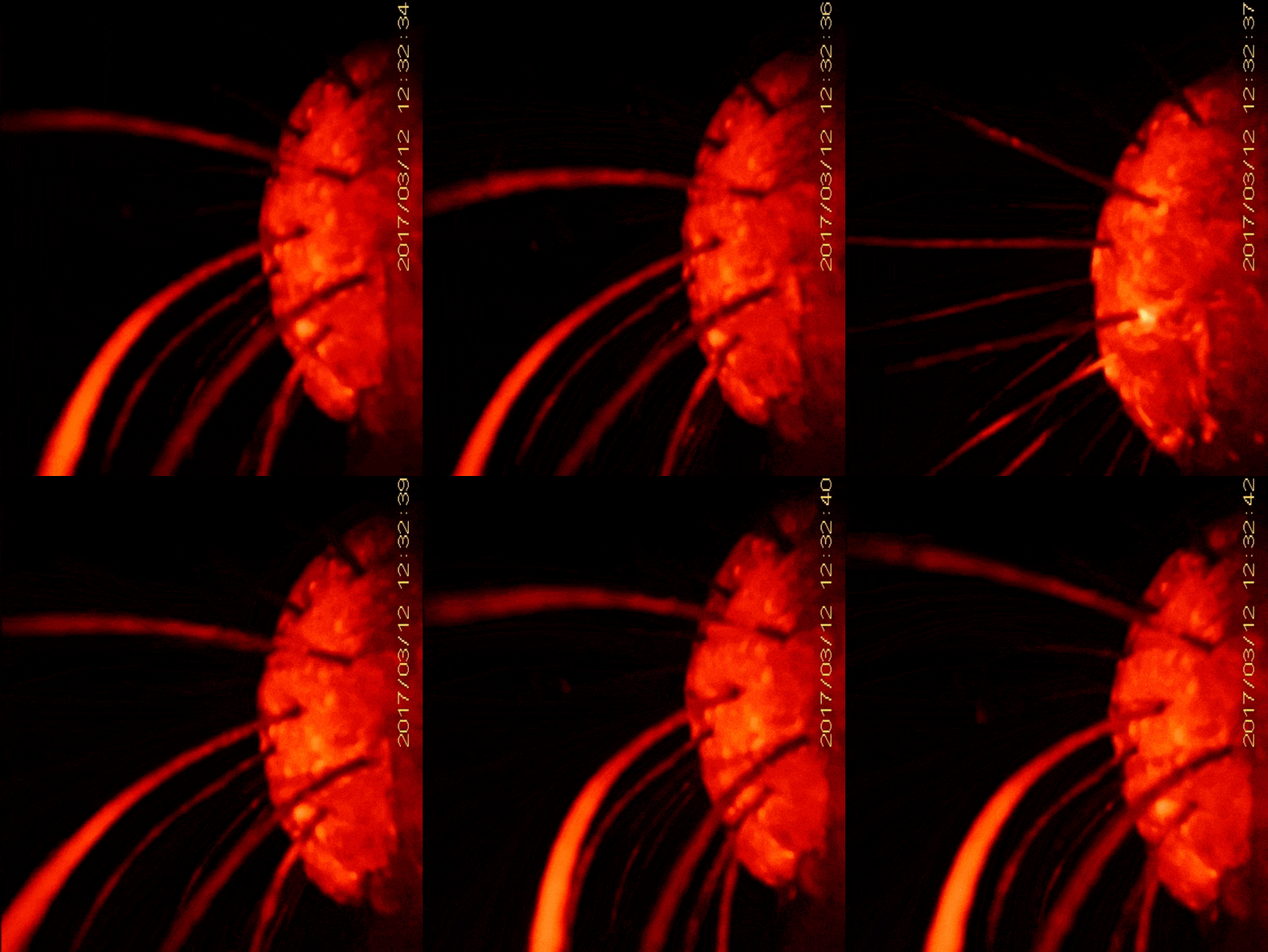
A deep-diving seal’s whiskers move during a hunt for fish in the dark. Credit: “Whiskers as Hydrodynamic Prey Sensors in Foraging Seals,” by Taiki Adachi et al., in Proceedings of the National Academy of Sciences USA, Vol. 119. Published online June 13, 2022
“We don’t have a facial whisker that we can move, so it’s very tricky to think about how seals sense nature with their whiskers,” Adachi says. “We see the world how we see the world; elephant seals see the world in a different way.” To investigate how the seals’ senses worked together to paint a picture of the immediate surroundings, Adachi and his team not only watched the whiskers—they also checked the camera footage for any visible bioluminescent prey that the seals would have been able to see. The researchers found that a bright bioluminescent glow only lined up with a successful catch for the seals in one out of five hunts, confirming that the animals weren’t relying on just their eyes. Whisker movement was likely playing a primary role.
“These field studies are really urgently needed,” says Guido Dehnhardt, a marine scientist at the University of Rostock in Germany, who has conducted many years’ worth of experiments monitoring whiskers in captive seals and was not involved in the new study. “To do this in the wild with free-ranging animals is really a great challenge—and the results are very impressive.” Dehnhardt cautions that video of the whiskers alone does not necessarily show that they are moving in response to changes in water motion around the seals. Future experiments would ideally measure both the whisker wiggles and the surrounding water flow simultaneously. Those data could go a long way toward showing just how much seals rely on whiskers for their submarine snacking success.