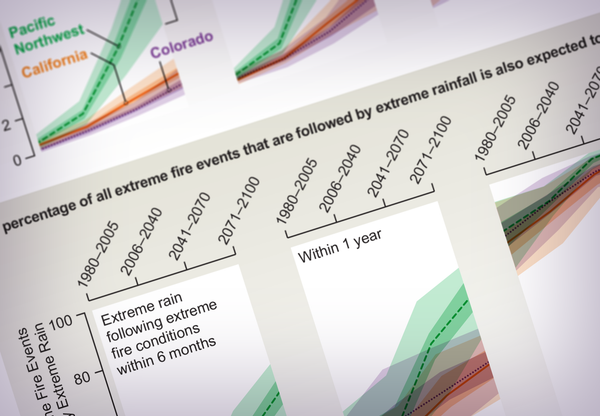
Climate change tends to bring out the worst in the weather, be it extreme cold or heat, rain or fire. A new study found that the warming atmosphere increases the likelihood that a wildfire in the Western U.S. will be followed by intense rainfall. This confluence of events raises the risk of landslides and flash floods.
“Once you've had a wildfire burn through, you kill off all the vegetation, and you don't have any root structures there holding the soil in place, so it's a lot more vulnerable,” says University of California, Santa Barbara, climate scientist Samantha Stevenson, who was a co-author on the study.
The fires aren't causing the storms, but the same rising temperatures that lead fires to become more severe allow the atmosphere to carry more moisture, causing rain events to dump more water quickly. “We're talking about superstrong rainstorms, the 99.9th percentile,” Stevenson says.
On supporting science journalism
If you're enjoying this article, consider supporting our award-winning journalism by subscribing. By purchasing a subscription you are helping to ensure the future of impactful stories about the discoveries and ideas shaping our world today.
Credit: Jen Christiansen; Source: “Climate Change Increases Risk of Extreme Rainfall following Wildfire in the Western United States,” by Danielle Touma et al., in Science Advances, Vol. 8, No. 13; April 1, 2022 (data)
Subscribe to Support Independent Journalism
Great science journalism requires human expertise, time, effort and creativity. And it costs money. That’s why I and the journalists here at Scientific American hope you’ll join our community.
When you subscribe, you are supporting staff and freelance journalists who are passionate about telling science stories that are true, important and compelling. Our editors and reporters are often experts in their fields, which means they understand the nuances of big discoveries and can untangle the breakthroughs from the hype. With a subscription, you are also supporting rigorous fact-checking to ensure the words we publish are precise and accurate. And you’re supporting original illustrations, graphics and photos that bring you closer to an advanced laboratory, an ice sheet in Antarctica or a space mission in orbit. You’re helping us craft other types of high-quality journalism as well: Our newsletters are carefully written, edited and curated by staffers you have or will come to know and love. Our Science Quickly podcast is based on original reporting, collaboration with editors and scientists and exacting production.
Subscriptions keep this engine running so we can continue to deliver thoughtful, rigorous and independent science journalism to you. In an era of viral misinformation, this work is crucial. If you value what we do, I hope you’ll consider joining us as a subscriber
Thank you,
Jeanna Bryner, Editor in Chief, Scientific American