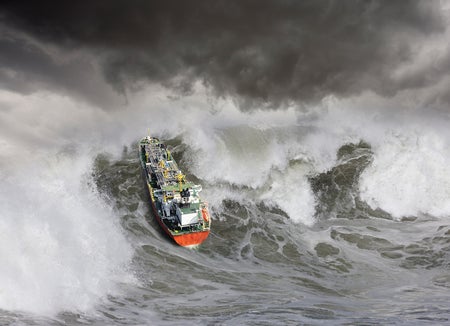
Dangerous Rogue Waves Aren’t Random—They’re Predictable
An 18-year dataset from the North Sea reveals that rogue waves are not freak accidents but particular products of ordinary swells stacking up—an insight that could make prediction possible

Avery Schuyler Nunn is an avid surfer, free diver and environmental science journalist based in California. She earned her Master of Science degree from Columbia University in 2021 and has used her notebook and camera as tools for exploration, both above and beneath the surface, ever since. She is a freelance contributor to Scientific American, National Geographic, Smithsonian Magazine, Grist, and more. Follow her work on Instagram and X (formerly Twitter) @earthyave and at www.averyschuylernunn.com

Dangerous Rogue Waves Aren’t Random—They’re Predictable
An 18-year dataset from the North Sea reveals that rogue waves are not freak accidents but particular products of ordinary swells stacking up—an insight that could make prediction possible

South Africa’s Coast Is Rising—And Scientists Have a New Explanation Why
Human water management contributes to sinking land across the globe, and it may also be responsible for an unexpected rise

See the Lush Kelp Forests Scientists Are Fighting for as Oceans Warm
New research helps the “ocean’s veins” thrive under heat stress

Surprising Chimpanzee Signal Reveals Secrets of Ape Communication
A rare and deliberate signal between a mother chimpanzee and her daughter raises new questions about ape communication, culture and the meaning of sharing a language

Global Warming Is Slowing the Earth’s Rotation
Drastic polar ice melt is slowing Earth’s rotation, counteracting a speedup from the planet’s liquid outer core. The upshot is that we might need to subtract a leap second for the first time ever within the decade

Can ‘Conversations’ with Whales Teach Us to Talk with Aliens?
A controversial 20-minute interaction with a humpback whale might help scientists communicate with extraterrestrials and nonhuman Earthlings alike