
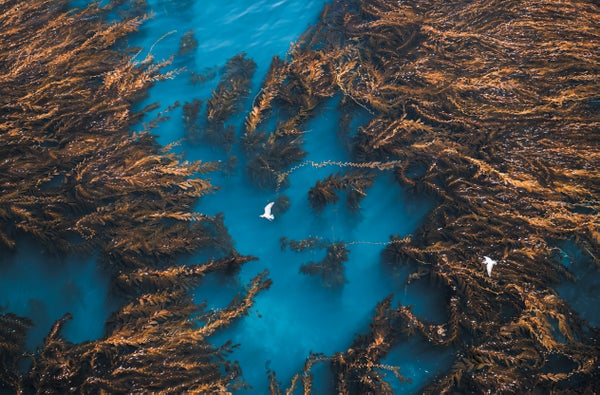
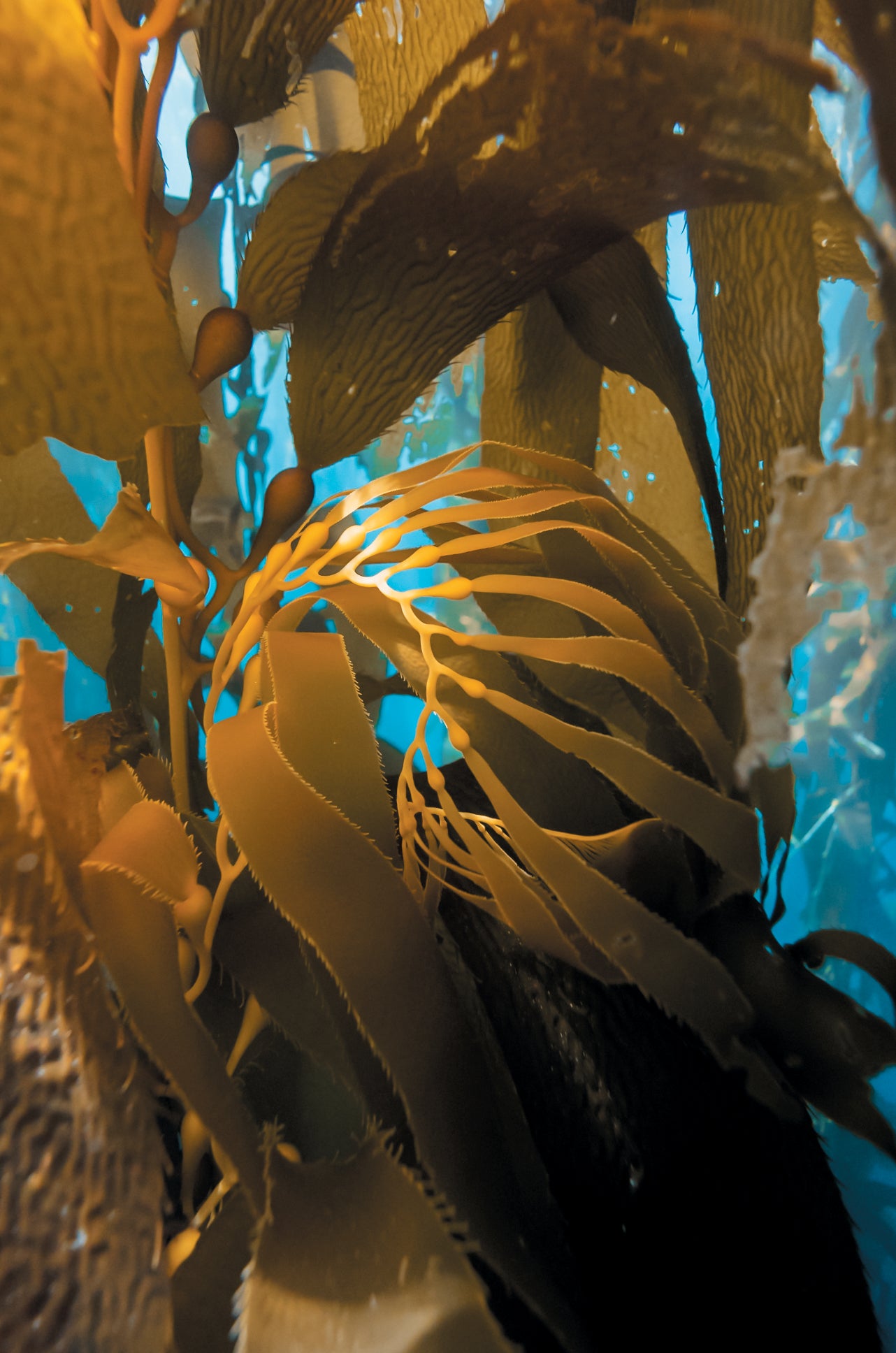
While free diving to photograph kelp forests along the California coastline, I’ve viscerally felt the consequences of finiteness as a living being—the fleeting nature of a single breath, the limits of my own lungs. Kelp forests, too, have a threshold. These towering underwater jungles, which unfurl in golden ribbons with the pull of the tides, exhale life-giving oxygen into the sea, sequester carbon, shelter other organisms, buffer shorelines and remain the basis of life for many marine worlds. But along the North American coasts, heat waves, sea star wasting diseases, declining sea otter numbers and surging urchin populations have stripped away vast kelp canopies, leaving barren seascapes underneath the waves: rocky crags devoid of life except for the kelp-devouring sea urchins. In some regions, more than 90 percent of these forests have disappeared within only the past 10 years. Some Indigenous communities, who have long understood kelp’s role as both refuge and lifeline, describe the plant as the ocean’s “veins,” carrying life through the currents. Now the pulse is fading.
Avery Schuyler Nunn
And yet scientists are studying kelp not just as a casualty of climate change but as a survivor. “Diving into the kelp forest is like falling into a dream,” says Sara T. Gonzalez, a researcher at the Woods Hole Oceanographic Institution. “But above all the magic of the kelp forest, what really motivated me to study kelp was its dual importance as an essential habitat for fish and invertebrates and as a valued natural resource in human society.”
On supporting science journalism
If you're enjoying this article, consider supporting our award-winning journalism by subscribing. By purchasing a subscription you are helping to ensure the future of impactful stories about the discoveries and ideas shaping our world today.
Gonzalez’s team is tapping into the remarkable resilience written in kelp’s DNA. In a recent study in the Journal of Applied Phycology, the researchers identified sugar kelp strains with natural genetic adaptations that help them withstand rising ocean temperatures. By crossbreeding heat-tolerant gametophytes—the microscopic precursors of adult kelp, as well as other algae and plants—from different species, they produced organisms that thrived under heat stress. Because gametophytes are crucial to kelp breeding, and because this resistance seems to be passed to offspring, the development could contribute to both wild kelp restoration and seaweed farming.

Avery Schuyler Nunn
The implications of this finding go beyond one species. Across the world’s oceans, from the fog-draped shores of the Pacific Northwest to the wild swells of Tasmania, kelp forests are indeed vanishing—but their own cells might hold the blueprints for their survival. “All kelps share the same life cycle,” Gonzalez says, so this knowledge—of heat-hardened lineages and stress-tested spores—could ripple outward. With each discovery, scientists edge closer to restoring these forests not just in one sea but in many, coaxing back the submerged canopies that breathe life into the planet’s shifting currents.

Avery Schuyler Nunn