
January 20, 2009
Portrait of Darwin as a young (flatulent) scientist: Natural selection serves as the theme of an incoherent reality show
Gary Stix, formerly senior editor of mind and brain topics at Scientific American, edited and reported on emerging advances that have propelled brain science to the forefront of the biological sciences. Stix has edited or written cover stories, feature articles and news on diverse topics, ranging from what happens in the brain when a person is immersed in thought to the impact of brain implant technology that alleviates mood disorders such as depression. Before taking over the neuroscience beat, Stix, as Scientific American's special projects editor, was responsible for the magazine's annual single-topic special issues, conceiving of and producing issues on Albert Einstein, Charles Darwin, climate change and nanotechnology. One special issue he oversaw on the topic of time in all of its manifestations won a National Magazine Award. With his wife Miriam Lacob, Stix is co-author of a technology primer called Who Gives a Gigabyte? A Survival Guide for the Technologically Perplexed.
Portrait of Darwin as a young (flatulent) scientist: Natural selection serves as the theme of an incoherent reality show
The Land of Milk and Money
The first drug from a transgenic animal may be nearing approval
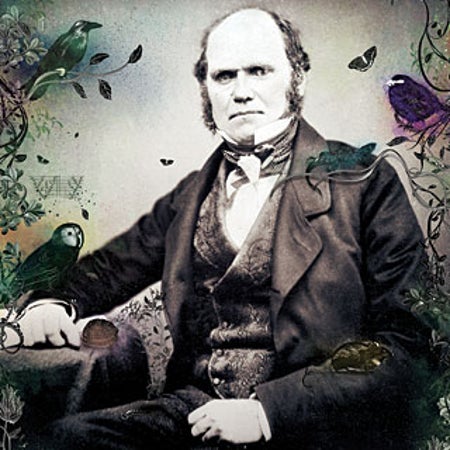
Darwin's Living Legacy--Evolutionary Theory 150 Years Later
A Victorian amateur undertook a lifetime pursuit of slow, meticulous observation and thought about the natural world, producing a theory 150 years ago that still drives the contemporary scientific agenda
Rough Sex at 40,000 Leagues Under the Sea
Technical Mumbo Jumbo May Scare Patients
Sewage Reveals Patterns of Illicit Drug Use
Robot Cartoons--Cute; Robot Humans--Creepy
Researchers take a closer look at creepiness in the almost human
Simple no-risk prenatal blood test may detect vast range of genetic disorders
Pot joins the fight against Alzheimer's, memory loss
Itching for treatments that scratching can't always soothe
Is Chronic Inflammation the Key to Unlocking the Mysteries of Cancer?
Understanding chronic inflammation, which contributes to heart disease, Alzheimer's and a variety of other ailments, may be a key to unlocking the mysteries of cancer
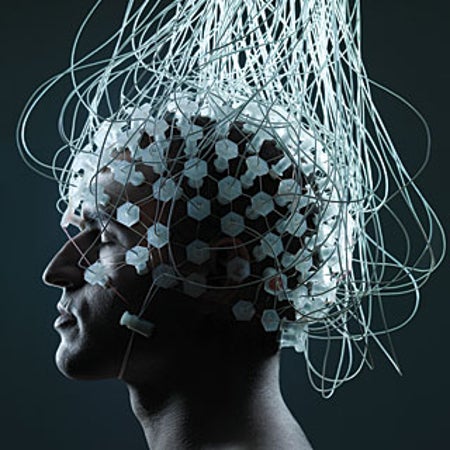
Jacking into the Brain--Is the Brain the Ultimate Computer Interface?
How far can science advance brain-machine interface technology? Will we one day pipe the latest blog entry or NASCAR highlights directly into the human brain as if the organ were an outsize flash drive?
Driving to Mach 1--"Jetmobiles" try to go supersonic
American and British teams face off in the desert to be the first to drive at the speed of sound
Shock-Wave Showdown in the Old West
British car and driver break the sound barrier
ArXiv, the wire service for physicists and mathematicians, marks a milestone
Bolivia tries to bolster public health with traditional medicine
Of Survival and Science
From street waif in war-torn Italy to "knocking out" the genes of mice--Mario R. Capecchi shows how genius springs from the most unlikely beginnings.
Mathematicians predicted stock market volatility years ago
Trends In Economics: A Calculus of Risk
Mathematicians, physicists and economists can help mitigate the vagaries of running a global business through derivatives
Who gets the most spam? This message brought to you by the letter "A"
MIT hackers make Massachusetts officials nervous at Defcon
Can fMRI Really Tell If You're Lying?
Will brain scans ever be able to tell if you're really being deceptive?
A Malignant Flame
Understanding chronic inflammation, which contributes to heart disease, Alzheimer's and a variety of other ailments, may be a key to unlocking the mysteries of cancer
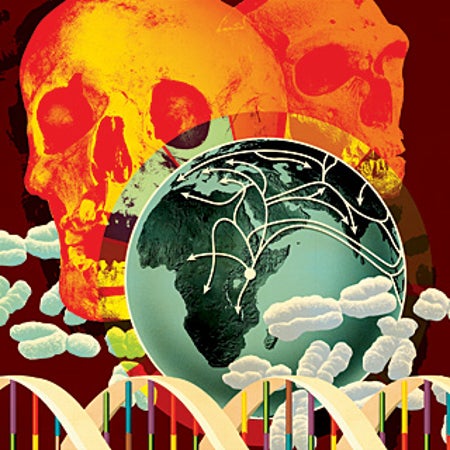
The Migration History of Humans: DNA Study Traces Human Origins Across the Continents
DNA furnishes an ever clearer picture of the multimillennial trek from Africa all the way to the tip of South America