Space & PhysicsSeptember 1, 2010
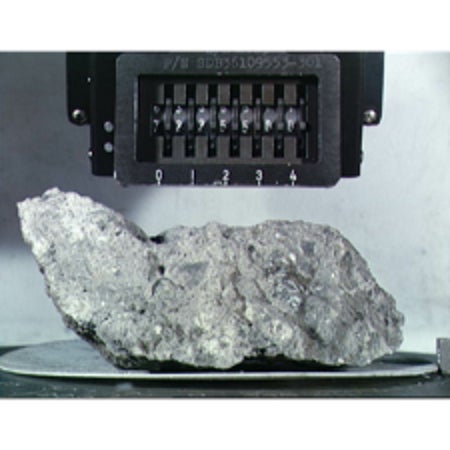
Lunar Pencil Lead: Graphite Found in Moon Rock Collected During Apollo 17
Impact-delivered graphite discovered in Apollo moon rock
John Matson is a former reporter and editor for Scientific American who has written extensively about astronomy and physics.
Lunar Pencil Lead: Graphite Found in Moon Rock Collected During Apollo 17
Impact-delivered graphite discovered in Apollo moon rock

Origami Sheets That Fold Themselves
Which Ray?: Conflicting Data on High-Energy Cosmic Rays Leave Their Source--or Sources--Unresolved
A new study proposes that ultrahigh-energy particles from space may have violent local origins, but not all observations are in agreement
A Little Flight Music: NASA Contest for Wake-Up Songs Prompts Astronauts to Recall Tuneful Highlights
From daily wake-up songs to portable music players, music is a big part of life in orbit
Distant astrophysical beacons reveal masses of the solar system's planets
One Big Family: Exoplanet System Hosts at Least 5, and Possibly 7, New Worlds
A planetary system 125 light-years away could represent the largest collection of known worlds outside the solar system
Meteorite nugget pushes back age of the solar system by nearly 2 million years
Slow and Steady: Astronomy Advisory Report Charts a Long Road for Exoplanet Science
The influential decadal survey champions the pursuit of potentially habitable worlds but offers few details for the near future
Four winners of the 2010 Fields Medal announced
Newfound lunar landforms point to moon's recent shrinkage
Double Shake: Multiple, Nearly Simultaneous Earthquakes Triggered Deadly 2009 Tsunami
The South Pacific disaster stemmed from an unusually tight sequence of massive earthquakes
Influential astronomy priority list favors multipurpose telescopes
Volunteers' Idle Computer Time Turns Up a Celestial Oddball
Einstein@Home, a distributed computing project searching primarily for gravitational waves, has found its first pulsar
Will the Perseid Meteor Shower Ever Run Dry?
Earth's annual passage through the debris stream left by Comet Swift-Tuttle is not likely to make a dent in the meteor shower's intensity anytime soon
Tricky Mantle: Intact Pocket of Ancient Earth May Have Escaped Mixing for 4.5 Billion Years
Primordial lavas from the Arctic may represent the oldest reservoir of terrestrial mantle--perhaps dating to shortly after Earth's formation
Flash Dance: Saturnian Auroras Ebb and Flow in Sync with the Planet's Radio Pulses
Two geomagnetic phenomena of the giant planet appear to pulsate in unison
Former NASA chief Sean O'Keefe reported to have survived Alaska plane crash
Supersaturation leads to melting in silicon, even as its temperature falls
Dry Again: New Analysis of Apollo Moon Rocks Points to a Largely Waterless Lunar Interior
The chlorine content of specimens returned from the moon indicates that the lunar interior never harbored much water, in disagreement with some recent studies
NASA plans quick fix for broken space station cooling unit
An Extra Quiet Sun
A long and pronounced solar minimum befuddles astronomers
NASA's Plan to Use Commercial Rockets Lifts Off
Perturbing Discovery: Does an Exoplanet's Orbital Oddity Reveal a Neighboring World?
Subtle changes in the observed orbit of a massive planet 700 light-years away may point to the gravitational influence of another object
Predicting small-scale turbulent flows could lead to more efficient airliners and ships