TechnologyJune 1, 2011
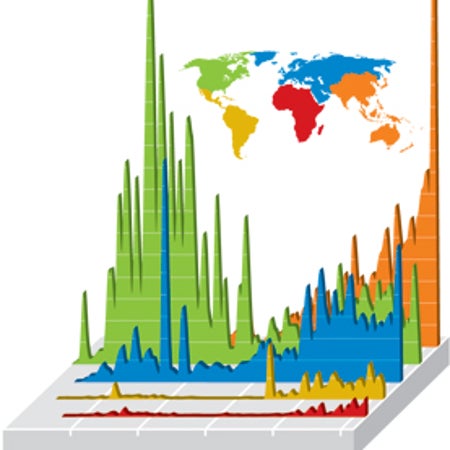
Will the Internet Stop on June 8?
Companies and individuals have gobbled up nearly every Internet protocol address available
Mark Fischetti was a senior editor at Scientific American for nearly 20 years and covered sustainability issues, including climate, environment, energy, and more. He assigned and edited feature articles and news by journalists and scientists and also wrote in those formats. He was founding managing editor of two spin-off magazines: Scientific American Mind and Scientific American Earth 3.0. His 2001 article “Drowning New Orleans” predicted the widespread disaster that a storm like Hurricane Katrina would impose on the city. Fischetti has written as a freelancer for the New York Times, Sports Illustrated, Smithsonian and many other outlets. He co-authored the book Weaving the Web with Tim Berners-Lee, inventor of the World Wide Web, which tells the real story of how the Web was created. He also co-authored The New Killer Diseases with microbiologist Elinor Levy. Fischetti has a physics degree and has twice served as Attaway Fellow in Civic Culture at Centenary College of Louisiana, which awarded him an honorary doctorate. In 2021 he received the American Geophysical Union’s Robert C. Cowen Award for Sustained Achievement in Science Journalism. He has appeared on NBC’s Meet the Press, CNN, the History Channel, NPR News and many radio stations.
Will the Internet Stop on June 8?
Companies and individuals have gobbled up nearly every Internet protocol address available

How Much Do Wildfires Cost in Terms of Property Damage?
Global warming could send more money up in smoke
Radiation Sources Range from Cigarettes to CT Scans
How many millisieverts are you getting? A special online-only addition to May 2011's Graphic Science
Exposed: Medical Imaging Delivers Big Doses of Radiation
Space rock: Vote for the new NASA wake-up song
The Dead Sea Is Disappearing, but It Could Be Saved [Slide Show]
Scientists analyze sinkholes and how mixing waters might alter the sea
Clean Tech Rising
China outshines the U.S. as the top investor, while Europe is a close third
Japan's two incompatible power grids make disaster recovery harder
Energy at the movies--tonight
Where Will the Rain Fall in 2100? [Slide Show]
Field work on remote Pacific islands reveals answers
Energy at the movies--huh?
Dangerous Asteroids: Orbits of Near-Earth Objects [Web Exclusive Graphic]
An online-only addition to the March 2011 Graphic Science column
Death by Asteroid: A Graphic Look at Rocky Threats from Space
What we don't know could hurt us
Can we get off oil now?
Oscar finalist in documentary category prompts Scientific American fracking article
Passionate Love in the Brain, as Revealed by MRI Scans [Web Exclusive Graphic]

Your Brain in Love
Cupid's arrows, laced with neurotransmitters, find their marks
The Fish Farm Revolution [Slide Show]
Fish farming could be a sustainable source of food in future
Money for Science: U.S. Funding over the Years [Web Exclusive Graphic]
A special online-only addition to January 2011's Graphic Science
Money for Science: U.S. Funding over the Years
Federal R&D spending shows how government priorities stack up

In Search of the Radical Solution: A Q&A with Venture Capitalist Vinod Khosla on New Energy Technology
The greatest energy payoffs, says investor Vinod Khosla, will come from fundamentally reinventing mainstream technologies
Silent Seas: Smart Controls Could Rescue Depleted Fisheries
The world's fisheries continue to collapse, although smart controls could help
The Web Turns 20: Web Science Reveals Human Interactions, Part 4 of 4
In this fourth article of a four-part series commemorating the World Wide Web's 20th birthday, Tim Berners-Lee tells Scientific American editor Mark Fischetti that we still have a lot to learn about the Web's design, operation and impact on society
The Web Turns 20: Free Bandwidth Connects the Masses, Part 3 of 4
In this third article of a four-part series commemorating the World Wide Web's 20th birthday, Scientific American editor Mark Fischetti describes an effort to bring free Internet access to African communities