
This article was published in Scientific American’s former blog network and reflects the views of the author, not necessarily those of Scientific American
On August 28, 1845, the first issue of Scientific American described the editors’ desire to provide readers “who delight in the development of those beauties of Nature, which consist in the laws of Mechanics, Chemistry, and other branches of Natural Philosophy—with a paper that will instruct while it diverts or amuses them, and will retain its excellence and value, when political and ordinary newspapers are thrown aside and forgotten.”
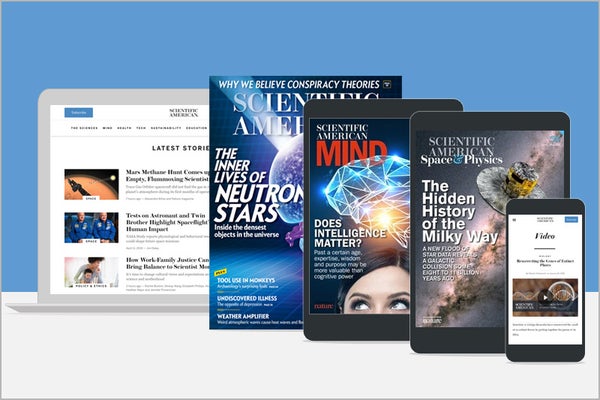
Today, with award-winning features, news, commentary and visual-storytelling—including articles by more than 200 Nobel Prize winners and other distinguished experts—ScientificAmerican continues to deliver unique insights about the ways that science changes our understanding of the world and shapes our lives. But in order to retain its excellence and value for another 175 years, the magazine must evolve. That is why, beginning April 15, we are launching a paywall on our website. Going forward, readers will be allowed access to three complimentary articles* per month before they are asked to subscribe to any of one Scientific American’s print or digital titles to read further. That includes the flagship monthly edition, one of our bimonthly anthologies (Scientific American Mind, Scientific American Space & Physics and Scientific American Health & Medicine) or our five yearly Collector’s Editions.
By subscribing to one or more of these outstanding products, you will support our mission to promote empirical and objective inquiry, as well as rationality and reason, through authoritative and engaging coverage of the most important and awe-inspiring advances in science and technology. With your help, our work will continue to influence policy leaders and decision-makers, and to introduce people to science in classrooms and living rooms around the world.
On supporting science journalism
If you're enjoying this article, consider supporting our award-winning journalism by subscribing. By purchasing a subscription you are helping to ensure the future of impactful stories about the discoveries and ideas shaping our world today.
Scientific American will change in other ways as well. Later this year, we are rolling out new webpage designs that will make feature reading more immersive, revamped newsletters that will be more succinct and engaging, and better website navigation that will make content easier to find. Exciting new titles, issues and special reports are also on their way. But the paywall is one of the first and most important steps that we’re taking to adapt to an increasingly digital marketplace and to ensure that we have a sustainable and scalable business model for many years to come. Our first issue noted that the paper “will be furnished to subscribers at $2.00 per annum.” That’s $66.52 in today’s dollars while a print and digital subscription to our monthly flagship edition, with 12 issues per year, costs just $34.99—a value for anyone who appreciates the fruits of research and discovery as much as we do.
So, please, read and enjoy!
* Content that appears in the monthly flagship edition will remain behind a hard paywall with no complimentary access, but all other content, including online-only features, news, commentary and multimedia will be subject to the metered version of the paywall with three complimentary articles within a 30-day period. All current subscribers can sign in immediately for online access. Print subscribers who have not yet created an account on the website will need to register before signing in (for more information please see our FAQ).