
In 1894 John William Strutt, Lord Rayleigh—who later went on to garner the 1904 Nobel Prize in Physics—penned an appreciation in Scientific American about the work of John Tyndall, an Irish physics professor, mathematician, geologist, atmospheric scientist, public lecturer and mountaineer.
“The most important work,” Strutt wrote, “that we owe to Tyndall in connection with heat is the investigation of the absorption by gaseous bodies of invisible radiation.” Tyndall's work showed the power of gases such as water vapor and “carbonic acid”—today known as carbon dioxide—to absorb heat and later speculated on such gases' effect on climate. Strutt himself repeated some of the experiments. As he wrote in his 1894 article: “When we replace the air by a stream of coal gas, the galvanometer indicates an augmentation of heat, so that we have before us a demonstration that coal gas when heated does radiate more than equally hot air, from which we conclude that it would exercise more absorption than air.”
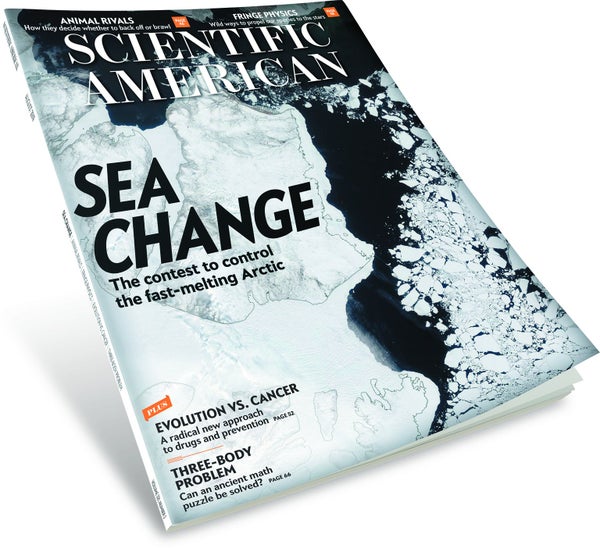
Today it is not a stretch to say that the way carbon dioxide and other so-called greenhouse gases are affecting climate is the story of our shared human experience globally. We at Scientific American look at various impacts nearly daily online and in every print issue. In this edition, we present a special report and cover story, “Future of the Arctic.”
On supporting science journalism
If you're enjoying this article, consider supporting our award-winning journalism by subscribing. By purchasing a subscription you are helping to ensure the future of impactful stories about the discoveries and ideas shaping our world today.
Coordinated by senior editor Mark Fischetti, the package looks at the geopolitical consequences of a fast-melting region: how different countries are vying for control (“Divide or Conquer,” by Fischetti), how rapid environmental alterations are transforming life at the putative top of the world (“A New Reality,” by Fischetti), and what to do about rising political tensions (“Is Confrontation Inevitable?” by political scientist and scientific group leader Kathrin Stephen).
Not all change is so far-reaching, of course. On a more prosaic note, I'll soon become dean of the College of Communication at Boston University, my alma mater. I love Scientific American and am hugely grateful for the privilege of my 18 years here, with the past decade as its editor in chief (and first woman in the role since its founding in 1845). At the same time, I feel passionate about supporting young minds to help shape a better future for us all. In other words, I'll be pursuing essentially the same mission of learning and sharing that knowledge—but from a different vantage point. I'll remain a contributor to Scientific American. More next month.