How Can We Cultivate Grit and Imagination in the Classroom?

Innovative Educator's Summit focuses on the intersection of grit and imagination in the classroom

Join Our Community of Science Lovers!

This article was published in Scientific American’s former blog network and reflects the views of the author, not necessarily those of Scientific American


Though grit and imagination are two important character traits for success, we often treat them as opposed to each other. However, many of the highest achievers find ways to incorporate both dreaming and doing into their work. Educators that combine the two can be an inspiration for students, setting them up for success in the classroom and beyond.

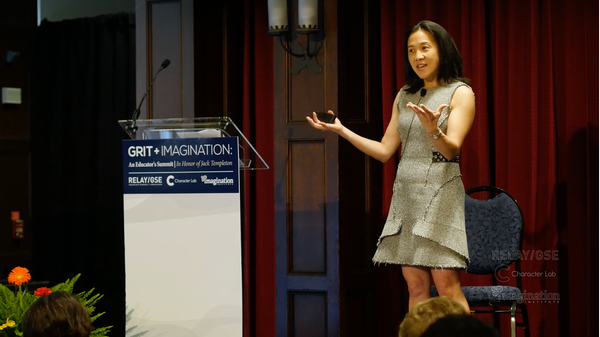
To help teachers receive the tools they need, the Relay Graduate School of Education (Relay), Imagination Institute, and Character Lab teamed up last summer to host the three-day Grit+Imagination: An Educator Summit in honor of Jack Templeton. Over 150 educators and leading researchers from around the world gathered in Philadelphia to explore the juxtaposition of grit, defined as passion and perseverance for long-term goals, and imagination, an essential component of creativity, curiosity, and innovation. While imagination offers the foresight to see beyond “what is” to “what could be,” grit is what turns that vision into a reality.  


On supporting science journalism

If you're enjoying this article, consider supporting our award-winning journalism by subscribing. By purchasing a subscription you are helping to ensure the future of impactful stories about the discoveries and ideas shaping our world today.


The Summit offered a space for educators and researchers to learn from each other’s expertise. Leading scholars in both grit and imagination, including Angela Duckworth, Martin Seligman, Scott Barry Kaufman, Susan Engel, K. Anders EricssonRobert Sternberg, Bob Mankoff, Jane Golden, Mary Helen Immordino-Yang, and Jane Gillham, suggested ways to apply cutting edge research to the classroom to cultivate grit and imagination in students.  Educators then had the opportunity to develop classroom practices that can ignite character-based growth.

Researchers also contributed to a series of videos and a Big Think piece further exploring their ideas. These videos hopefully serve as a helpful resource for educators interested in character-based instruction. All videos, think pieces, and links can be found here.


Scott Barry Kaufman is a humanistic psychologist exploring the depths of human potential. He has taught courses on intelligence, creativity and well-being at Columbia University, N.Y.U., the University of Pennsylvania, and elsewhere. He hosts the Psychology Podcast and is author and/or editor of nine books, including Transcend: The New Science of Self-Actualization, Wired to Create: Unraveling the Mysteries of the Creative Mind (with Carolyn Gregoire), and Ungifted: Intelligence Redefined. Find out more at http://ScottBarryKaufman.com. In 2015 he was named one of "50 groundbreaking scientists who are changing the way we see the world" by Business Insider. He wrote the extremely popular Beautiful Minds blog for Scientific American for close to a decade. Follow him on X.

More by Scott Barry Kaufman

It’s Time to Stand Up for Science

If you enjoyed this article, I’d like to ask for your support. Scientific American has served as an advocate for science and industry for 180 years, and right now may be the most critical moment in that two-century history.

I’ve been a Scientific American subscriber since I was 12 years old, and it helped shape the way I look at the world. SciAm always educates and delights me, and inspires a sense of awe for our vast, beautiful universe. I hope it does that for you, too.

If you subscribe to Scientific American, you help ensure that our coverage is centered on meaningful research and discovery; that we have the resources to report on the decisions that threaten labs across the U.S.; and that we support both budding and working scientists at a time when the value of science itself too often goes unrecognized.

In return, you get essential news, captivating podcasts, brilliant infographics, can't-miss newsletters, must-watch videos, challenging games, and the science world's best writing and reporting. You can even gift someone a subscription.

There has never been a more important time for us to stand up and show why science matters. I hope you’ll support us in that mission.

Thank you,

David M. Ewalt, Editor in Chief, Scientific American

Subscribe