
This article was published in Scientific American’s former blog network and reflects the views of the author, not necessarily those of Scientific American
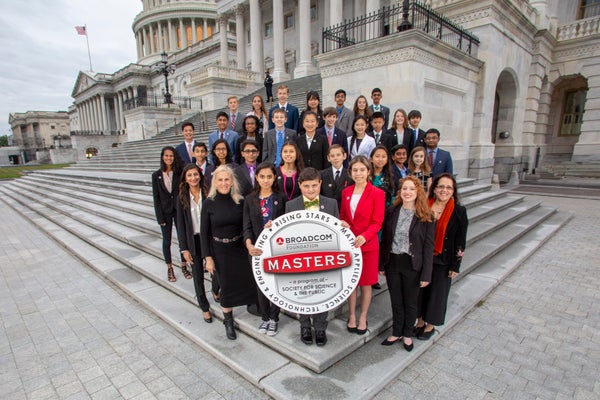
Science competitions often have to find a balance between celebrating individual accomplishments and acknowledging that science seldom happens alone. The Broadcom Foundation and the Society for Science and the Public – purveyors of a breadth of well-recognized science competitions – wanted to take the talents of highly capable kids and put their ability to work in a team in the spotlight. Like most of the organizations’ competitions, the Broadcom MASTERS competition starts with a science fair. But that just gets students in the door. The competition takes off when students from around the country are teamed up and have to solve a series of hands-on challenges.
Maya Ajmera, President and CEO of the Society for Science and the Public, gets excited by the focus on teambuilding skills, because too many kids are fed “the myth of the lone scientist.” Ajmera also believes that placing such challenges in the transitional, middle school period has a huge potential for impact. “It’s an impossible age. They are changing emotionally, they are changing physically, and they are starting to think about the future,” Ajmera said. “It’s a chance to get them excited before more fears and stereotypes set in.”
The initial pool of eligible students comes from the tens of thousands of participants in flagship science fairs around the country. Those who score in the top 10% (~8,000-10,000 kids) are eligible to apply. The most recent round had ~2,300 applicants. In the future, Ajmera hopes the applicant pool will include every eligible student. A panel of judges select the top 300 young scientists, and then that group is finally narrowed to 30 finalists.
On supporting science journalism
If you're enjoying this article, consider supporting our award-winning journalism by subscribing. By purchasing a subscription you are helping to ensure the future of impactful stories about the discoveries and ideas shaping our world today.
Selection at this stage is clearly an honor in itself, but it counts as step one for the finalists. They are then flown to Washington, D.C. and placed into teams of five for the hands-on part of the competition. Unlike the science fair – where most of the work takes place behind the scenes and students share a polished outcome – the hands-on challenges create a space where the work is the competition itself. The competition’s education team works to make each team of students as diverse as possible, including academic focus and experience.
As the acronym for Broadcom MASTERS would suggest – Math, Applied Science, Technology, & Engineering for Rising Stars – the students here are integrating primarily technical fields for the real world. In competition those approaches are translated into a range of challenges, from designing a new kind of shark tag to tracking a potential zombie pathogen. With such breadth, each challenge will need the insight and expertise of multiple team members. There will be kids who know Arduino and those who don’t. There will be kids who have worked with medical data and those who have not. And over the seven challenges, each person has a chance to work in and out of their depth. Ajmera said that when faced with such variety, students “were thankful for the chance to try something new.”
Judges observing the challenges aren’t just looking for outcomes. They are in the room for the duration, and they are looking for leadership, teamwork, problem solving, and coping mechanisms. Ajmera explained that experience has helped them adapt the hands-on part of the competition to have more and shorter challenges to observe. When it comes to awards, each honor goes to something a bit different. Students are assessed both on the initial research they did individually, but also on the specific factors each sponsor hopes to honor with its award. Ultimately the competition is able to honor students from a range of disciplines and with a variety of strengths.
Many Broadcom MASTERS winners go on to other competitions and academic success, but Ajmera said one of the most gratifying pieces of feedback is how many students experience a sense of coming together with true peers – the relief of, “finally, my people.” Whether these wins lead to future Broadcom MASTERS keynotes or national awards, such competitions can provide a powerful inflection point for middle schoolers who might be questioning their futures and need a reminder that they are not going into the world of STEM alone.