
This article was published in Scientific American’s former blog network and reflects the views of the author, not necessarily those of Scientific American
As 'Oumuamua (formerly known as C/2017 U1 (PANSTARRS)) recently barreled its way through our inner solar system we've been puzzling over its seemingly strange shape. This tumbling, probably interstellar visitor appears to have a highly elongated form, possibly stretching 180 meters with a width of only about 30 meters.
While it's tempting to muse on whether 'Oumuamua's odd proportions could be signaling that it's more than a chunk of rock ('look Ma! A spaceship!') the truth is that current astronomical data really only gives a range of dimensions, and this object could have a more ordinary 4:1 axial ratio.
And our own solar system has many funky-looking asteroids of its own. They're awfully hard to take images of (being small and dark), but Earth-based planetary radar can build some pretty convincing maps of these bodies. Doppler delay radio maps allow planetary scientists to construct both 'images' and eventually 3D models of the better examples.
On supporting science journalism
If you're enjoying this article, consider supporting our award-winning journalism by subscribing. By purchasing a subscription you are helping to ensure the future of impactful stories about the discoveries and ideas shaping our world today.
For fun, here are some to ponder. For my money many of these look just as wacky as 'Oumuamua.

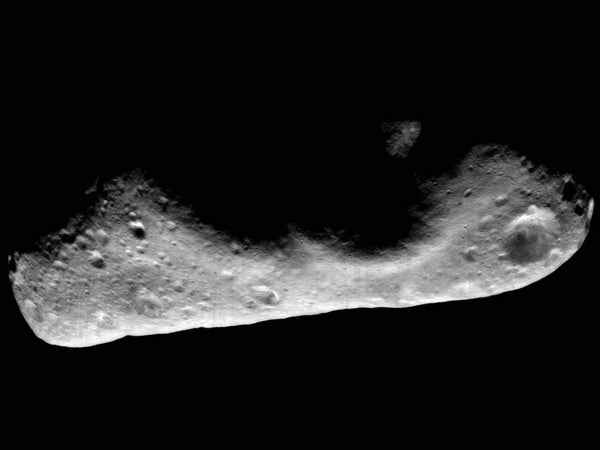
2 km long, and rotating in 11 days - it's a long potato. Credit: Arecibo, NASA and NSF

Contact binary asteroid 1999 JD6, a 2 km long double-lump. Credit: NASA, JPL-Caltech and GSSR
Asteroid 2017 BQ6 radar animation, 200 meters across, 6 hour rotation. Credit: NASA, JPL-Caltech and GSSR

Dogbone, 216 Kleopatra, about 150 km long, top-radar, middle & lower are models. Kleopatra even has 2 tiny moons of its own, not seen here. Credit: Arecibo and S. Ostro

Asteroid 2010 JL33, 1.8 km wide, with probable impact crater (the dent). Credit: NASA and JPL-Caltech
.gif)
2011 UW158, timelapse, 300 meters across, dubbed the 'Trillion Dollar Asteroid' due to potential platinum content. Credit: Arecibo

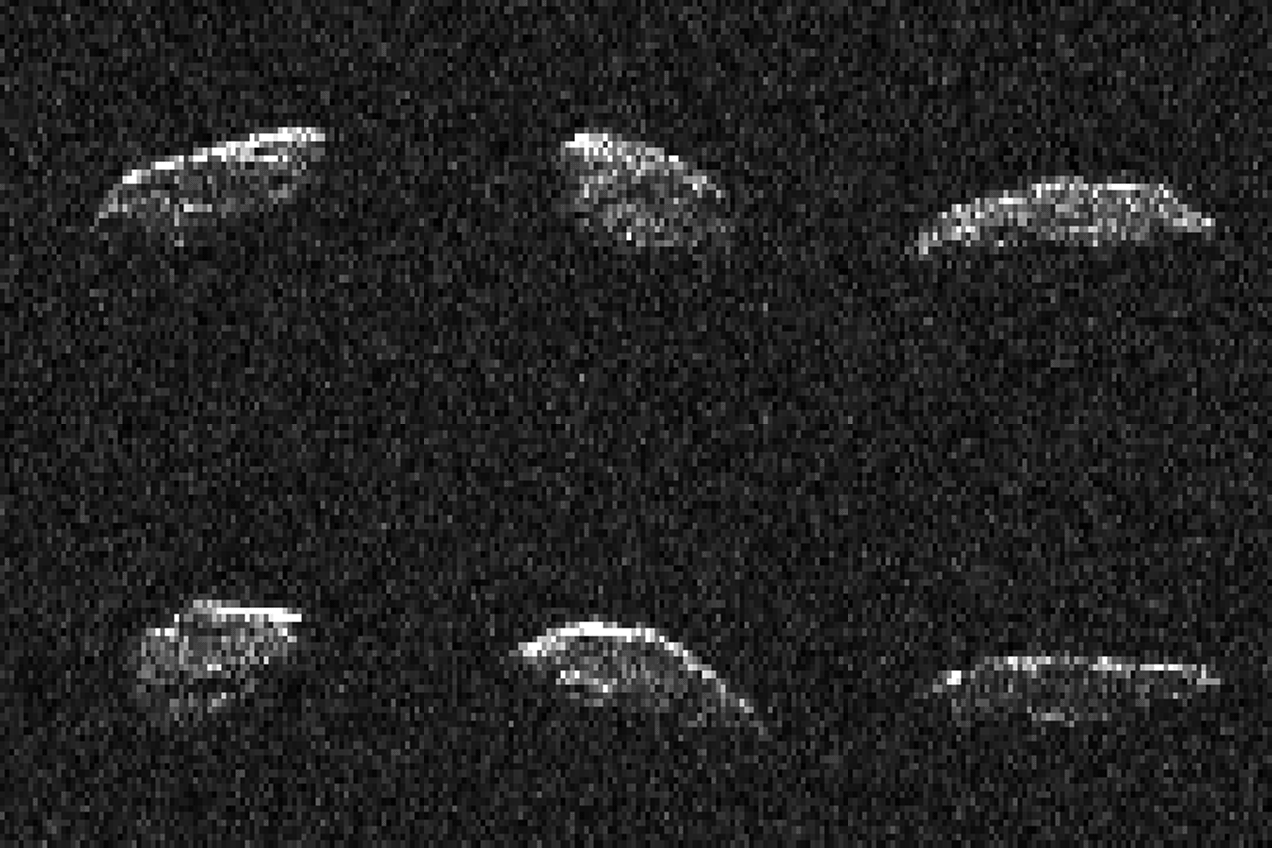
2015 HM10, 80 meters across and very elongated. Credit: NASA, JPL-Caltech, NRAO, AUI and NSF