
This article was published in Scientific American’s former blog network and reflects the views of the author, not necessarily those of Scientific American
Those of us who live in big cities or sprawling suburbs often forget how much our health and well-being are tied to the plants, animals and other organisms with whom we share this planet. Sometimes the relationship is mutually beneficial—as when the friendly bacteria in our gut crowd out the dangerous ones. Other times, too much closeness triggers new diseases and devastating epidemics—as occurs when a burgeoning human population consumes entire forests and jungles to survive.
The negative consequences take center stage in a powerful new PBS documentary, "Spillover—Zika, Ebola & Beyond," set to premier this Wednesday night. Running at just about an hour, this incredibly engaging film chronicles the growing number of viruses that make the jump, or spill over, from animals to people. As you might expect, the filmmakers spend most of their time on the two biggest recent spillover events: the 2014 Ebola outbreak in West Africa and the current Zika epidemic in the Americas.
Both cases stunned international health experts with their ferocity and rapid spread. Indeed, the whole globe may owe Amayo Adadevoh an enormous debt of gratitude. As chief doctor at the First Consultant hospital in Lagos, she quarantined a patient who had traveled to Nigeria in the summer of 2014 with what the clinician suspected was Ebola. Then she resisted intense pressure to release him. Her courage and professionalism—and those of several other doctors and nurses at the hospital—quite likely stopped the virus from spreading throughout the populous country and beyond to the rest of world. She paid for her constancy with her life, having herself succumbed to Ebola herself on August 19, 2014.
On supporting science journalism
If you're enjoying this article, consider supporting our award-winning journalism by subscribing. By purchasing a subscription you are helping to ensure the future of impactful stories about the discoveries and ideas shaping our world today.
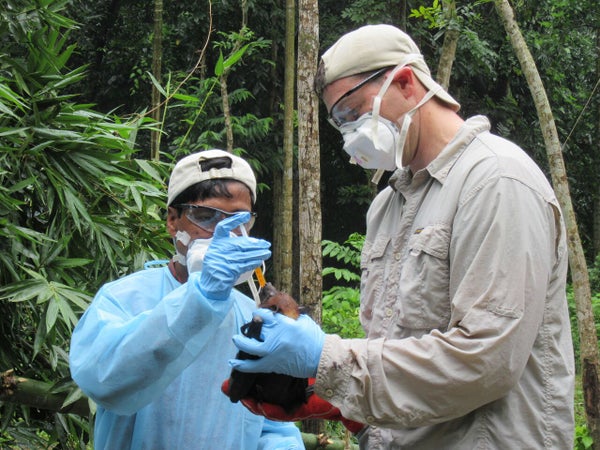
PBS has given us permission to share a clip from “Spillover.” I chose one about Nipah, yet another viral threat that emerged in the late 1990s in Southeast Asia, because it is not as well known as either Ebola or Zika. For as long as anyone can remember, people in Bangladesh have enjoyed raw sap drinks collected from palm trees during the winter. It turns out that fruit bats like to avail themselves of the collection pots for an illicit sip of sap at night. And as the clip demonstrates, Nipah likely jumped from bats to people over the course of time because both of them shared a fondness for sweet palm juice.
Ebola, Zika and Nipah are just three of the more famous spillover viruses that have been identified to date. By some estimates the number of times that viruses cross species barriers to cause diseases in people has quadrupled in the past half century.
No one knows how many more there might be. A global consortium called PREDICT is trying to fiind other viruses that might one day make the jump. Over the past five years, they have identified 800 viruses that bear closer examination. As Tom Frieden of the Centers for Disease Control and Protection puts it in the film, “[These viruses] all show us one essential fact. Threats are emerging. We will have another health threat. I can’t tell you what it will be or when it will be here, but we know with 100% certainty that it will occur.”
Finally, the last words of “Spillover” are some of the most philosophical that I have ever heard coming from a public health official. “Unless we accept that our fate is linked across people and across animals, across the world,” says name Emily Gurley of the International Center of Diarrheal Disease Research in Dhaka. “Then we’re never going to do what’s needed to get ahead of these kinds of public health threats.”
Read this next:
Interactive Graphic: Zika Goes Local in the U.S.
Malaria Increases with Deforestation in Brazil
From Liberia, Ebola Survivors Report They Are Still Afflicted with Disabling Symptoms