
This article was published in Scientific American’s former blog network and reflects the views of the author, not necessarily those of Scientific American
Fifty years ago this week, an estimated 600 million people sat transfixed, wreathed in the glow of cathode-ray tubes, as Neil Armstrong and Edwin “Buzz” Aldrin walked on the surface of the moon. It was one of the world’s first global media events.
But 71 years before that auspicious moment in science (and video) history, one Frenchman used screen magic to bring a dark, strange vision of the moon as close to viewers as the Apollo 11 crew would later bring the world to the actual thing.
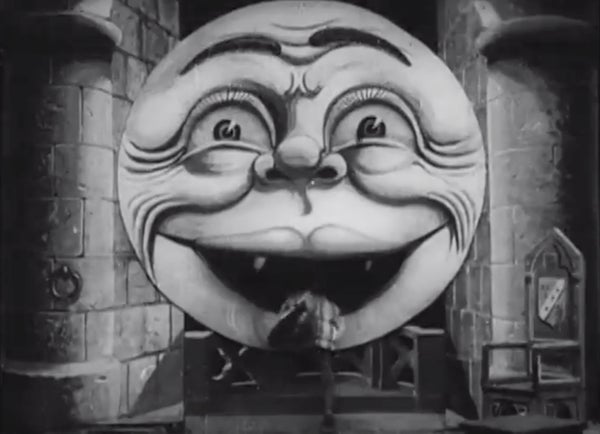
In 1898 Georges Méliès released La Lune à un Mètre, or The Moon at a Meter (also known as The Astronomer’s Dream). At the time, film, as a medium, was a newborn.
On supporting science journalism
If you're enjoying this article, consider supporting our award-winning journalism by subscribing. By purchasing a subscription you are helping to ensure the future of impactful stories about the discoveries and ideas shaping our world today.
The short movie teems with fairy-tale visions of angels and demons. A maleficent moon invades the screen, intent on chewing up and spitting out the wizened Astronomer. It’s a visual fever dream of mythology mixed with science, and it seems to show how desperately we yearned to touch the lunar surface—and how greatly the reality of that mysterious celestial body could terrify us.
It’s important to keep a little motion picture history in mind: Eadweard Muybridge’s Sallie Gardner at a Gallop (one of the world’s earliest moving pictures, and probably the equivalent of the world’s first animated GIF) was only published in 1878. And several inventors, including Thomas Edison, worked to make movie cameras of various designs between the1880s and 1890s. The Lumière brothers Auguste and Louis Lumière created one of the first movie theaters, where the public could view their films on a (relatively) big screen, in Paris in 1895.
Méliès’s part in all this was to imbue the fledgling medium of cinematography with sleight-of-camera magic tricks. He created some of the world’s first special effects and employed stop-motion, time-lapse and substitution techniques that are still being used, albeit in vastly more digitally intensive ways, in Hollywood today.
Méliès quickly built on the complexity of the effects shown in La Lune à un Mètre. Four years after it was released, he created his best-known film: Le Voyage dans la Lune, or The Voyage to the Moon. (If you haven’t seen the film, you’ve probably seen its most iconic image—the man in the moon with a rocket in his eye—somewhere out there in the cultural ether.)
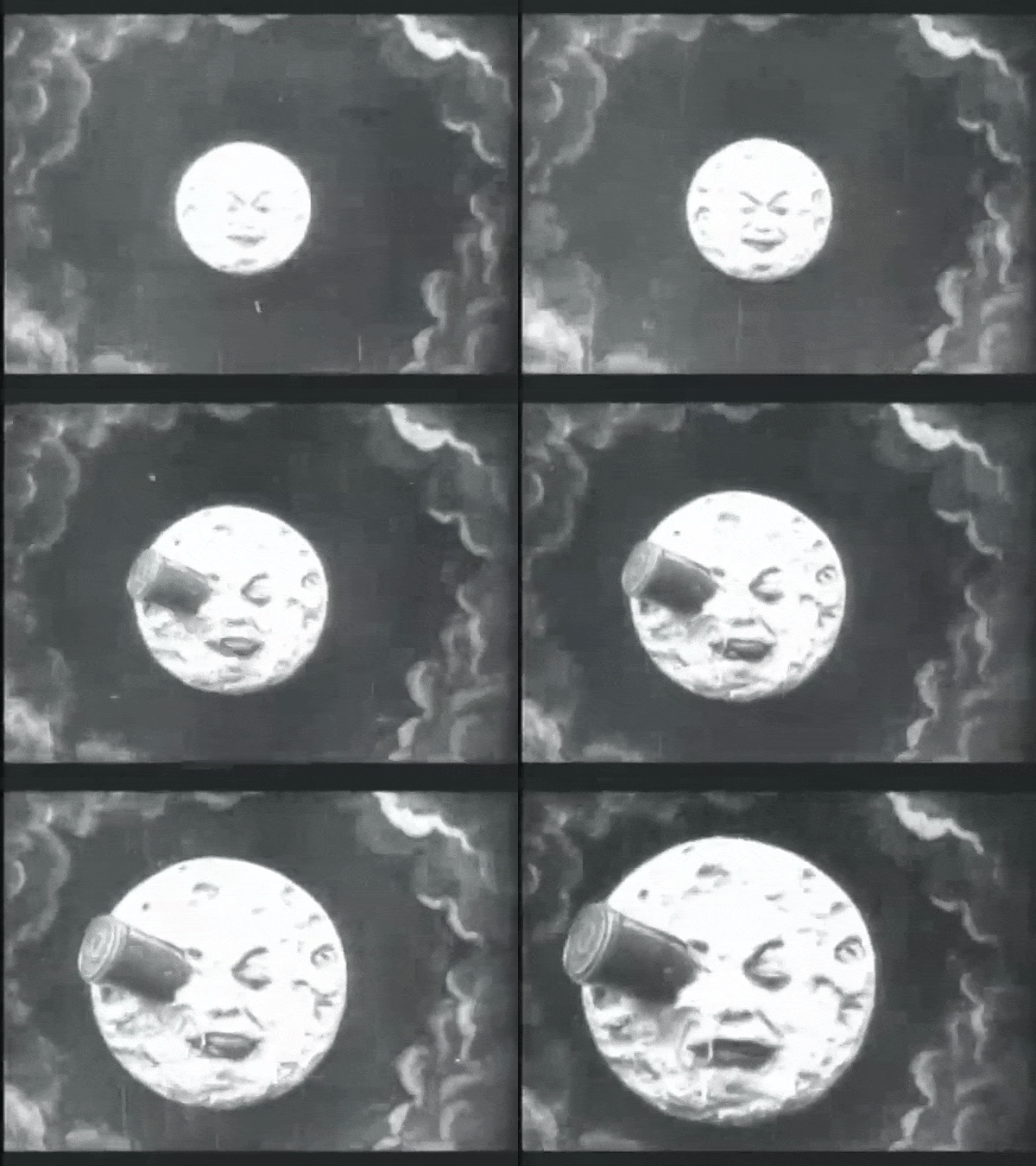
Credit: A screen capture sequence from Le Voyage dans la Lune, 1902
In just four years, Méliès managed to bring the moon to the viewer and the viewer to the moon. Little did he know, at the time of his death in 1938, that a mere three decades later, humanity would actually make it to the place his mind had only imagined.