Gene Regulation, Illustrated

What are epigenetic modifications, and how might they play out across generations?

Join Our Community of Science Lovers!

This article was published in Scientific American’s former blog network and reflects the views of the author, not necessarily those of Scientific American


Perhaps you read The New Yorker article by Siddhartha Mukherjee on epigenetics last week. Or maybe you skipped straight-ahead to the critiques, in which scientists and journalists holler that the story ignores key research areas, and dances around details to the point of being misleading. 

One thing that everyone seems to agree upon: gene regulation is complicated. As is writing about it for a non-specialist audience.

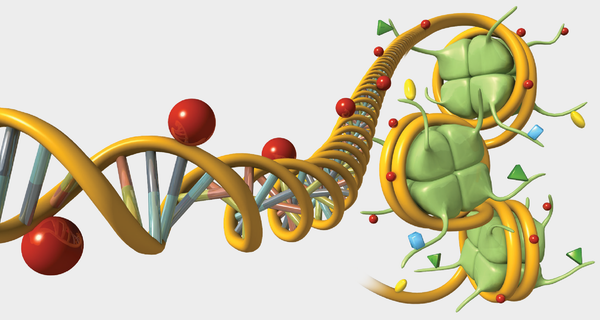
At Scientific American, we've tackled the challenge of illustrating different aspects of epigenetics a few times over the last five years. In the spirit of helping to establish baseline understanding of the topic, here are a few figures from the archive.


On supporting science journalism

If you're enjoying this article, consider supporting our award-winning journalism by subscribing. By purchasing a subscription you are helping to ensure the future of impactful stories about the discoveries and ideas shaping our world today.


I'd be remiss if I didn't point out that—like The New Yorker article—the graphics presented here do not attempt to present all epigenetic mechanisms and do not include the transcription factors that are so critical to gene activity. These illustrations were originally produced to accompany articles on specific lines of research by Eric Nestler (2011) and Michael Skinner (2014), respectively. But I think they are useful, in providing some context: Specifically, what are epigenetic modifications, and how might they play out across generations?

Illustration by AXS Biomedical Animation Studio. Originally produced for "Hidden Switches in the Mind," By Eric Nestler, in Scientific American, December 2011.

Illustration by Emily Cooper. Originally produced for "A New Kind of Inheritance," By Michael Skinner, in Scientific American, August, 2014.

Jen Christiansen is acting chief of design and senior graphics editor at Scientific American, where she art directs and produces illustrated explanatory diagrams and data visualizations. She is also author of the book Building Science Graphics: An Illustrated Guide to Communicating Science through Diagrams and Visualizations (CRC Press). In 1996 she began her publishing career in New York City at Scientific American. Subsequently she moved to Washington, D.C., to join the staff of National Geographic (first as an assistant art director–researcher hybrid and then as a designer), spent four years as a freelance science communicator and returned to Scientific American in 2007. Christiansen presents and writes on topics ranging from reconciling her love for art and science to her quest to learn more about the pulsar chart on the cover of Joy Division’s album Unknown Pleasures. She holds a graduate certificate in science communication from the University of California, Santa Cruz, and a B.A. in geology and studio art from Smith College. Follow Christiansen on Bluesky @jenchristiansen.com

More by Jen Christiansen

It’s Time to Stand Up for Science

If you enjoyed this article, I’d like to ask for your support. Scientific American has served as an advocate for science and industry for 180 years, and right now may be the most critical moment in that two-century history.

I’ve been a Scientific American subscriber since I was 12 years old, and it helped shape the way I look at the world. SciAm always educates and delights me, and inspires a sense of awe for our vast, beautiful universe. I hope it does that for you, too.

If you subscribe to Scientific American, you help ensure that our coverage is centered on meaningful research and discovery; that we have the resources to report on the decisions that threaten labs across the U.S.; and that we support both budding and working scientists at a time when the value of science itself too often goes unrecognized.

In return, you get essential news, captivating podcasts, brilliant infographics, can't-miss newsletters, must-watch videos, challenging games, and the science world's best writing and reporting. You can even gift someone a subscription.

There has never been a more important time for us to stand up and show why science matters. I hope you’ll support us in that mission.

Thank you,

David M. Ewalt, Editor in Chief, Scientific American

Subscribe