
This article was published in Scientific American’s former blog network and reflects the views of the author, not necessarily those of Scientific American
The mind of Martin Krzywinski is a rich and dizzying place, teeming with fascinating questions, ideas, and inspiration. Krzywinski is a scientist and data visualizer whose primary line of work involves genome analysis for cancer research. In his spare time, though, he explores his many different interests as a scientific and visual thinker through creative projects. For the past few years, one such project has occupied him on a recurring basis each March: reimagining the digits of pi in a novel, science-based, and visually compelling way.
Today, this delightful March 14th ("Pi Day") tradition brings us the digits of pi mapped onto the night sky, as a star catalogue. Like the infinitely long sequence of pi, space has no discernible end, but we earthbound observers can only see so far. So Krzywinski places a cap at 12 million digits and groups each successive series of 12 numerals to define a latitude, longitude and brightness, resulting in a field of a million stars, randomly arranged.
Just as humans throughout history have found figures and narratives among the stars, this new array of celestial bodies also yields a story. As a way to honor our evolutionary ancestors, Krzywinski connects the dots to create shapes of extinct animals from around the globe.
On supporting science journalism
If you're enjoying this article, consider supporting our award-winning journalism by subscribing. By purchasing a subscription you are helping to ensure the future of impactful stories about the discoveries and ideas shaping our world today.
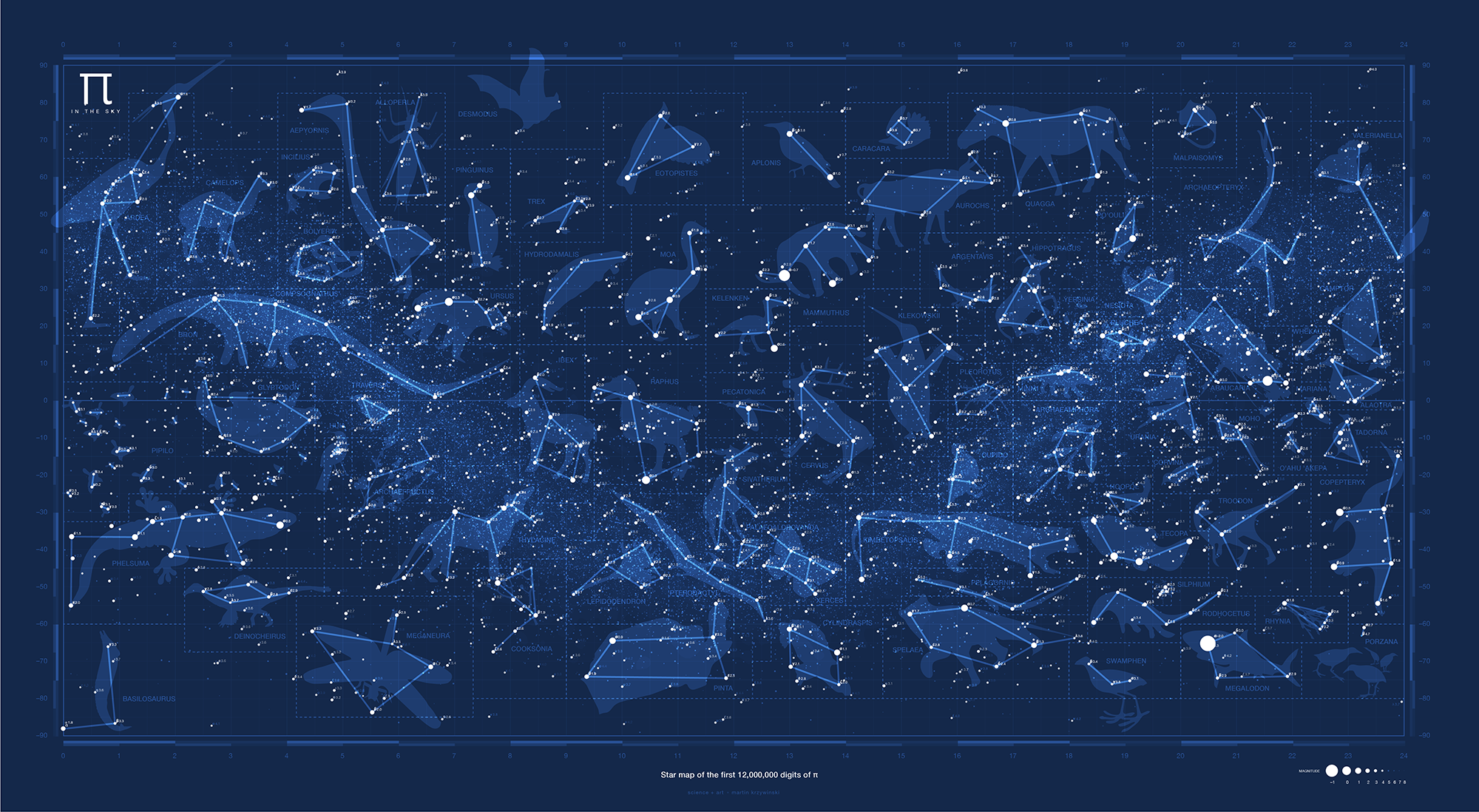
Carée projection of “Pi in the Sky” star chart
Credit: Martin Krzywinski
But he couldn’t possibly stop there, so Krzywinski takes the visualization a step further, experimenting with different projections to re-create the map in various spatial iterations.
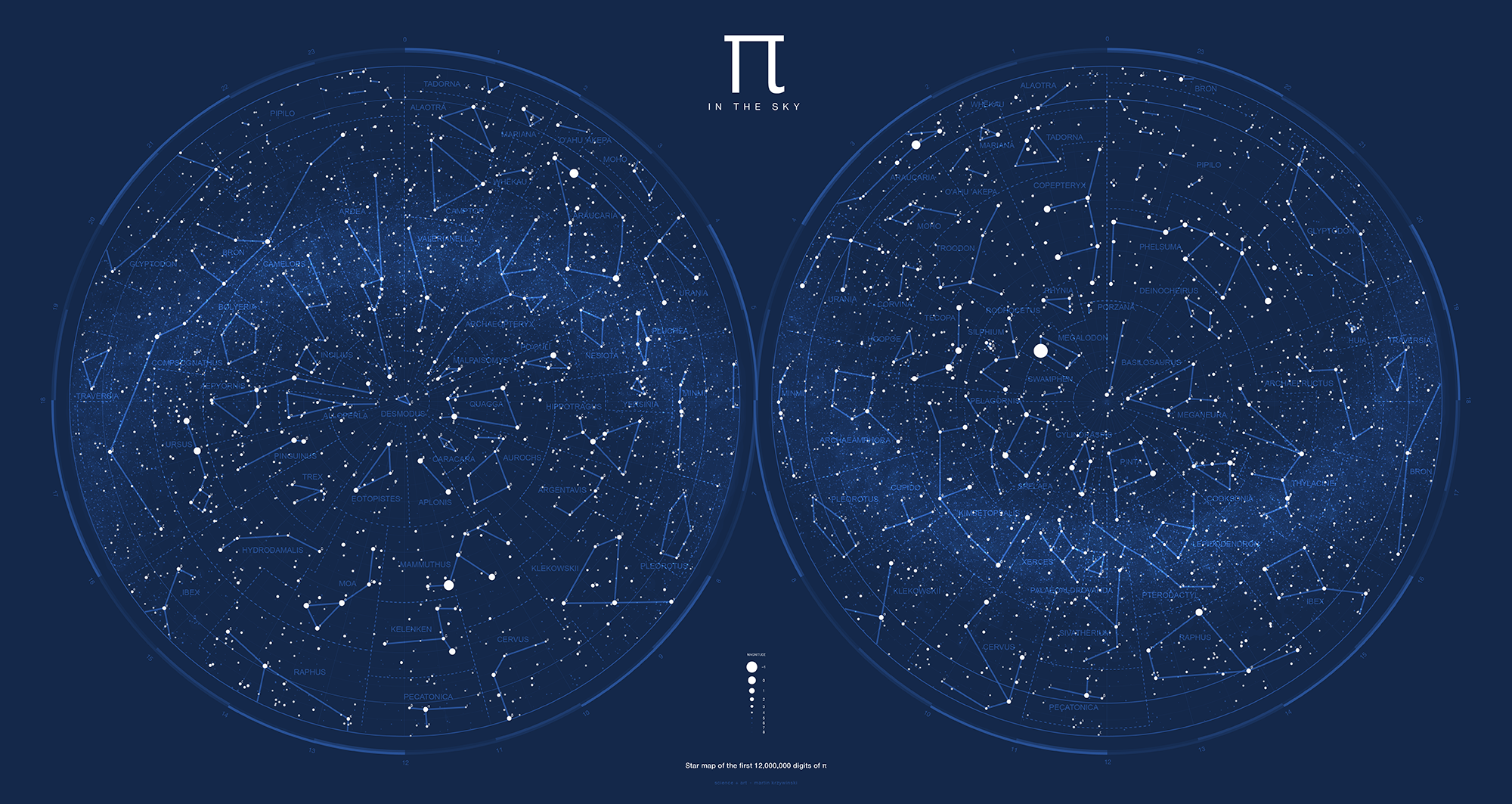
Azimuthal projections of “Pi in the Sky” star chart
Credit: Martin Krzywinski
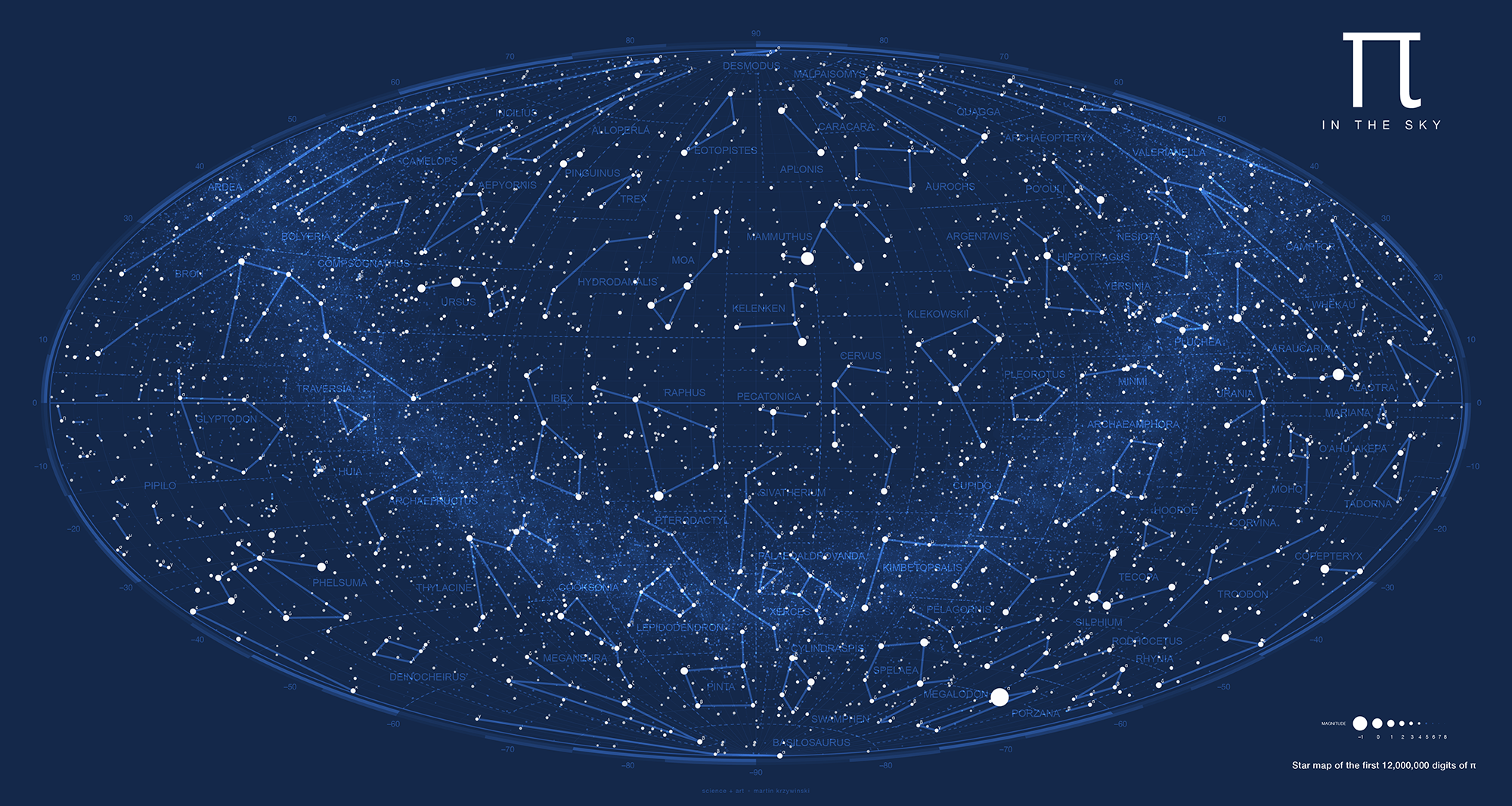
Hammer/Aitoff projection of “Pi in the Sky” star chart
Credit: Martin Krzywinski
To read more about the visualization, including descriptions of the animals depicted, and a poem written by the artist’s collaborator Paolo Marcazzan, visit Martin Krzywinski’s website. There, you can also explore his previous Pi Day visualizations and even purchase them as posters.
