
This article was published in Scientific American’s former blog network and reflects the views of the author, not necessarily those of Scientific American
In a Scientific Americanarticle published September 2017, scientists Sarah-Jane Leslie and Andrei Cimpian described how certain fields of study—such as philosophy, for example—seem to ascribe an outsized value to brilliance, a trait generally considered innate rather than learned, among its scholars. Whereas on its face this attitude seems relatively innocuous, Leslie and Cimpian observed that it tends to coincide with a marked lack of diversity in the academic disciplines in which it prevails. They wrote:
Philosophers seek a certain quality of mind—regardless of whose mind it is. This seemingly logical preference quickly becomes problematic, however, in light of certain shared societal notions that incorrectly associate superior intellect with some groups—for example, white males—more than others.
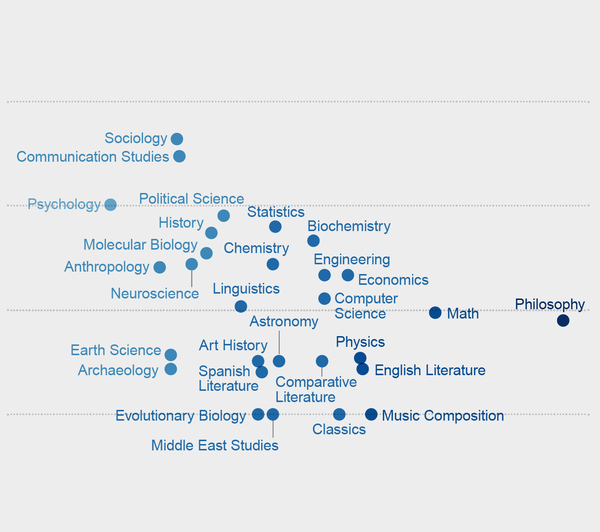
To test their hypothesis that the “brilliance” factor might have a negative impact on diversity, the two researchers conducted a survey of nearly 2,000 academic professionals, measuring the emphasis on natural genius within each of 30 fields. They combined their results with data from the National Science Foundation on the races and genders of those earning PhDs in the same disciplines.
On supporting science journalism
If you're enjoying this article, consider supporting our award-winning journalism by subscribing. By purchasing a subscription you are helping to ensure the future of impactful stories about the discoveries and ideas shaping our world today.
The data set that emerged included remarkable findings about both gender and racial imbalances in academia. But as the article focused heavily on gender, and as these demographics involve different population-wide baselines, I thought the subset of data on African-American PhDs deserved its own visualization.

Credit: Amanda Montañez
Source: “Expectations of Brilliance Underlie Gender Distributions Across Academic Disciplines,” by Sarah-Jane Leslie et al., in Science, Vol. 347; January 16, 2015 (Ph.D. data); U.S. Census Bureau (population data)
In the midst of Black History Month, these data serve as a not-so-subtle reminder the legacy of racism and inequality in the U.S. persists. And academia—like all institutions sorely lacking in racial and ethnic diversity—is the poorer for it. The work of Leslie and Cimpian represent at least the foundation of a step forward. However, as they soberly acknowledge, “The hard work of figuring out how best to put all this information to use—how to intervene—lies ahead of us.”
