How Hackers Tried to Add Dangerous Lye into a City’s Water Supply
A cybersecurity expert explains how safety systems stopped the attack

How Hackers Tried to Add Dangerous Lye into a City’s Water Supply
A cybersecurity expert explains how safety systems stopped the attack

How to Stop Doomscrolling News and Social Media
“Doomscroll Reminder Lady” Karen K. Ho explains how to step away from the screen


What the Capitol Riot Data Download Shows about Social Media Vulnerabilities
A massive amount of information downloaded from Parler includes potentially incriminating material. But innocuous posts on mainstream platforms can also create vulnerabilities

Twitter Bots Are a Major Source of Climate Disinformation
Such accounts can distort online conversations and potentially diminish support for climate policies

How to Make Artificial Intelligence More Democratic
A new type of learning model uses far less data than conventional AIs, allowing researchers with limited resources to contribute

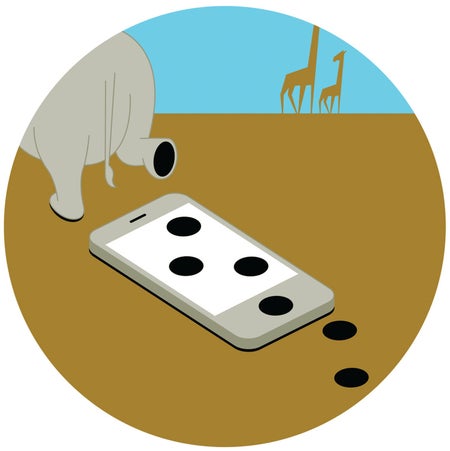
New App Tracks Black Rhinos through Their Footprints
Indigenous trackers inspire a safer way to help rhinoceroses

Towering Sequoias Are Even Bigger Than Thought, Laser Scans Suggest
Laser light reveals the structure of the planet’s tallest trees

Giant U.S. Computer Security Breach Exploited Very Common Software
A cybersecurity expert explains how hackers used SolarWinds to steal information from government and industry organizations

2020’s Top 10 Tech Innovations
Scientific American and the World Economic Forum sifted through more than 75 nominations for the most innovative and potentially game-changing technologies in 2020. The final top 10 span the fields of medicine, engineering, environmental sciences and chemistry. And to win the nod, the technologies must have the potential to spur progress in societies and economies by outperforming established ways of doing things. They also need to be novel (that is, not currently in wide use) yet likely to have a major impact within the next three to five years. Here’s your guide for the (hopefully) near future.
Read the full report here.

Artificial Intelligence Is Now Shockingly Good at Sounding Human
Synthetic voices have become ubiquitous. They feed us directions in the morning, shepherd us through phone calls by day and broadcast the news on smart speakers at night. And as the technology used to make them improves, these voices are becoming more and more human-sounding. This is the final frontier in synthetic speech: replicating not just what we say but how we say it.
Rupal Patel heads a research group at Northeastern University that studies speech prosody—the changes in pitch, loudness and duration that we use to convey intent and emotion through voice. “Sometimes people think of it as the icing on the cake,” she explains. “You have the message, and now it’s how you modulate that message, but I really think it’s the scaffolding that gives meaning to the message itself.”
Patel says she grew interested in prosody after finding it was the only element of vocal communication that seemed to be available to people with some kinds of severe speech disorders. These patients were able to make expressive sounds even if they could not speak clearly. In 2014 Patel founded a company to build custom synthetic voices for nonspeaking individuals. VocaliD has since expanded to commercial brands and influencers.
Synthetic speech has come a long way over the years. At age nine, Siri is the oldest virtual assistant—but in the world of speaking machines, she’s a baby. People have been trying to synthesize speech since at least the 18th century, when an Austro-Hungarian inventor built a crude replica of the human vocal tract that could articulate entire phrases (albeit in a monotone).
Current machine-learning techniques can model human speech, complete with awkward pauses and lip smacks. Still, training on thousands of samples per second is prohibitively expensive for most real-world systems. Researchers, including those at VocaliD, are continually implementing newer and more efficient methods.
But even as the remaining gaps between human and synthetic speech are steadily closing, truly lifelike prosody continues to elude even the most sophisticated systems. Maybe what’s still missing requires machines not only to mimic humans but also to feel like us.

Lack of Sleep Could Be a Problem for AIs
Some types of artificial intelligence could start to hallucinate if they don’t get enough rest, just as humans do

Will Artificial Intelligence Ever Live Up to Its Hype?
Replication problems plague the field of AI, and the goal of general intelligence remains as elusive as ever