
Scientific American

June 1, 2018

2 min read

Google Logo Add Us On GoogleAdd SciAm

Chasing the Biggest (and Smallest) Questions in the Universe

Since 2008, the Kavli Prize has been honoring scientists for their seminal research in astrophysics, nanoscience and neuroscience. As we prepare for the 2018 prize announcement, we look back at how the laureates have fundamentally transformed our understanding of the Universe.

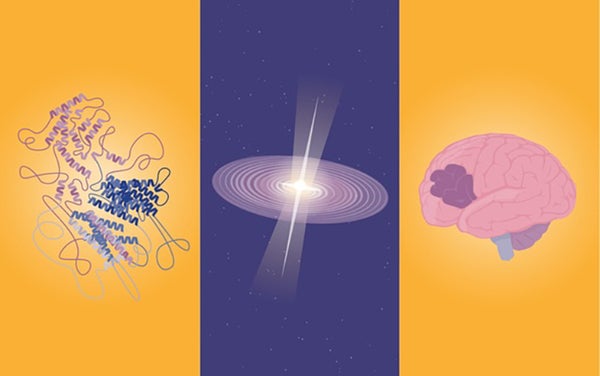
Illustration depicting a brain and universe against purple and orange backgrounds
Scientific American Custom Media LogoLogo for the Kavli Foundation

This article was produced for The Kavli Prize by Scientific American Custom Media, a division separate from the magazine's board of editors.

Join Our Community of Science Lovers!

The Kavli Prize has been honoring scientists for their seminal research in astrophysics, nanoscience and neuroscience since 2008. In the past decade, 40 scientists have been awarded prizes, 14 in astrophysics, 15 in neuroscience, and 11 in nanoscience.

On May 31st, the Kavli Prize will add new laureates to the list. In a ceremony that spans two continents, Ole M. Sejersted, president of the Norwegian Academy of Science and Letters, will announce the winners of the 2018 Kavli Prizes from Oslo. Brian Greene, a physicist and author of The Elegant Universe, will provide an introduction from New York. For those interested in watching the ceremony, tune in to the live stream on www.kavliprize.org at 8:30am Eastern time.

The prize is a partnership between The Norwegian Academy of Science and Letters, The Kavli Foundation in the United States, and The Norwegian Ministry of Education and Research. Laureates are selected by the Norwegian Academy of Science and Letters based on recommendations from Prize Committees comprised of leading experts from six of the world’s most renowned science societies and academies.

For readers who would like to better understand the impact former laureates and their discoveries have had on our understanding of existence at its SMALLEST, BIGGEST and most COMPLEX scales, we’ve assembled some extraordinary graphics below.

To learn more about brilliant work of Kavli Prize Laureates, visit The Kavli Prize. To explore more of the biggest questions in science, click here.

This article is part of a special report, “The Biggest Questions in Science,” sponsored by The Kavli Prize. It was produced independently by Scientific American and Nature editors, who have sole responsibility for all the editorial content.

Subscribe to Support Independent Journalism

Great science journalism requires human expertise, time, effort and creativity. And it costs money. That’s why I and the journalists here at Scientific American hope you’ll join our community.

When you subscribe, you are supporting staff and freelance journalists who are passionate about telling science stories that are true, important and compelling. Our editors and reporters are often experts in their fields, which means they understand the nuances of big discoveries and can untangle the breakthroughs from the hype. With a subscription, you are also supporting rigorous fact-checking to ensure the words we publish are precise and accurate. And you’re supporting original illustrations, graphics and photos that bring you closer to an advanced laboratory, an ice sheet in Antarctica or a space mission in orbit. You’re helping us craft other types of high-quality journalism as well: Our newsletters are carefully written, edited and curated by staffers you have or will come to know and love. Our Science Quickly podcast is based on original reporting, collaboration with editors and scientists and exacting production.

Subscriptions keep this engine running so we can continue to deliver thoughtful, rigorous and independent science journalism to you. In an era of viral misinformation, this work is crucial. If you value what we do, I hope you’ll consider joining us as a subscriber

Thank you,

Jeanna Bryner, Editor in Chief, Scientific American

Subscribe

Subscribe to Scientific American to learn and share the most exciting discoveries, innovations and ideas shaping our world today.

Subscription PlansGive a Gift Subscription
  • Explore SciAm
  • Latest Issue
  • News
  • Opinion
  • Newsletters
  • Podcasts
  • Games
  • Travel
  • Company
  • About
  • Press Room
  • FAQs
  • Contact Us
  • Standards & Ethics
  • International Editions
  • Advertise
  • More
  • Accessibility
  • Terms of Use
  • Privacy Policy
  • US State Privacy Rights
  • Use of cookies/Do not sell my data
  • Return & Refund Policy

Scientific American is affiliated with LabX Media Group, which owns or has commercial relations with other B2B and B2C brands (many of them can be found at www.labxmediagroup.com). Scientific American maintains a strict policy of editorial independence in reporting developments in science to our readers.

© 2026 SCIENTIFIC AMERICAN INC.
ALL RIGHTS RESERVED.

