


Community-based programs supported by the Davos Alzheimer’s Collaborative, each adapted to the local country and culture, are testing new ways of managing dementia care. Learn more in our special report, The New Age of Alzheimer’s.
On some days, worries can cloud the typically upbeat mood at the Synval Santos Day Center, a modest care facility for the elderly with Alzheimer’s disease, in Volta Redonda, the old steel town 60 miles west of Rio de Janeiro. But Danielle Freire knows just what to do.
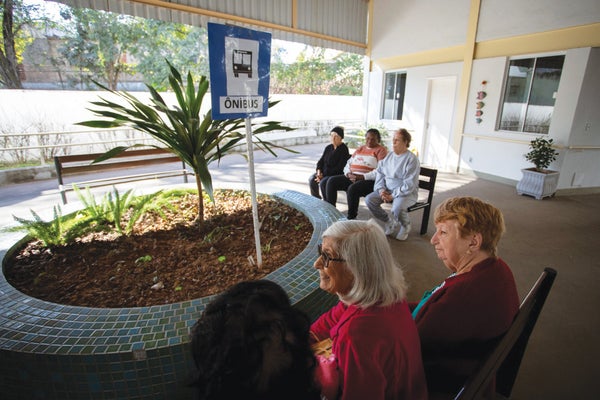
Freire, a psychologist and the center’s coordinator, takes the anguished “patron” (no “patients” here, please!) by the arm and coaxes her (8 of 10 clients are female) to the faux “bus stop” in an arbored patio. There, they sit, chat and reminisce about childhood and the old days, until the panic subsides, as they wait for a bus that never comes.
Years of trial and error have taught Freire’s team of 22 caretakers at Synval Santos how to manage sundown syndrome—a pique of late afternoon distress or the sudden urge to flee that is common to Alzheimer’s patients. Nimble intervention, one-on-one attention, patience, and a gentle sleight of hand is the routine for the facility’s 75 elderly patrons, who have moderate stage Alzheimer’s. (At the facility, which is part of the Davos Alzheimer’s Collaborative’s Healthcare System Preparedness Program, patients come for the day and go home in the evenings.)
“If you show concern, stay calm, and never argue,” Freire told me on a recent visit to the Center, “the stress passes, and even those anxious to flee soon forget their troubles.”
Brazil is a country the size of a continent, with staggering inequalities, where the wealthy enjoy world-class private health services and the poor languish at understaffed public hospitals. Synval Santos Day Center, however, is a rare exception in Latin America: a publicly financed and managed social service that works.
The institution’s decade-long record of caring for those with Alzheimer’s is already a beacon for Brazil and elsewhere. Its success makes it a magnet for people from surrounding towns and even out of state.
Volta Redonda, however, is atypical. It is one of just 106 towns among Brazil’s 5,568 municipalities to provide no-fee services—workshops, exercise and cognitive calisthenics—for the elderly. The city boasts Brazil’s first and perhaps its only public center dedicated to Alzheimer’s. It’s much the same across Latin America, where the number of people with dementia is expected to soar from 7.8 million in 2013 to more than 27 million by 2050.
Many poor nations have islands of excellence in medicine and clinical care, but only for the well-off. Just 25 percent of Brazilians have private health insurance and access to top-tier treatment. In theory, Brazil’s Universal Health System (SUS, in Portuguese) tends to the other three-quarters through a nationwide network of free neighborhood clinics and hospitals. The system proved vital during the pandemic, treating COVID emergencies and administrating vaccines to millions, even as the central government downplayed the contagion and dismissed the advice of public-health experts.
But SUS is plagued by chronic underfunding, red tape and patchy services that vary according to the agendas of local officials and national political class.

Synval Santos's psychologist and coordinator Danielle Freire helps to celebrate Carnivale at the day-care center.
Image courtesy of Synval Santos Day Center
Volta Redonda was different. A group of forward-looking city officials, social workers and residents in the city were inspired by a local dentist, whose wife struggled for years with Alzheimer’s. They saw dementia as a social emergency in the making. In 2015, they launched the Center for the Elderly with Alzheimer’s and Family (the formal name for Synval Santos), financed entirely by the city.
In Volta Redonda, where budgets are stretched, creativity helps. Besides the make-believe bus stop, a common tactic in Alzheimer’s therapy, the center has developed a strategy of building “workstations” tailored to individual users.
For instance, Synval’s staff talk about how rekindling memories helped Zequinha, a former shoemaker (who died in 2022), through some difficult days. “Of course you can go home, but would you mind fixing this shoe first?” a psychologist would ask, coaxing him over to a workbench covered with tools. For Luzia, another patron known for her green thumb, it’s the table with potted plants and gardening spades that helps keep her centered. And Luzia and her friends are soothed by a baby doll which each one is allocated to carry, cradle and rock and call by name, as if their own.
Brazil needs more than artfulness. The country has no national plan or protocols for dementia, and a 2020 bill to launch an Alzheimer’s policy is still stuck in Congress. An estimated 80 percent of cases of dementia go undiagnosed, and even when patients test positive, confirmation routinely comes late. “There’s a barrier in Brazil to implementing public policy until a problem becomes a crisis,” says Felipe Vecchi, a physician and medical director for Brasil Senior Living, a private elderly facility.
One obstacle to prioritizing the elderly in low- and middle-income societies is the host of other endemic problems, including tuberculosis, yellow fever, HIV/AIDS and dengue—which compete for attention and resources. As a chronic disease, with gradual onset, Alzheimer’s is easy for politicians to ignore or shortchange come budget time. With the share of Brazilians aged 65 and over set to grow 488 percent by 2065, they do so at their peril.
Compounding the crisis is a lack of research on dementia (Latin America accounted for just 6 percent of global clinical trials in 2020) and shortage of resources for screening (there’s a wait period of up to six months for PET scans), which leave patients behind and policymakers with too little data. Families and neighbors become first responders of the dementia epidemic, with knock-on effects across the economy.
“The secondary cost of Alzheimer’s is enormous,” says Otelo Corrêa dos Santos Filho, a psychiatrist in Brazil who works with the Davos Alzheimer’s Collaborative. “The brunt of the disease burden falls on sons and daughters—especially the daughters. Children often give up their jobs to care for sick relatives. In some homes, the elderly care for the elderly.”
As age-related diseases such as Alzheimer’s spread, so will the social fallout. “By failing to make aging and cognitive decline a national priority, we put the welfare of the elderly at risk but also their families and household savings,” says Renato Veras, director of the Open University for Senior Citizens, an annex of the State University of Rio de Janeiro.
Unless planners and policymakers can overcome inertia and acute political shorterm-ism, Brazil’s intrepid family caretakers will need caretakers themselves.
This article is part of The New Age of Alzheimer’s, a special report on the advances fueling hope for ending this devastating disease.