
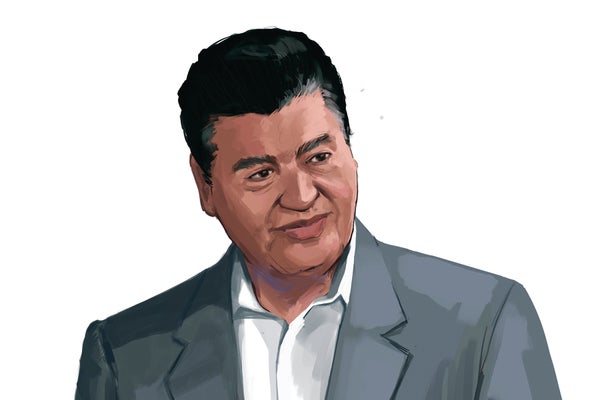

When Elias Zerhouni took over as director of the National Institutes of Health in 2002, the only way doctors could know for certain whether a dementia patient had Alzheimer’s disease was to perform an autopsy.
A few years later, new technologies that could deliver a definitive diagnosis revealed an embarrassing truth: many of the ongoing clinical trials for Alzheimer’s treatments included a significant number of subjects who had been misdiagnosed. “We didn’t know who had the disease and who didn’t have it,” Zerhouni recalls.
It fell to Zerhouni and his colleagues at NIH to fashion a research program that could exploit the power of the new diagnostic technologies—which now include imaging, biomarker tests and digital cognitive tests, among others—to learn about what has turned about to be a hugely complex disease.
Since leaving NIH in 2008, Zerhouni has carried on that work in various roles—as head of research at Sanofi from 2011 to 2018 and, currently, as a founding board member of the Davos Alzheimer’s Collaborative (DAC). He is helping DAC assemble a cohort of Alzheimer’s patients that reflect the world’s genetic, environmental, social and economic diversity, which he believes is crucial to understanding and treating the disease. DAC’s Global Cohorts program has so far engaged 26 different countries, with the goal of drawing up to one million people from rich and poor nations alike in North America, South America, Africa, Europe, Asia and the Middle East.
Expanding research to include a diverse cohort is essential to treating Alzheimer’s disease, he believes. Still, new drugs that can slow the progress of Alzheimer’s, despite their limitations, are a turning point, and bode well for the future. “Progress in medicine tends to occur like a swarm around a fortress,” he says. “When there is a crack in one place, you have a lot of people going through that crack, not knowing if it’s a dead end or if it’s the beginning of redemption.”
Scientific American Custom Media talked with Zerhouni about the last two decades of Alzheimer’s research and his vision for what needs to happen going forward.
SCIENTIFIC AMERICAN CUSTOM MEDIA:
You’ve had a bird’s-eye view of many different human diseases. How is Alzheimer’s unique?
ZERHOUNI: A perfect life is: you are born, you’re healthy, you remain healthy, and you die.
However, that’s not what you see. What you see is that you have a healthy beginning after childhood illnesses, you’re pretty healthy until about 50, when there are some cancers. For many people who live longer and remain physically healthy, cognitive impairment because of neuronal degeneration leads to a more profound loss of quality of life.
Alzheimer’s is a slow pandemic. It’s growing along with the prevalence of obesity and diabetes and with aging populations almost worldwide. It has a huge economic impact—a permanent impact, because you have a population of patients that could have been healthy and self-sufficient but no longer are.
We found that if you delayed the onset of Alzheimer's disease by five years, it would reduce its burden on society by 50 percent. We also found that the mortality of caregivers—the wife who takes care of the husband and vice versa—is extremely high.
If you do not have a functioning neural system, you can’t have a functioning body. That’s not just Alzheimer’s, it’s neuroscience generally. The number-one cause of disability between the ages of 25 and 44 is depression. The impact of a cognitive deficit is often much greater than the impact of a physical deficit.
Why is the medical field so excited about the recent treatments for Alzheimer’s?
It’s the first crack in the mystery of the disease. In medicine, progress is never a delta function, where you have no treatment and then all of a sudden you have a treatment.
HIV is a good example. We were desperate in the mid-1980s. People were dying right and left. And then we had a cancer drug called AZT that had some effects. It showed that it was doable. It changed the paradigm.
At the time, no one thought that a drug, a small molecule, could stop a virus. After that, a lot of researchers said, “Wait a minute, maybe we can develop a better AZT. Maybe I can get one against this part of the virus or that part of the virus.” Today, you have triple therapies that control the disease for years.

Oboh Moses
After years of disappointment, the news about Alzheimer’s research has only recently gotten brighter. How did we get here?
When I became NIH director in 2002, we could see the evolution of the disease when it became clinically relevant and clinically obvious. We had no idea what happened before you were symptomatic. When I reviewed the [NIH research] plans for Alzheimer’s, I said that we would be unlikely to reverse a disease process that has destroyed so much of the brain’s tissues, [including the] neurons important for memory and behavior. It’s almost like waiting for the plane to crash and then trying to put it back together.
By 2018, after spending $20 billion on clinical trials, all the phase 3 trials of the major companies failed. People were desperate, wondering what went wrong and what happened. By then I had become head of R&D for Sanofi, a major pharmaceutical company, which had a program for Alzheimer’s disease. I found the same issues. We had no ability to truly diagnose the disease properly. We had no biomarkers. We couldn’t do a biopsy of the brain to confirm a diagnosis, like you can do in cancer. We didn’t know who had the disease and who didn’t have it.
On top of that, almost all the research was being done on Caucasians and on patients in rich countries. The knowledge base was fragmented, incomplete and incoherent.
Is that when you realized that Alzheimer’s researchers needed to study a larger and more diverse population?
At NIH, we funded quite a few investigators looking at Alzheimer’s disease. As we did this, we realized that every investigator had a few hundred patients here, a couple thousand there, 500 over here, and so forth, all around the world. But nobody had the critical mass of patients you need to understand variations between individuals and what drove those variations.
As biomarker tests improved, we realized that in many of the trials, perhaps 30 percent to 40 percent of patients did not have Alzheimer’s disease. They had dementia from other causes. We had an incomplete hypothesis in a group of patients who don’t even represent the disease we’re studying.
Was there any value in that work?
When we looked at the data on thousands of patients from the various phase 3 trials, all of the patients who had had a response to treatments were early-stage Alzheimer's patients who had only just started to develop symptoms. Patients who had established memory impairments did not improve. That told me that my analogy—that you can’t put a crashed plane together again—was true. It also told me that you could prevent a plane crash if you knew that the engines were having trouble early enough to make a correction.
About this time, George Vradenburg asked me to speak to a meeting in Lausanne with a specific question in mind: “Don’t talk to us about what didn’t work. Don’t talk to us about what failed. Just tell us what ideas you think we should really consider to advance the field.”
In the talk, I said that to understand a disease, you cannot just study people with the same genetic background as one another. When you look at the genetics of patients with Alzheimer’s, there was a group of families in Colombia that had a very high frequency of the disease, which led to the discovery of a mutation in the gene that produces the presenilin protein. It was later confirmed in other groups, which shows the power of comparative genomics. More recently, a 73-year-old patient from the affected families in Colombia did not develop Alzheimer’s disease, leading us to begin searching for the protective mutation that made her resistant, despite her predisposition for Alzheimer’s.
You couldn’t interpret it because all comparisons had been done within the same group.
Also, I didn’t think we knew what the natural evolution of the disease was in any one patient. Some patients develop symptoms and decline very quickly, and others decline much more slowly. Why? That’s the central question in Alzheimer’s research. Are there unknown protective mutations that could be exploited for novel therapeutics? I had the sense that we didn’t quite understand what was going on and that we needed to find out by studying a more diverse global population.
The number-one rule in drug development is: understand the biology. The number-two rule is to understand the epidemiology of the disease—when do you intervene? The third rule is, do you have the right population in your trial?
What needs to happen going forward to get Alzheimer’s to the point where it’s a manageable disease?
We need genomics at a global scale. That allows you to compare and separate environmental effects versus disease effects and discover protective mutations. That is why we want to expand DAC’s Global Cohort program to include 100,000 people.
If you have a diversity of patients from around the world, you can extract the disease-related mutations or changes by comparing populations. You can also exclude environmental factors. For instance, people in Africa have a much lower incidence of colon cancer than people in America. Research has found that the heavily meat-driven diet of the developed world is driving the incidence of cancer. By comparing environmental effects around the world, you can come up with conclusions and discover what is driving the disease in the first place, as we did for hypertension and cholesterol.
Solving Alzheimer’s is like scaling a 100-foot cliff, and we have ten 10-foot ladders. Wouldn’t it be better to put them together and have a 100-foot ladder so we can get over the cliff?
If you found a patient with this disease who had the same genetic background as someone else, and one of them was a fast progressor and one of them was a slow progressor, you’d ask: “What is protecting the slow progressor from declining faster?” This is what we look for in genomics. By looking at the genome of all these patients and comparing them, we find mutations that are protective. That’s important for discovery and for treating this disease.
How many people do you have now in the Global Cohorts program?
22,000—it’s the largest cohort in the world right now.
What is the challenge of getting to 100,000?
It’s multifactorial. First of all, Alzheimer’s is a long, chronic disease. We want to focus on existing cohorts that have followed patients for a long time already. You don’t just go in and say, “Who wants to do this research?” and then wait for 20 years before you have the cohort. We’re trying to build on what is already existing that has enough of a longitudinal timeline that will essentially make the 100,000 we select very powerful immediately.
Second, quality has to be standardized. We have to have a central lab for blood tests. That requires a lot of collaboration, cooperation and negotiation. For example, China does not allow the export of DNA from Chinese citizens. So, we have to have a lab in China, but then we have to have an agreement that the data will be shared.
Every center we’ve approached has been willing to share data in a federated way. Gates Ventures is funding our digital backbone and data analysis and is willing to provide the framework. Ethics is also important. You absolutely have the obligation to get informed consent, especially if you do new types of studies. That takes time.
There is also a clinical trial network, in parallel to the cohort, which is pre-positioning interested scientists worldwide to be able to conduct proof of concept trials quickly. A study of 1,000 patients is ongoing to test the various biomarkers that are being proposed, so that we can select the best ones, including novel digital biomarkers using smartphones, for the cohort. It’s a heavy lift that requires a lot of time and resources.
Aside from assembling a large cohort, what else needs to be done?
When do you know if someone has the disease and will develop a more severe form? Discovering biomarkers is critical. If you think that your therapy is only effective early in the disease, then you need to have a reliable way of detecting who that is who deserves the treatment. To do that, diversity is important because blood is not the same blood everywhere in the world.
What about digital biomarkers?
Typically, when you want to diagnose mild cognitive impairment, you use a series of tests. The doctor gives you seven words to memorize, makes you do something else, and then 15 minutes later, asks you again. Other cognitive tests focus on ideation, rational ability, and so on. They are all dependent on cultural context—on where the test is given and what doctor or nurse administers the test. It’s an extremely noisy signal. This makes it difficult to categorize patients in a meaningful way.
A digital biomarker is, you take your cell phone and I ask you to type in a few words. I can measure the speed at which you type and I can measure it over time. It’s an objective measure. We know from research that a person’s voice print changes with the onset of Alzheimer’s disease. So does the ability to verbalize. We can measure them and, with artificial intelligence, we can classify it.
A researcher in England used the U.K. Biobank, which has accumulated 500,000 patients over the past 25 years. Then they asked the question, who among those patients developed Alzheimer’s disease? We know that a mutation called APOE4 is a good predictor of whether or not you will develop Alzheimer’s disease. This researcher recorded the voices for a whole series of patients and, lo and behold, the voice print analysis could actually detect the patients that had APOE4 mutations.
There are many factors that contribute to Alzheimer’s disease that need to be discovered. The cohort program of DAC is creating a critical mass of diverse patients that represents the global nature of the disease and that can be used to separate environmental effects from biological ones and discover clues to protective mutations.
As you look at large populations, you immediately realize that what we call Alzheimer’s disease is not one disease, it’s multiple diseases that each have very different outcomes. To have a one-size-fits-all approach to this complex disease does not serve us well. Many in the field are coming to the conclusion that there may be at least two kinds of Alzheimer’s: inflammatory and noninflammatory types.
We’ve talked a lot about genetics as a risk factor. What would you like to know about environmental or geographic factors?
What I would like to know is whether there is differential incidence in different countries. Is the U.S. getting a higher incidence of Alzheimer’s than people in Uganda? And if so, why?
Is there any feeling that environmental factors play a big role in Alzheimer’s?
[Laughs.] It’s hard to think it will be environmental. Alzheimer’s was discovered a century ago. Unlike heart disease, which was low in the early part of the century and then became high and deadly in the ‘50s, ‘60s and ‘70s, we haven’t seen that in Alzheimer’s. We are seeing more Alzheimer’s because life expectancy has gone up. But I’m not seeing a complete change—a complete delta. When you see a delta in epidemiology, that’s when you suspect an environmental cause.
But there has been a rise in obesity and heart disease, which are linked to Alzheimer’s.
Yes, there are certainly aggravating factors, no question about it. Lack of exercise, lack of mental stimulation, obesity, sedentariness, loneliness, mental health—all of those are aggravating factors. I don’t think that they’re causal, but that is my opinion. The one thing you have to learn in this business is humility because the mystery is bigger than all of us.
What would you tell someone who was diagnosed with early-stage Alzheimer’s right now?
The cofactors need to be acted upon—if you have heart disease, diabetes, obesity, you absolutely need to put yourself in a good health status. We also know that some medications can delay [the onset of symptoms], but they are only effective for a year or two.
It all depends on the age of onset. If the age of onset is 75 or 80—like President Reagan, for example—you can manage it for three to four years. If it happens earlier, that is where the need for new therapy is. You could propose [taking] antibodies that have just been approved, but we know that it’s about 18 months to stabilize, and we don’t know what the long-term slowdown of the disease would be.
Is the U.S. healthcare system adequate to tackle Alzheimer’s?
It’s an absolutely critical question. The U.S. healthcare system is not geared towards prevention. There is also a lack of preparation of the healthcare system to deal with a slowly growing chronic disease. And that is a focus of the healthcare preparedness component of DAC. Look at obesity—we’re not dealing with it. Do you think we’re dealing with diabetes? We’re not dealing with it. The U.S. health system is designed for acute, interventional care, not the long-term, low but steady care that is required to prevent disease.
Prevention is not paid for in our system. Why? Because in large part insurance companies change clients every year or two. If you are an insurance company and you say, “I’ll pay for your prevention,” next year you’ll be someone else’s client. I don’t know that I have a solution, but clearly Alzheimer’s is going to present a conundrum because it’s a disease that requires early intervention to prevent damage later on, a little bit like diabetes and heart disease.
Is there anything that the U.S. government should be doing?
Yes. There is not currently a mechanism to have a “Manhattan Project” approach to a disease like this, but we should consider it. We’ve done it with HIV. But Alzheimer’s doesn’t seem to get the energy at this point. The National Institute of Aging has received more funding, and that’s good. DAC has applied for a grant to the NIH to be able to support the cohort, and I think there is receptivity. We want to provide a phased, milestone-based approach to the program.
What would a Manhattan Project in the U.S. for Alzheimer’s look like? Does any other country have one?
The U.K. comes closest because of the 500,000 patients they’re following in [the U.K.] Biobank. The problem is lack of diversity. We have a program called All of Us, in which a million Americans will be completely sequenced and analyzed. The problem with that is that you may not have enough patients in any one group to reach solid conclusions—a million people with 1,000 diseases, few of which have a critical mass. You’ll have enough critical mass to study obesity, but I don’t think you’ll have critical mass for early Alzheimer’s disease.
It would have some value because then you can compare the genomes of people with Alzheimer’s with people who have no Alzheimer’s. But it’s not comprehensive enough and integrated enough around this disease process.
And remember, the economic impact of Alzheimer’s is huge, in addition to the huge cost to health.
The U.S. alone wouldn’t really be able to have a Manhattan Project, because of the lack of diversity. You really do need the breadth of a global effort.
That is my position, yes.
Unlike cardiovascular disease or cancer or many other diseases, there’s something taboo about the brain. You cannot biopsy the brain. You cannot really invasively study the normal brain or the Alzheimer’s brain. We biopsy cancers all the time, we put catheters all around the vessels, we’ve developed angioplasty and stents and so on and so forth. But the culture of neuroscience is much more conservative. Even though we know that the micro-biopsy of the brain is doable without being life-threatening or mind-altering, we have an aversion to it. For example, simple spinal taps are well accepted in Europe but not in the U.S., which greatly hampers research in Alzheimer’s disease.
If you look at the history of medicine, the heart used to be taboo as well. In the ‘30s, doctors felt that if you tickle the heart with the catheter, it would stop. It was dogma that you couldn’t touch the human heart, until a cardiologist in Austria, Werner Forssmann, did it and got the Nobel Prize for it. We are at the same stage in neuroscience as we were in the 1930s with cardiology.
This article is part of The New Age of Alzheimer’s, a special report on the advances fueling hope for ending this devastating disease.