

Community-based programs supported by the Davos Alzheimer’s Collaborative, each adapted to the local country and culture, are testing new ways of managing dementia care. Learn more in our special report, The New Age of Alzheimer’s.
A few years ago, mental health researcher Christine Musyimi traveled to rural Kenyan villages to investigate how people perceived dementia. She made some disconcerting discoveries. Some people thought that dementia was simply part of the aging process. Others had never heard of Alzheimer’s or thought it was strictly a Western disease. Still others thought people showing symptoms of dementia were cursed and were being punished by the gods.
Today it’s another story. “We’ve come from very far,” says Elizabeth Mutunga, a psychotherapist who founded Alzheimer’s and Dementia Organization Kenya (ADOK), a Nairobi-based nonprofit advocacy and research group, and has worked to educate people about dementia. “It took a lot of knocking on doors, but now people are no longer pushing it under the rug and saying, ‘there’s nothing we can do about it,’” says Mutunga, who was a coauthor, with Musyimi, of a 2021 study reporting the work. “There’s a better understanding of the condition now.”
An estimated 87,000 people in Kenya have some type of dementia. By 2050, the number of cases is projected to rise to 361,000—a 315 percent increase—driven primarily by population growth. But before ADOK’s work, misperceptions about dementia have kept many people in Kenya, a largely rural nation of 55 million people, from getting the care that they need.
“The combination of poor awareness and ill-equipped health-care systems leads to stigma manifested in the form of patchy diagnostic pathways, neglect and abuse,” Musyimi, Mutunga and their co-authors wrote in their 2021 study.
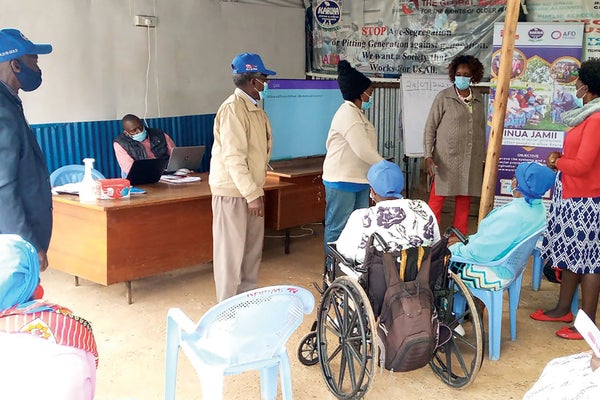
To combat misperceptions about Alzheimer’s, in 2022 ADOK, the Kenya Ministry of Health and others teamed up to create the STRIDE Kenya initiative. (STRIDE stands for Strengthening Responses to Dementia in Low and Middle Income Countries.) Based on input from dementia patients and their caregivers, the idea is to get more people talking about Alzheimer’s disease. “We know the most effective way to reduce stigma is through social contact,” says Sara Evans-Lacko, a mental health services researcher at the London School of Economics and Political Science who worked on an anti-stigma toolkit the STRIDE Kenya team developed.
The toolkit, called “Don’t Forget I’m Human,” includes an intervention how-to for caregivers and clinicians. The centerpiece of the approach is to gather caregivers, show them videos of people with dementia, and then hold a discussion in which caregivers share their thoughts and personal experiences. Participants are encouraged to reflect on how they can support the people with dementia they are helping take care of. “It’s really trying to humanize people with dementia, to build empathy,” says Evans-Lacko..
Building trust among caregivers is an important component of the approach. “We didn’t want to just go in and start telling them about dementia,” says David Ndetei, a professor of psychiatry at the University of Nairobi who helped design the intervention. “We went right to the families, and we asked them a simple question: Do you see people who seem to forget sometimes?” That started a dialogue based on mutual respect, he says.
The next step after education is to find ways of delivering care. To that end, Musyimi spearheaded the DEM-SKY project, an initiative to train community healthcare workers in rural Makueni County in screening people over 60 for dementia at the same time as other conditions, such as diabetes. The project, which is funded by the Davos Alzheimer’s Collaborative (DAC) and is the first of its kind in Kenya, screened 3,500 people in rural areas for six months. It found dementia in about 18 percent of cases.
The team is now trying to secure funding to determine whether the trainings led to increased access to care. Mutunga believes they’ll find that it has. “Once people have understanding, then a lot of people actually come in to get care,” she says.
The challenge now is to scale up these efforts and make screening, care and support the norm and not the exception. Kenya’s Minister of Health Simon Njuguna told a June 21 virtual meeting on healthcare system preparedness, convened by DAC: “We’re very keen to develop a national plan on dementia.”
So far, Alzheimer’s advocates have made “great progress in terms of the policy impact,” says Evans-Lacko. “So don’t give up,” Mutunga says. “Keep pushing. Eventually the door will open.”
This article is part of The New Age of Alzheimer’s, a special report on the advances fueling hope for ending this devastating disease.