

Community-based programs supported by the Davos Alzheimer’s Collaborative, each adapted to the local country and culture, are testing new ways of managing dementia care. Learn more in our special report, The New Age of Alzheimer’s.
Arax Vartevanian started forgetting names and dates in 2017, but she wasn’t diagnosed with Alzheimer’s until last year, when a neurologist ordered a brain scan and blood test. By then, she had developed a tendency to repeat a question over and over. Her husband, Gegham, grew increasingly frustrated trying to get her to stop, to no avail.
Recently, though, Gegham learned a crucial piece of information that helped him cope with his wife’s illness: “Repeating stories or asking questions over and over again are symptoms of [Alzheimer’s] disease and are not intentional,” he read in a guide for caregivers. Now, he says, when the same thing happens, he usually gives in.
Helpful advice for Alzheimer’s caregivers has not been commonplace in Armenia. The former Soviet republic, with a population of 2.8 million at the crossroads of Europe and Asia, has largely neglected its dementia patients, because of a lack of awareness of the condition and stigma. But the country has made considerable progress, in part because of the work of NGOs such as Alzheimer’s Care Armenia (ACA), which in 2021 began distributing 10,000 caregiver’s guides to clinicians and patients—the guide that proved so helpful to the Vartevanians. The ACA, with funding from the Davos Alzheimer’s Collaborative (DAC) and other organizations, has put in place several initiatives designed to bring medical and psychological support to Alzheimer’s patients.
Jane Mahakian, a gerontologist who lives in the U.S., founded ACA in 2017 after she noticed, during her decades of trips to Armenia, that many people lacked an awareness of Alzheimer’s. She organized the country’s first Alzheimer’s conference in 2018, and, to her surprise, more than 400 people attended. “That was a pivotal point in our efforts to start creating visibility and just get people to start thinking about cognitive impairments not only for older adults but for all adults,” she says.
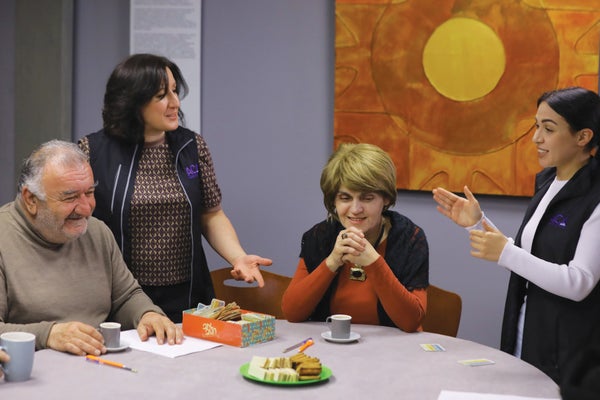
Building on that momentum, she collaborated with Mission Armenia, an NGO that provides meals and other support to the elderly, to establish two “healthy aging memory clubs,” where people with mild to moderate memory challenges can engage in activities that promote brain health, such as playing games, socializing, and making music and art. At these clubs, held at the Mission Armenia facility in Yerevan, psychologists lead movement therapy sessions, give classes on education and nutrition, and conduct tests every three months to track participants’ cognitive abilities. “Those small programs were actually very instrumental in building up the awareness and visibility within the country,” she says. (Two other NGOs, Mission Armenia and Oron, now oversee the groups.)
Participants are tested every three months to track changes in cognition. “We have seen people score better on their assessment test” after participating in the programs, she says.
For people with more advanced dementia, ACA started a memory cafe in October 2022. Weekly gatherings, led by a psychologist and a social worker, offer a safe space for people with dementia to engage in cognitive exercises and games over coffee and snacks and for caregivers to get support. “It’s a happy place for them,” says Mahakian. “It’s a way to connect. For many of them, this is really the only place where they feel a sense of belonging.”
To reach more people who may need Alzheimer’s care, Mahakian got the idea to create a mobile clinic in a minivan that would travel the country with a team of clinicians. She partnered with Armenian EyeCare Project, a mobile clinic for eye care that had already been conducting exams and performing surgeries. Beginning in June 2022, ACA’s healthcare providers have been following the EyeCare vans and providing dementia screening to their clients. “Partnering with them was very important” for getting buy-in from both patients and healthcare practitioners, she says. “It took the fear out of the disease.”
The Brain Health Armenia Project, a DAC-funded program that runs the mobile screening unit, also provides training to healthcare providers at hospitals and clinics around the country in recognizing signs of dementia. In May 2023, the project began providing in-home care to Alzheimer’s patients as well.
ACA has also tried some unconventional strategies for spreading awareness and improving care. The organization teamed up with a robotics expert, Karen Khachikyan, to develop “Robin the Robot,” a dementia companion deployed at the Nork Old Age Home in Yerevan. Studies found that Robin the Robot helped alleviate loneliness and isolation and improve cognitive ability of the residents. ACA also started a national radio show on the country’s public radio network to showcase “older adults leading positive lives,” says Mahakian.
A small but ambitious constellation of researchers is working to strengthen dementia research capacity. Under a new project called COBRAIN Armenia, Yerevan State Medical University, with input from advisors from across Europe and the U.S., is exploring new ways to treat and prevent chronic brain disorders, including Alzheimer’s disease.
Zaven Khachaturian, president of the Campaign to Prevent Alzheimer’s Disease, who serves as an advisor on the project, says it could play an important role in improving care for people with not just dementia, but other brain disorders as well. “It would benefit not only Armenia, but it would be a prototype for building a next-generation healthcare system for chronic brain disorders,” he says. Khachaturian is Armenian, but lives in the U.S., and served as associate director at the U.S. National Institute on Aging from 1977 to 1995.
In March, as part of a wider World Health Organization initiative, Armenia began drafting a national dementia plan. Although details haven’t been released, Mahakian would like to see the government mandate screening for dementia by physicians during annual checkups.
Key to improving care, she says, is strengthening coordination between NGOs, researchers and the Armenian government. “We’re really working on developing these multilevel partnerships to not only create sustainability for our early detection screening program that we have been very successful with but also to develop better ways to get people care,” she says. “How do we best meet their needs and treat them? We really need to think outside the box.”
This article is part of The New Age of Alzheimer’s, a special report on the advances fueling hope for ending this devastating disease.