


Community-based programs supported by the Davos Alzheimer’s Collaborative, each adapted to the local country and culture, are testing new ways of managing dementia care. Learn more in our special report, The New Age of Alzheimer’s.
Hisatomo Kowa is not waiting around for new drug treatments for Alzheimer’s. He is already exploring preventive measures, including changing fundamental lifestyle habits before the onset of the debilitating disease.
“Once a patient is diagnosed with the disease, there are drugs to treat the symptoms. But the disease itself cannot be cured,” says Kowa, a neurologist and director of the Dementia Preventing Center at Kobe University Graduate School of Health Sciences. “So how can we prevent or delay the onset at an earlier stage?”
Since 2019, Kowa has been leading a program, called Cognicare, at Kobe University. It emphasizes the importance of educating the public on leading a balanced lifestyle that cares for and boosts brain function, including healthy eating habits and exercises that mix mental tasks with physical ones. “If we are all living to be 100 years old, we should all be more mindful of brain health from an early age,” he says.
Kowa’s view reflects a common societal attitude towards aging and mental health in Japan, which currently has one of the oldest populations in the world. In 2021, the average lifespans were 81.5 years for men and 87.6 years for women, according to government statistics. With many people living to well over 100—Japan had more than 90,000 centenarians in 2022—the number of people being diagnosed with Alzheimer’s disease and other forms of dementia is on the rise. The Health Ministry estimates approximately 7 million will be diagnosed with dementia in 2025, up from 4.62 million in 2012. “People need to change their lifestyle habits beginning in their 40s because the brain begins to change roughly 20 years before the onset of dementia,” he says.
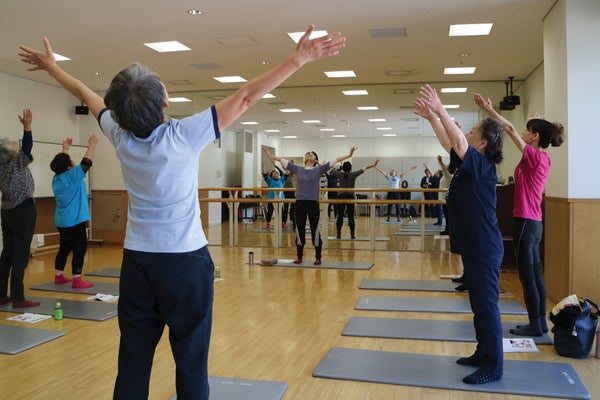
Cognicare aims to teach people good brain hygiene. For the equivalent of $40 per month, each participant gets a basic medical checkup; attends health-related seminars, including information on nutrition; and takes part in “cognicise” exercise classes (available physically or over video-conferencing). The program has attracted participants from 40 to 90 years old, with most in their 70s.
Cognicare has garnered much media attention. Created by the National Center for Geriatrics and Gerontology, based in Aichi Prefecture, instructors and caregivers proselytize on social media platforms, including Instagram and YouTube, where they demonstrate fun and creative ways to stimulate the brain while exercising, including word games, counting backwards while walking and clapping your hands while stomping your feet. The exercises often focus on focusing the mind on one task while the body performs another. The goal is not to get better at both tasks but rather to tax the brain and the body simultaneously.
“The exercises are actually complex and difficult to do,” says Mie Nishihama, a caregiver and occupational therapist at Shigei Hospital in Okayama Prefecture, who has been overseeing classes offered by the hospital’s culture and fitness arm, Harmony Kurashiki, since 2019. “But what’s important is for the exercises to be done in groups so that participants have people to laugh with when they make mistakes.” She stresses the importance of a communal connection, especially among the elderly. The program does not collect data on how much patients improve from the exercises.
Yuka Ota, a certified instructor of cognicise in Shizuoka Prefecture, says that teaching elderly people is “similar to running up a down escalator.” She has been teaching classes at various facilities since 2016. Her impression is that while it is hard to see her students making significant improvements, she knows from experience that “sustaining the status quo [in health and cognition] takes a tremendous amount of effort.”
Kowa is currently working on the final analysis of the effects of a separate multifactorial intervention aimed at preventing dementia. Specifically, he and his group are exploring the significance of two new methods for the early detection of Alzheimer’s disease: a digital cognitive assessment tool, and a tool to estimate the presence of amyloid in the brain using blood-based biomarkers, as part of the Davos Alzheimer’s Collaborative Healthcare System Preparedness Program. He hopes the study’s results will contribute to the development of dementia-prevention measures in Japan.
To better educate the public on brain health, Kowa also recently published a nutrition book for a general audience. The title translates from the Japanese roughly as: “Eighty is not too late to start. How to eat to keep dementia away: The complete guide.” The book introduces foods, such as some types of fish, that are good for the brain and warns against lack of sleep, as well as smoking. He also cites in the book the 2020 report of the Lancet Commission on Dementia Prevention, Intervention, and Care that states modifying 12 risk factors (including the lack of education, nutrition, and social, cognitive, and physical activity) may prevent or delay up to 40 percent of dementia.
“Alzheimer’s disease is not something that happens suddenly. This is why it’s important to have a comprehensive program such as Cognicare to check for early signs so that medical professionals can better guide patients to minimize the deterioration as much as possible,” says Kowa. “We are all at risk of dementia as we age. And there is no single answer to prevent this. It’s not just about nutrition or exercise, but it’s about leading a balanced lifestyle starting early and continuing that lifestyle for as long as possible.”
This article is part of The New Age of Alzheimer’s, a special report on the advances fueling hope for ending this devastating disease.