



By some estimates, only about one person in 2,200 lives to be 100 years old. Some of them, though, not only make it to 100, but they remain active—sometimes doing things that people in their 30s might not do. Here, we introduce three such centenarians.
Lifelong Lobstering
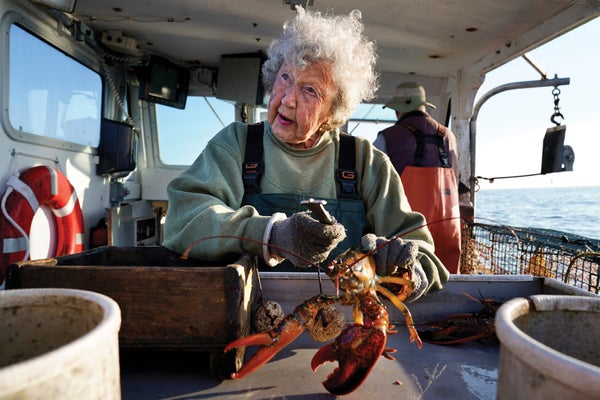
On June 6, 1920, Virginia Oliver was born in Rockland, Maine. When she was eight, Oliver joined the family business with her lobster-catching father and brother. It became a life-long passion.
“I like being along the water,” she said in an interview in her home with author Barbara Walsh. “It’s beautiful. Some people never, ever get to see the sun rise out there. There’s nothing like it.”
She also wanted to be in charge. She eventually became the captain of her boat, which her late husband had named Virginia. “I’m the boss,” she said. “I’m kind of independent, you know.”
Though a fall kept Oliver off her lobster boat for the 2023 and 2024 seasons, she hoped to return to the ocean in the summer of 2025 at the age of 105.
“You can’t sit around watching TV all day,” she said. “You’ve got to keep moving, otherwise you’ll end up in a wheelchair.”
Sources: Barbara Walsh and her book The Lobster Lady: Maine’s 102-Year-Old Legend (Irish Rover Press, 2022)
Years and Miles Fueled by Veggies

Mike Freemont.
Matthew Allen Photography
Mike Fremont was born in Cincinnati, Ohio, in 1922. He became an entrepreneur and an advocate of healthy diet and exercise.
He studied mechanical engineering at Yale, worked for utility companies and other industries in Pittsburgh and Boston before returning to his hometown in 1948 to start his own company, Torque, Inc., a supplier of industrial clutches and brakes.
Two weeks after the youngest of his three children was born, Fremont’s wife died of a brain hemorrhage. To cope with his grief, the challenges of being a single parent and the stress of owning a business, he started running. After work, he’d run across a nearby dam. “Sometimes, I’d run with one of my children, maybe holding hands,” he says.
Since then, Fremont has run more than 60 marathons. In 2018, he ran a mile at the Drake Relays in Iowa in just under 14 minutes, setting a record for the 95-plus category.
Fremont was diagnosed with colorectal cancer at age 70. He declined surgery and instead switched to a vegan diet. It “killed the pains, and they never came back,” he says. “That diet works for me. It’s the best possible thing you can do.” When the cancer returned two years later, he had the surgery.
In the fall of 2024, at age 102, Fremont was still running and paddling a canoe.
Source: Interviews
Community and Hard Work

Aziz Gündogdu.
dpa picture alliance/Alamy Stock Photo
Aziz Gündogdu grew up in a rural village with few material things, but he had the comfort and support of family and community. “There was poverty back then, but people loved each other very much,” he said. “They helped each other a lot.”
After a stint in the military, Gündogdu worked much of his life as a farmer. He appreciated the value of hard work. He was able to remain active into his 100s, he believed, because he never stopped doing physical labor, and watching what he ate.
At 102, Gündogdu was still tending the garden in his yard and taking long walks around Doğanca, a village in northwestern Turkey.
“The reason I have lived this long,” he said, “is because I drink goat’s milk.”
Sources: Alamy and The Star Online
Explore the emerging science of healthspan in other stories in this special report.