Welcome to Scientific American’s Science Talk, posted on November 21st, 2019. I’m Steve Mirsky.
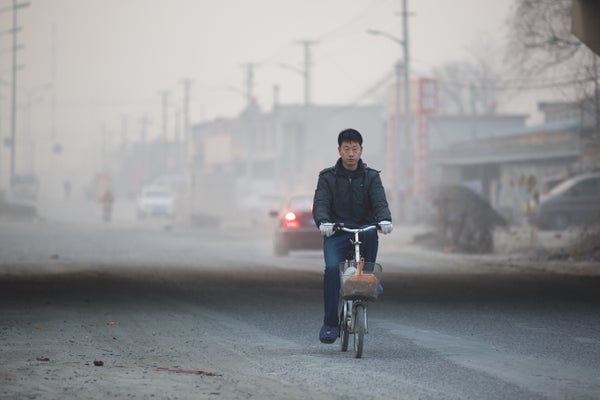
Here’s the beginning of a New York Times story from October 24th: “New data reveals that damaging air pollution has increased nationally since 2016, reversing a decades-long trend toward cleaner air.”
And here’s a line from a BBC story dated November 4th: “An Indian health ministry official said the city's pollution monitors did not have enough digits to accurately record pollution levels, which he called a ‘disaster.’”
[GARDINER CLIP]
That’s journalist and author Beth Gardiner. And her new book is Choked: Life and Breath in the Age of Air Pollution. I recently called her at her home in London. After my 30-minute conversation with Gardiner, stay tuned for a five-minute segment, sponsored by the Kavli Prize, with CRISPR gene-editing pioneer Jennifer Doudna. And now Beth Gardiner.
[GARDINER SEGMENT]
[DOUDNA SEGMENT]
That’s it for this episode. Get your science news at our Web site: www.ScientificAmerican.com, where you can find at least 30 stories in our archives about CRISPR and gene editing.
And follow us on Twitter, where you’ll get a tweet whenever a new item hits the Web site. Our twitter name is @sciam. For Scientific American’s Science Talk, I’m Steve Mirsky. Thanks for clicking on us.
Subscribe to Support Independent Journalism
Great science journalism requires human expertise, time, effort and creativity. And it costs money. That’s why I and the journalists here at Scientific American hope you’ll join our community.
When you subscribe, you are supporting staff and freelance journalists who are passionate about telling science stories that are true, important and compelling. Our editors and reporters are often experts in their fields, which means they understand the nuances of big discoveries and can untangle the breakthroughs from the hype. With a subscription, you are also supporting rigorous fact-checking to ensure the words we publish are precise and accurate. And you’re supporting original illustrations, graphics and photos that bring you closer to an advanced laboratory, an ice sheet in Antarctica or a space mission in orbit. You’re helping us craft other types of high-quality journalism as well: Our newsletters are carefully written, edited and curated by staffers you have or will come to know and love. Our Science Quickly podcast is based on original reporting, collaboration with editors and scientists and exacting production.
Subscriptions keep this engine running so we can continue to deliver thoughtful, rigorous and independent science journalism to you. In an era of viral misinformation, this work is crucial. If you value what we do, I hope you’ll consider joining us as a subscriber