
Space & PhysicsMay 26, 2011
Astronomical Deficit Forces Downsizing of U.S. Telescope Projects
The federal fiscal crisis is pushing NASA and National Science Foundation officials to make painful choices between present and proposed astronomy programs
Astronomical Deficit Forces Downsizing of U.S. Telescope Projects
The federal fiscal crisis is pushing NASA and National Science Foundation officials to make painful choices between present and proposed astronomy programs
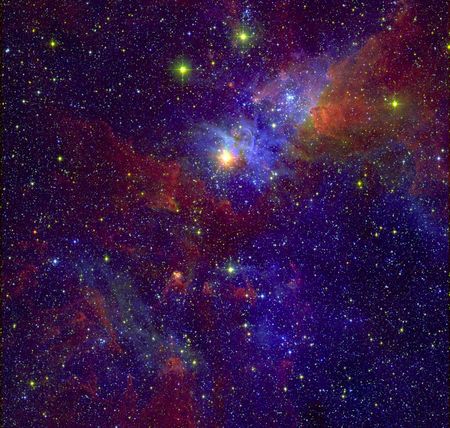
Turbulent Nursery: Young Stars in Nearby Nebula Already Exploding
BOSTON—Supernova explosions mark the violent end for many massive stars, but for some that end comes shortly after the beginning.

Arm's Trace: Astronomers Spot a Newfound Piece of the Milky Way Galaxy
A looping spiral arm of gas some 70,000 light-years away seems to preserve the galaxy's spiral symmetry
WiggleZ Project Confirms Dark Energy's Effects
A survey of 150,000 galaxies confirms predictions about dark energy, thought to be what's driving galaxies apart. John Matson reports
Big Space: The Scale of the Solar System
Bring Science Home: Activity 14
Accelerated Expectations: All Eyes on Large Hadron Collider in Dark Matter Hunt
Researchers from a number of overlapping disciplines are awaiting a big boost from the world's largest particle collider
Array of Hope: Australia and South Africa Vie for Massive Radio Telescope Project
The ambitious, unprecedentedly vast Square Kilometer Array project should open up new realms in astrophysics. But will it live up to its name?
Milky Way Should Have Much More Companionship
Our understanding of dark matter says the Milky Way should have many times more than its dozen or so small satellite galaxies. John Matson reports
WIMP Wars: Astronomers and Physicists Remain Skeptical of Long-Standing Dark Matter Claim
An Italian research group has for years trumpeted a cyclical ebb and flow in particulate activity that the researchers ascribe to dark matter. But support for the claim has been hard to come by

The Lost Galaxies
By the latest estimate, the observable universe contains 200 billion galaxies. Astronomers wonder: Why so few?

Readers Respond to "Flu Factories" and Other Articles
Letters to the editor from the January 2011 issue of Scientific American
Giant Energetic Bubbles Adorn the Milky Way
Two 30,000 light-year-long blobs called Fermi bubbles have been discovered on either side of our galactic plane. John Matson reports