
The SciencesOctober 19, 2009
Bright light hints at a dark centre to the Galaxy
Mysterious matter may be colliding at the Milky Way's core.
Bright light hints at a dark centre to the Galaxy
Mysterious matter may be colliding at the Milky Way's core.
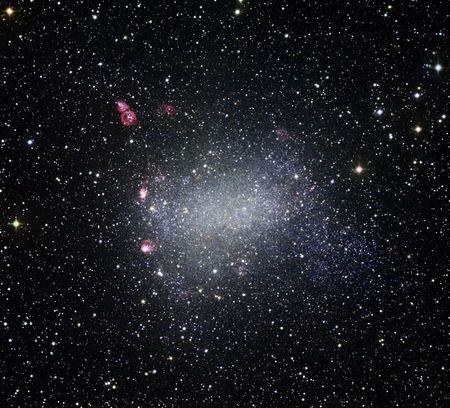
Active Star Formation Revealed in Nearby Barnard's Galaxy
A newly released image of one of our nearest galactic neighbors, Barnard's Galaxy, also known as NGC 6822, reveals regions of star formation and strange-looking nebulae, such as the bubble visible in the image [upper left].

Astronomical Survey Reveals Andromeda's Galaxy-Gorging Past
Scraps of devoured dwarf galaxies surround the Milky Way's sister galaxy
Simon DeDeo: For a Lifetime of Scientific Curiosity, the Sky's the Limit
Astronomers Size Up a Candidate for Midsize Black Hole
An object hundreds or thousands of times the mass of the sun would represent an elusive class of black hole
A better way to size up distant galaxies
Let There Be Blobs: Mystery Object Spotted in the Early Universe
Researchers may have found a precursor to today's galaxies, dating back to when the universe was in its infancy
Distant Starbursts Light Up the Sky--We Just Can't See Them
A survey from on high confirms the far-flung source of a celestial infrared background
What Shape Is Your Galaxy?
Yale astrophysicist Kevin Schawinski talks about Galaxy Zoo, a distributed computing project in which laypeople can help researchers characterize galaxies. And we tour Kroon Hall, the new green home of the Yale School of Forestry and Environmental Sciences. Plus, we'll test your knowledge of some recent science in the news. Web sites related to this episode include www.galaxyzoo.org; www.environment.yale.edu/kroon
If galaxies are all moving apart, how can they collide?
Cosmologist Tamara Davis, an associate of the Dark Cosmology Center in Denmark, pulls together an answer
Seeking Out the Sun's Long-Lost Siblings
A new proposal contends that stars formed alongside our sun might be recognizable, even after billions of years of separation
Which came first--galaxies or black holes?