New Issue: Orbital Catastrophe Ahead? Read Now

Active Star Formation Revealed in Nearby Barnard's Galaxy

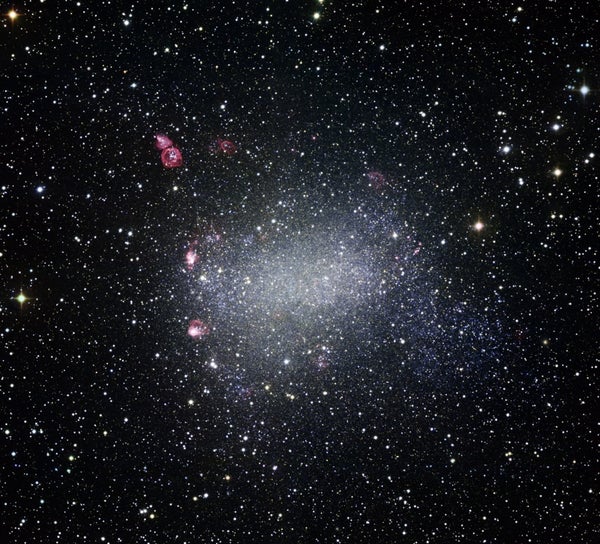
A newly released image of one of our nearest galactic neighbors, Barnard's Galaxy, also known as NGC 6822, reveals regions of star formation and strange-looking nebulae, such as the bubble visible in the image [upper left].

ESO

Join Our Community of Science Lovers!


On supporting science journalism

If you're enjoying this article, consider supporting our award-winning journalism by subscribing. By purchasing a subscription you are helping to ensure the future of impactful stories about the discoveries and ideas shaping our world today.


A newly released image of one of our nearest galactic neighbors, Barnard's Galaxy, also known as NGC 6822, reveals regions of star formation and strange-looking nebulae, such as the bubble visible in the image [upper left].

NGC 6822, about 1.6 million light-years away, is classified as an irregular dwarf galaxy because of its odd shape and relatively small size compared with other galaxies, such as our own, the Milky Way, and its other neighbors, the Andromeda and Triangulum galaxies. All are members of the Local Group of galaxies. Barnard's Galaxy contains about 10 million stars, well under our own's estimated 200 billion to 400 billion.

Astronomers obtained this image of Barnard's Galaxy using the Wide Field Imager attached to the 2.2-meter MPG/ESO telescope at the European Southern Observatory's La Silla Observatory in northern Chile. Reddish nebulae reveal regions of active star formation, where young, hot stars heat up nearby gas clouds. The bubble is a nebula with a clutch of massive, hot stars at its center that is sending waves of matter smashing into the surrounding interstellar material, generating a glowing structure, which looks like a ring from our perspective.

Other similar ripples of heated matter thrown out by young stars are dotted across Barnard's Galaxy.

Irregular dwarf galaxies like Barnard's get their bloblike forms from close encounters with other galaxies. Gravity's attraction can dramatically scramble the shapes of the passing or colliding galaxies, pulling and flinging stars and forming irregularly shaped dwarf galaxies like NGC 6822.

Subscribe to Support Independent Journalism

Great science journalism requires human expertise, time, effort and creativity. And it costs money. That’s why I and the journalists here at Scientific American hope you’ll join our community.

When you subscribe, you are supporting staff and freelance journalists who are passionate about telling science stories that are true, important and compelling. Our editors and reporters are often experts in their fields, which means they understand the nuances of big discoveries and can untangle the breakthroughs from the hype. With a subscription, you are also supporting rigorous fact-checking to ensure the words we publish are precise and accurate. And you’re supporting original illustrations, graphics and photos that bring you closer to an advanced laboratory, an ice sheet in Antarctica or a space mission in orbit. You’re helping us craft other types of high-quality journalism as well: Our newsletters are carefully written, edited and curated by staffers you have or will come to know and love. Our Science Quickly podcast is based on original reporting, collaboration with editors and scientists and exacting production.

Subscriptions keep this engine running so we can continue to deliver thoughtful, rigorous and independent science journalism to you. In an era of viral misinformation, this work is crucial. If you value what we do, I hope you’ll consider joining us as a subscriber

Thank you,

Jeanna Bryner, Editor in Chief, Scientific American

Subscribe