

During the last ice age, the northern half of North America was blanketed by ice. But along the Pacific coast of Canada, some land remained bare…a place where animals and plants could thrive. And humans too.
Archaeologists have found stone tools and cave sites 12,000 to 13,000 years old in the coastal Pacific Northwest. One find was a mastodon rib with a bony weapon in it. And now scientists at the Hakai Institute and the University of Victoria have made a spectacular discovery: clay soil, trampled by human feet—the oldest footprints uncovered in North America.
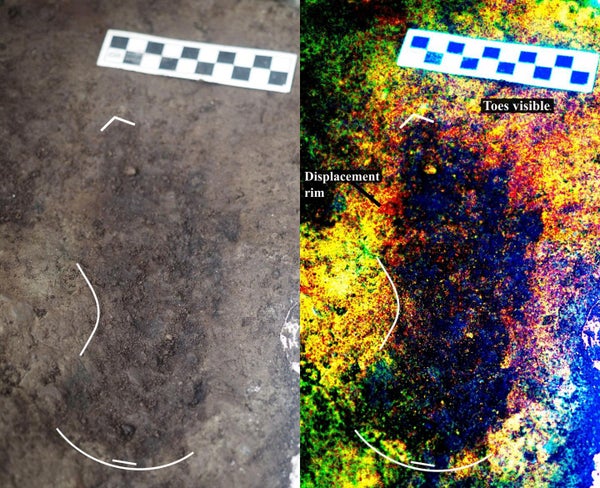
Researchers were digging several feet below a modern-day beach on British Columbia's Calvert Island, about 250 miles northwest of Vancouver, when they discovered tracks. They found 29 in all. Some had toes, arches and heel prints—indicating the people who left them were probably barefoot. And using a shoe size measurement chart—like the ones you find in a shoe store—they determined that the footprints likely belonged to a child and two adults. Who lived and walked the area some 13,000 years ago.
On supporting science journalism
If you're enjoying this article, consider supporting our award-winning journalism by subscribing. By purchasing a subscription you are helping to ensure the future of impactful stories about the discoveries and ideas shaping our world today.
The results are in the journal PLOS ONE. [Duncan McLaren et al., Terminal Pleistocene epoch human footprints from the Pacific coast of Canada]
The tracks are not in a line, like the famous Laetoli footprints in Tanzania. Instead, they're facing different directions, suggestive of people gathering. Or perhaps, the authors write, they could be the footprints of people getting out of a boat, headed towards higher and drier land. Still on the move.
—Christopher Intagliata
[The above text is a transcript of this podcast.]
