

Karen Hopkin: This is Scientific American’s 60-Second Science. I’m Karen Hopkin.
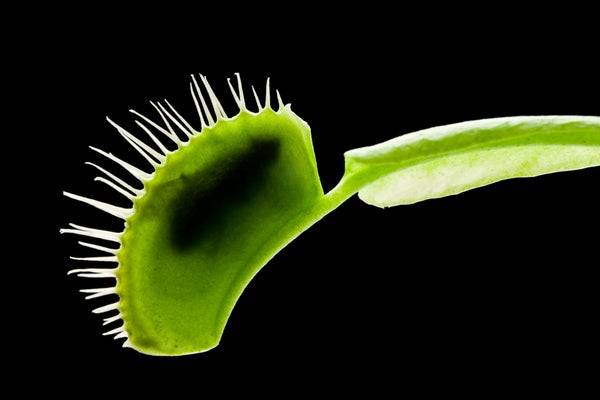
They say you can catch more flies with honey than with vinegar. But what if you had access to a remote-controlled carnivorous plant? Because researchers have engineered a bio-inspired system…an artificial neuron, if you will…that can trigger the snap of a Venus fly trap.
Simone Fabiano: Hi, my name is Simone Fabiano. I'm associate professor at Linköping University in Sweden.
On supporting science journalism
If you're enjoying this article, consider supporting our award-winning journalism by subscribing. By purchasing a subscription you are helping to ensure the future of impactful stories about the discoveries and ideas shaping our world today.
Hopkin: Fabiano designed the trap-springing device using nerve cells as a kind of bio-based blueprint.
Fabiano: The way our biological neurons work is that they integrate information from different inputs over time, perform computation, and communicate the result to other neurons by means of voltage pulses.
Hopkin: Now, standard, silicon-based systems can also deliver electrical pulses. But if you want to couple them with something living…to produce bionic prosthetics or engineer any kind of brain/machine interface…well, they suffer from several limitations…
Fabiano: …such as rigidity, poor biocompatibility, complex circuit structures, and operation mechanisms that are fundamentally different from those of biological systems.
Hopkin: To smooth biological integration, Fabiano built his system from polymers that conduct both electrons…like, everyday electronics…and ions, which is how neurons get things done. It’s the ions that…
Fabiano: …enable communication between biological and artificial neurons.
Hopkin: Each part of the artificial neuron…which the researchers describe in the journal Nature…has a direct counterpart in its biological role model.
Fabiano: We have an input terminal that acts as the biological neuron’s dendrite…
Hopkin: That dendrite collects the incoming electrical signals and sends them to a capacitor which…like a neuronal cell body…integrates the information. Then, once the voltage reaches a specific threshold, a pulse is fired along organic amplifiers that mimic a nerve cell axon.
Fabiano: We use the ionic concentration-dependent switching characteristics of our transistors to modulate the frequency of spiking, which is to a large extent analogous to biological systems.
Hopkin: So the ions control the current that flows from the faux neuron to its target…in this case, a live Venus flytrap…triggering the rapid-fire closure of its leafy appendages. All in all, a dramatic demonstration of the potential of neuromorphic design that should give interested engineers…and interloping fruit flies…something to watch out for.
For Scientific American’s 60-Second Science, I’m Karen Hopkin.
[The above text is a transcript of this podcast.]
