
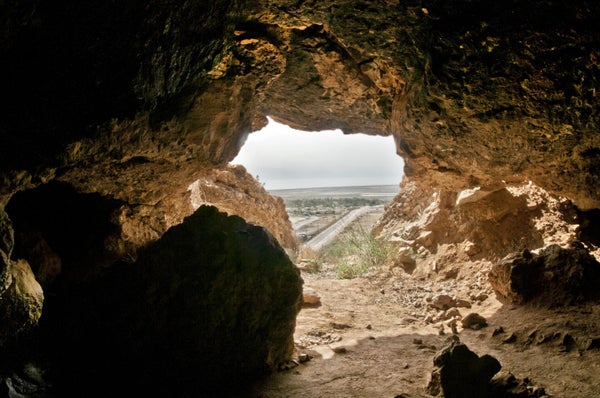

The Dead Sea Scrolls are religious manuscripts that were written from the third century B.C.E. to the first century C.E. They were discovered in the 1940s and ’50s in caves along the shore of the Dead Sea. The parchments have been the topic of intense religious, literary and historical debate. They also continue to be the subject of scientific analysis—including DNA.
“So the idea was to try to match and piece apart fragments based on their genetic identity—namely based on the animals from which they were made.”
Oded Rechavi is a molecular biologist Tel Aviv University. His team sequenced the DNA from bits of scroll dust.
On supporting science journalism
If you're enjoying this article, consider supporting our award-winning journalism by subscribing. By purchasing a subscription you are helping to ensure the future of impactful stories about the discoveries and ideas shaping our world today.
“Almost all the scrolls we sampled were perhaps surprisingly found to be made of sheep skin. We found two out of cow skin, which is a big story.”
Here Rechavi’s colleague Noam Mizrahi from the university’s department of biblical studies picked up the story. The scrolls, he says, came from a place called Qumran, a three day’s walk from the cultural center of Jerusalem. Mizrahi explains that the people of Qumran were an extremist group, with apocalyptic predictions, who harshly criticized the views of others.
Therefore, he says, there’s been long-standing debate about how much the scrolls—unearthed from this sect in Qumran—represented just this faction’s views or more general Jewish thought at the time. The presence of cow skins in a desert region, inhospitable to cattle, is provocative because it suggests that ...
“Cow-made scrolls do not reflect the sectarian community of Qumran but were rather brought from outside, written from outside—and hence reflect broader Jewish society of the period.”
That finding is in the journal Cell. Several other lines of evidence point to the ancient Qumran library containing a broad diversity of texts. [Sarit Anava et al., Illuminating genetic mysteries of the Dead Sea Scrolls]
Mizrahi says genetics have added a new dimension to his studies, complementing his analysis of the content and language of the parchments.
“Here I discovered that the material of the scrolls, the very biological material from which the scrolls are made, is as informative and as telling.”
In other words, sometimes you need the subtext—in this case, literally the material under the writing.
—Christopher Intagliata
[The above text is a transcript of this podcast.]
