
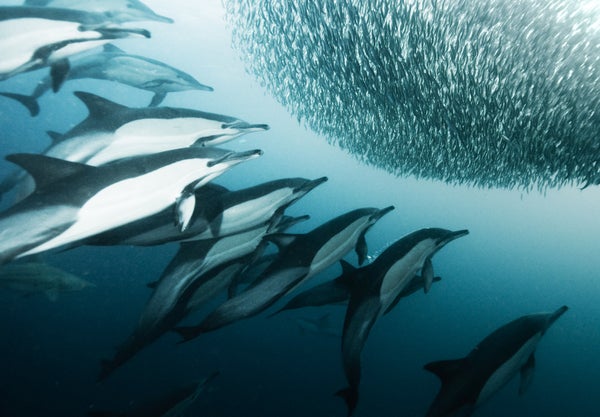

Long before dolphins swam the seas, their near look-alike ichthyosaurs inhabited the earth's oceans. Now scientists say these ancient seafaring reptiles may have had more in common with modern-day sea turtles and marine mammals than we knew.
Over time, a dead animal’s bones can be slowly replaced by minerals, leaving behind a rocky fossil. The researchers demineralized the 180-million-year-old fossil of an ichthyosaur…leaving them with soft, flexible tissues.
"Which is kind of amazing."
On supporting science journalism
If you're enjoying this article, consider supporting our award-winning journalism by subscribing. By purchasing a subscription you are helping to ensure the future of impactful stories about the discoveries and ideas shaping our world today.
Johan Lindgren, a paleontologist at Lund University in Sweden. "It turns out that organic remains, the skin, is still there, with cells and cellular organelles. And even traces of the original biomolecular makeup."
Those remains revealed that the ichthyosaur sported camouflage appropriate for its underwater environment—light on the bottom, darker on top—like many marine animals have today.
The researchers also found a black, glossy substance that was harder to identify. So they collected dead sea turtles and porpoises and mimicked fossilization by heating and squashing the creatures’ skin. Which led them to realize that that the darker substance in the ichthyosaur fossil must be blubber.
"So from having blubber we can say that, to some extent the ichthyosaurs must have been warm blooded, so to say. At least to the same degree as the leatherback turtle."
The write-up and photos of the fossil are in the journal Nature. [Johan Lindgren et al, Soft-tissue evidence for homeothermy and crypsis in a Jurassic ichthyosaur]
There's one more intriguing secret contained in the remains: proteinaceous material. If you sequenced it, could you go backwards, and reconstruct the DNA that coded for the proteins?
In other words:
Of course, ichthyosaurs were not dinosaurs, but the Jurassic Park methodology is what’s important. So, could we resurrect one starting from their protein sequences?
"Yeah well, perhaps. You should never say never!"
—Christopher Intagliata
[The above text is a transcript of this podcast.]
